Why Women Look for ‘Estrogen-Rich’ Foods
Women often start looking for estrogen rich foods when estrogen begins to change during perimenopause or menopause. The reason may be hot flashes, sleep changes, vaginal dryness, changes in mood or energy, or simply a desire to support the body through this stage naturally.
Diet absolutely matters during midlife, but there is one important distinction to make before we start listing foods.
Soy, flaxseed, sesame seeds, and other plant foods do not contain the same estrogen your ovaries produce.
What they contain are phytoestrogens, naturally occurring plant compounds that can interact with estrogen receptors in the body.
This is why foods such as tofu and flaxseed are often described online as “estrogen-rich.” The phrase is easy to understand, but biologically it is not quite the same as saying that a food raises or replaces estrogen.
In my practice, this distinction matters because it changes the goal of the conversation. I do not want women choosing foods because they have been promised that one ingredient will “balance hormones” or restore estrogen. I want them to understand what the food actually provides, how strong a phytoestrogen source it is, and what else it contributes nutritionally.
In this guide, we will go through the 10 foods most commonly associated with phytoestrogens, what the research says about them, how they may fit into a menopause diet, and where the evidence ends.
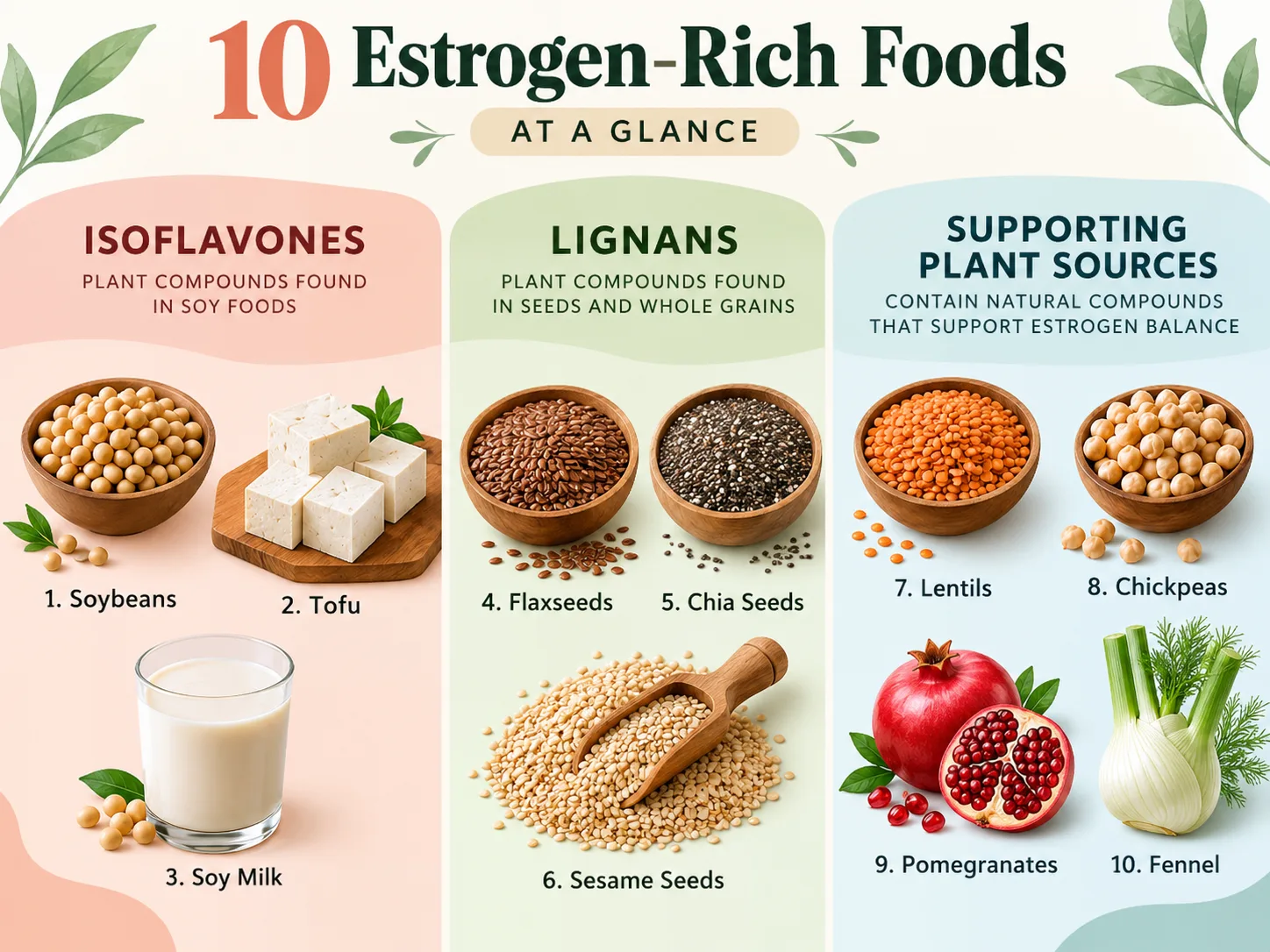
Estrogen-Rich Foods at a Glance
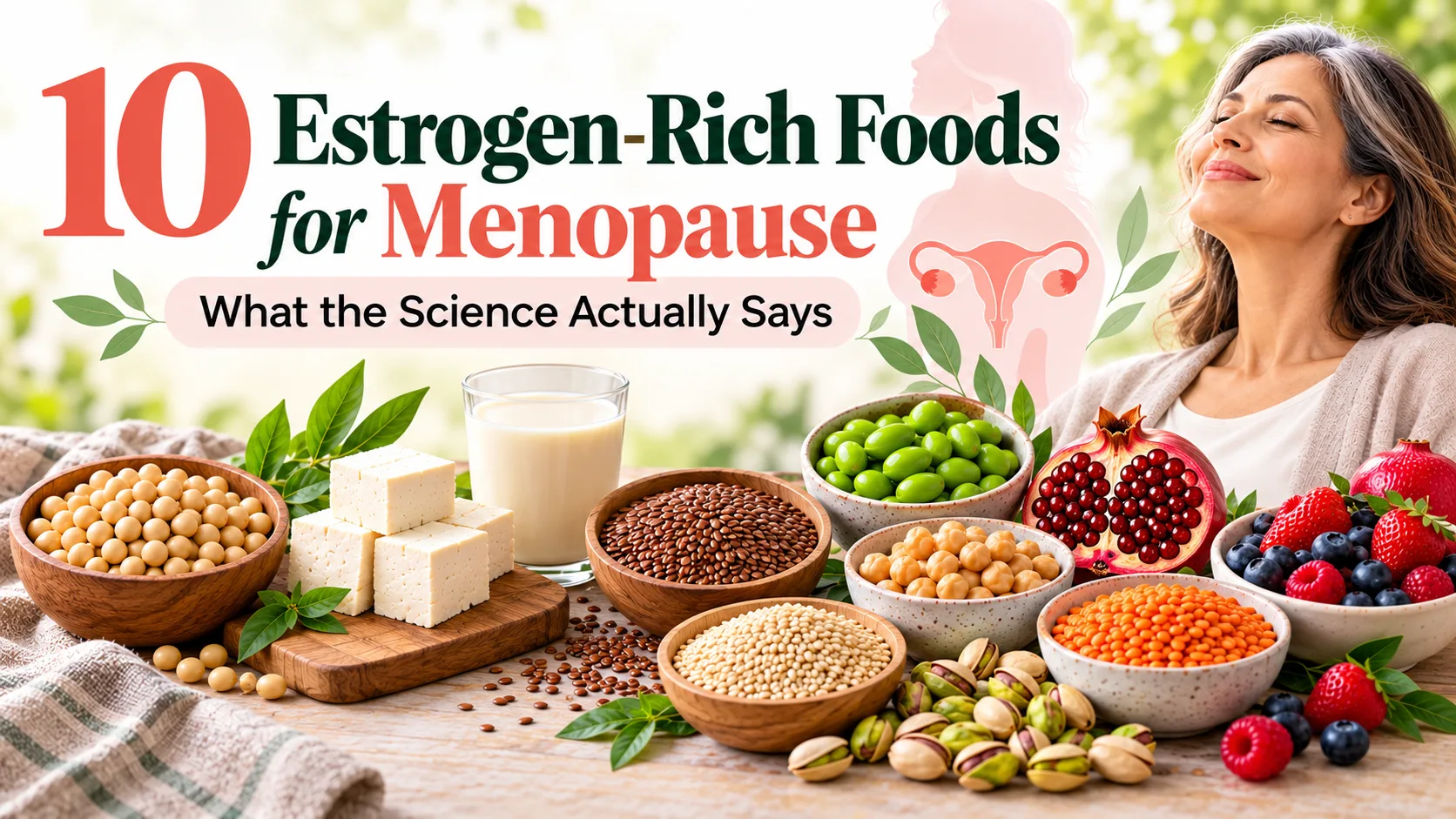
If you are looking for the food list first, these are the 10 groups we will discuss in detail.
|
Food
|
Main Phytoestrogen Angle
|
Simple Way to Add It
|
|
Ground flaxseed
|
Particularly rich source of lignans
|
Add to oatmeal, yogurt, or smoothies
|
|
Soybeans and edamame
|
Rich in isoflavones
|
Add to salads, grain bowls, or eat as a snack
|
|
Tofu and tempeh
|
Soy isoflavones plus plant protein
|
Use in stir-fries, soups, wraps, or bowls
|
|
Sesame seeds and tahini
|
Dietary source of lignans
|
Add tahini to dressings, dips, or toast
|
|
Chickpeas and hummus
|
Legume phytoestrogens plus fiber and protein
|
Add to salads, soups, or use as a dip
|
|
Lentils and beans
|
Plant compounds, fiber, and plant protein
|
Use in soups, chili, salads, or bowls
|
|
Dried apricots, dates, prunes
|
Lignans and other plant polyphenols
|
Use in modest portions with meals or snacks
|
|
Peaches, berries, grapes
|
Smaller amounts of lignans and phytonutrients
|
Eat fresh or add to yogurt or oatmeal
|
|
Pistachios and peanuts
|
Plant compounds plus healthy fats and protein
|
Use as snacks or toppings
|
|
Whole grains
|
Lignans plus dietary fiber
|
Choose oats, barley, rye, and whole-grain foods
|
| There is an important detail most “estrogen foods” lists hide: these foods are not equally rich in phytoestrogens. |
Flaxseed is a good example. Data summarized by the Linus Pauling Institute at Oregon State University list about 85.5 mg of total lignans in 1 ounce of flaxseed, compared with approximately 11.2 mg in 1 ounce of sesame seeds. Typical servings of broccoli, kale, apricots, and strawberries contain much smaller amounts.
The same principle applies to soy. Soybeans and soy foods are among the richest dietary sources of isoflavones, but even different soy products can contain very different amounts. So instead of treating every plant food as an equal “estrogen booster,” we will look at what each one actually contributes.
What Does “Estrogen-Rich Food” Actually Mean?
The term estrogen-rich food is commonly used, but it can make the effect of food sound more direct than it really is.
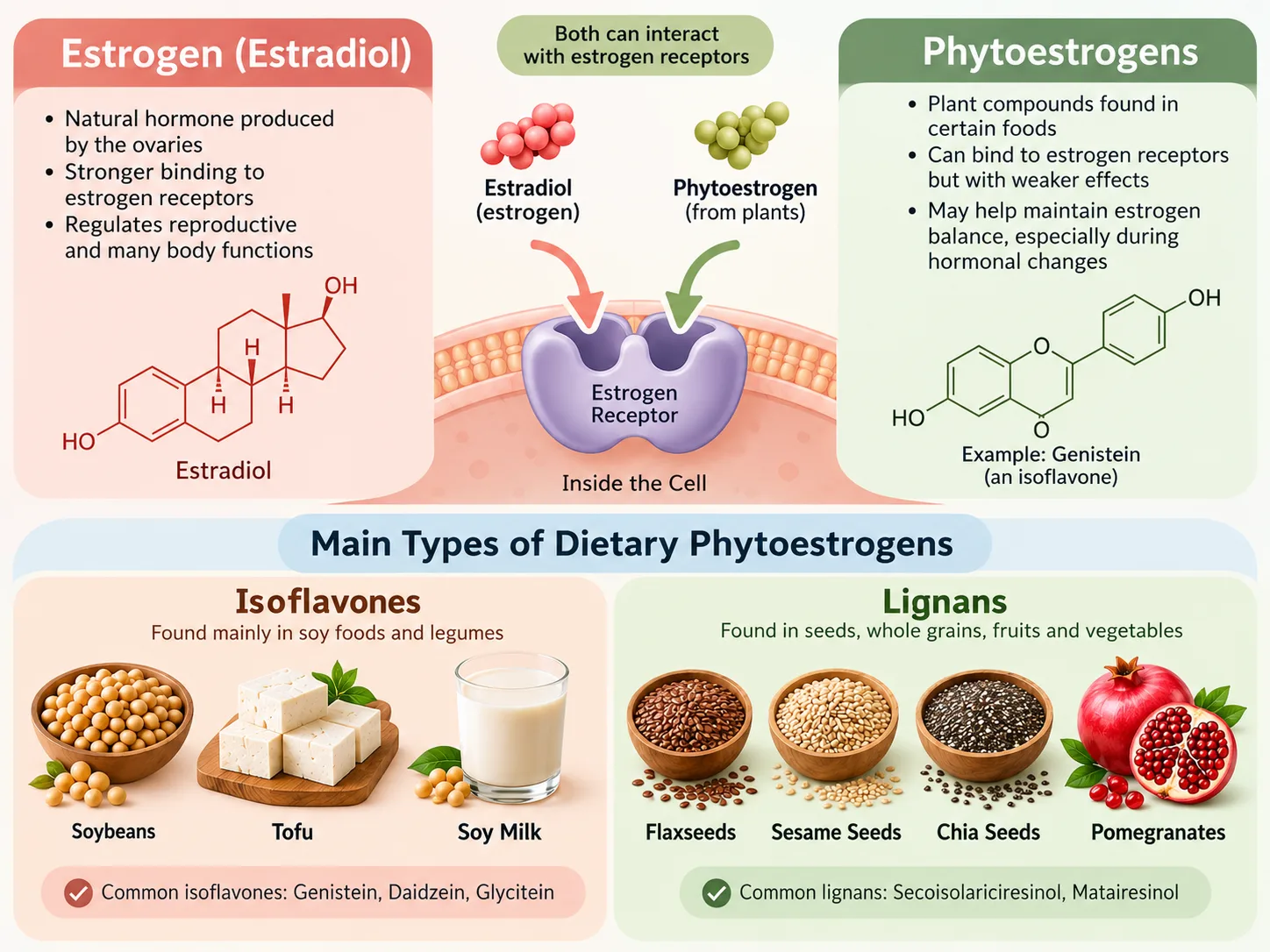
Estradiol is one of the main forms of estrogen produced by the ovaries. It circulates through the body and acts on estrogen receptors in tissues including the reproductive tract, bones, brain, blood vessels, breasts, and urinary system. Plant foods do not provide estradiol in the way menopausal hormone therapy does.
Instead, some plants contain compounds with structures that allow them to interact with estrogen receptors. These are called phytoestrogens. The National Center for Complementary and Integrative Health describes phytoestrogens as plant substances whose chemical structures are similar to estrogen, and identifies soy isoflavones and flaxseed among the better-known dietary examples.
The word similar is important. Phytoestrogens may have weak estrogen-like activity, but that does not mean:
• soy is equivalent to estrogen,
• flaxseed replaces estradiol,
• eating more phytoestrogens automatically increases blood estrogen,
• or a phytoestrogen-rich diet can substitute for treatment when estrogen therapy is medically indicated.
Different phytoestrogens interact differently with estrogen receptors. Their effects can also vary depending on the tissue, dose, metabolism, gut microbiome, and the woman’s own hormonal environment. For that reason, I do not evaluate these foods only by asking whether they “increase estrogen.”
A serving of tofu may be useful because it provides isoflavones and protein. Ground flaxseed provides lignans and fiber. Lentils and chickpeas add plant protein and fiber. Nuts and seeds contribute healthy fats and minerals. Those benefits matter even if the food never produces a measurable rise in estradiol.
|
Dr. Kashyap’s Insight
I prefer to think of phytoestrogen-rich foods as one part of a woman’s overall diet rather than as a hormone treatment. If soy, flaxseed, legumes, nuts, seeds, and whole grains fit naturally into the way you eat, they can add useful nutrients along with phytoestrogens. The goal is not to build every meal around “boosting estrogen.”
|
What Are Phytoestrogens?
Phytoestrogens are plant compounds capable of interacting with estrogen-related pathways in the body. There are several types, but for an everyday discussion about food, isoflavones and lignans are the two most useful groups to understand.
Isoflavones
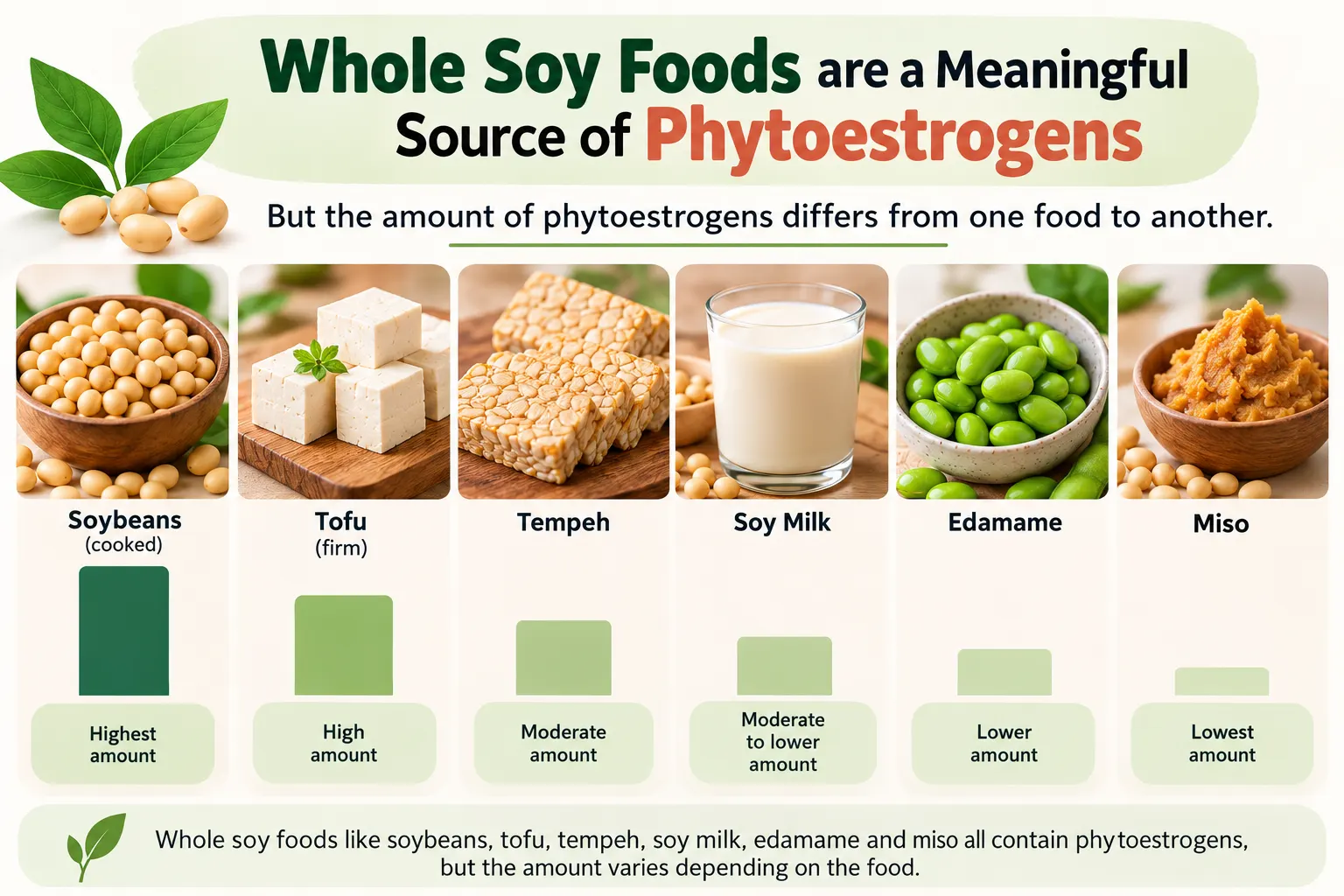
Isoflavones are strongly associated with soy. The main soy isoflavones include genistein, daidzein, and glycitein. Common sources include soybeans, edamame, tofu, tempeh, miso, and soy milk.
Even within this group, the numbers vary considerably. The Linus Pauling Institute’s soy-isoflavone data lists about 56 mg of total isoflavones in a half cup of boiled mature soybeans and around 51.5 mg in 3 ounces of tempeh. A cup of low-fat soy milk contains considerably less, about 6.2 mg. Values vary between brands and processing methods, so these figures are a guide rather than an exact prescription.
Does Soy Help With Menopause Symptoms?
Soy isoflavones have been studied extensively for menopause symptoms, particularly hot flashes. But the research does not give one simple answer. Earlier trials and meta-analyses found modest improvements in hot flashes with some soy-isoflavone interventions, while newer reviews continue to show considerable variation between studies.
For example, a 2025 systematic review and meta-analysis of soy isoflavones in perimenopausal women found a small improvement in overall menopausal symptoms but no significant improvement in hot flashes, sweating, insomnia, or overall vasomotor symptoms, and cautioned that the available studies were relatively small. A separate 2024 systematic review and meta-analysis also did not find a significant overall improvement in menopausal symptoms or quality of life with soy isoflavones.
This does not mean soy has no value. It means I would not tell a woman that eating tofu will stop her hot flashes. Soy may help some women, while others notice no symptom change at all. Either way, tofu, tempeh, edamame, and other soy foods can still be useful sources of protein and other nutrients.
Lignans
The other major group is lignans. Lignan precursors occur in many plant foods, including flaxseed, sesame seeds, legumes, whole grains, fruits, and vegetables , but they are not evenly distributed.
The Linus Pauling Institute’s review of dietary lignans identifies flaxseed as by far the richest dietary source of plant lignans.
There is also an interesting gut connection. After we eat lignan-containing foods, bacteria in the intestine can convert some plant lignan precursors into enterodiol and enterolactone. These compounds have weak estrogenic activity, although researchers are also studying effects that may be unrelated to estrogen receptors. This conversion is one reason two people eating the same amount of flaxseed may not process its lignans in exactly the same way , gut microbial composition differs from person to person.
Ground Flaxseed vs Whole Flaxseed
Whole flaxseeds can pass through the digestive tract without being completely broken down; crushing or milling improves access to their lignans. The Oregon State review of lignans notes that lignan bioavailability can be improved by crushing or milling flaxseed, and that flaxseed oil does not typically provide lignans unless ground flaxseed has been added to the oil. So for lignans and fiber, ground flaxseed is usually the form I would choose. Flaxseed oil is still a source of alpha-linolenic acid (ALA), but it should not be treated as nutritionally identical to ground flaxseed.
|
Dr. Deepali Kashyap on Phytoestrogens
Phytoestrogens are often described as “natural estrogen,” but that wording creates more confusion than clarity. They are better understood as plant compounds with estrogen-like activity. Phytoestrogens are not the same as estradiol, and neither should automatically be treated as a substitute for menopausal hormone therapy.
|
Can Foods Increase Estrogen Levels Naturally?
If estrogen declines during menopause, increasing it through food seems straightforward , but the physiology is not that simple. There is no individual food shown to reliably raise estradiol to a predictable therapeutic level. Phytoestrogens can interact with estrogen receptors, and some interventions may influence certain hormone-related measurements, but this does not translate into a dependable food-based method of replacing estrogen.
A 2022 systematic review and meta-analysis of isoflavone supplementation illustrates why. The researchers found a change in estradiol across pooled studies, but there was very high variability between trials, and isoflavones did not significantly improve hot flashes. Even when a laboratory measurement changes in a study, that does not automatically mean women experience a meaningful clinical benefit.
If a woman is simply trying to improve the quality of her diet, adding foods such as soy, flaxseed, beans, lentils, seeds, and whole grains can make a lot of sense. If she is trying to treat persistent hot flashes, painful sex, vaginal dryness, major sleep disruption, or symptoms related to early loss of ovarian function, food alone may not address the problem.
In my practice, I would first ask: what symptoms are present, how much are they affecting daily life, and what is actually driving them? A woman with occasional mild hot flashes may need something very different from someone waking several times a night drenched in sweat. A woman with vaginal dryness may need targeted treatment rather than another tablespoon of flaxseed. And a younger woman who has unexpectedly lost ovarian function needs evaluation, because prolonged estrogen deficiency can have implications for bone, cardiovascular, and reproductive health.
At Galleria, our approach to menopause treatment looks at symptoms, age, stage of menopause, medical history, risks, and treatment preferences rather than assuming every woman needs the same solution. Phytoestrogen-rich foods can be useful, but for realistic reasons: soy adds high-quality plant protein; flaxseed contributes fiber, lignans, and ALA; beans and lentils provide fiber and protein; nuts and seeds contribute healthy fats and minerals; whole grains add fiber and plant compounds; fruits and vegetables broaden overall phytonutrient intake. None of these foods has to function like estrogen medication to deserve a place on the plate.
10 Estrogen-Rich Foods to Add to Your Diet
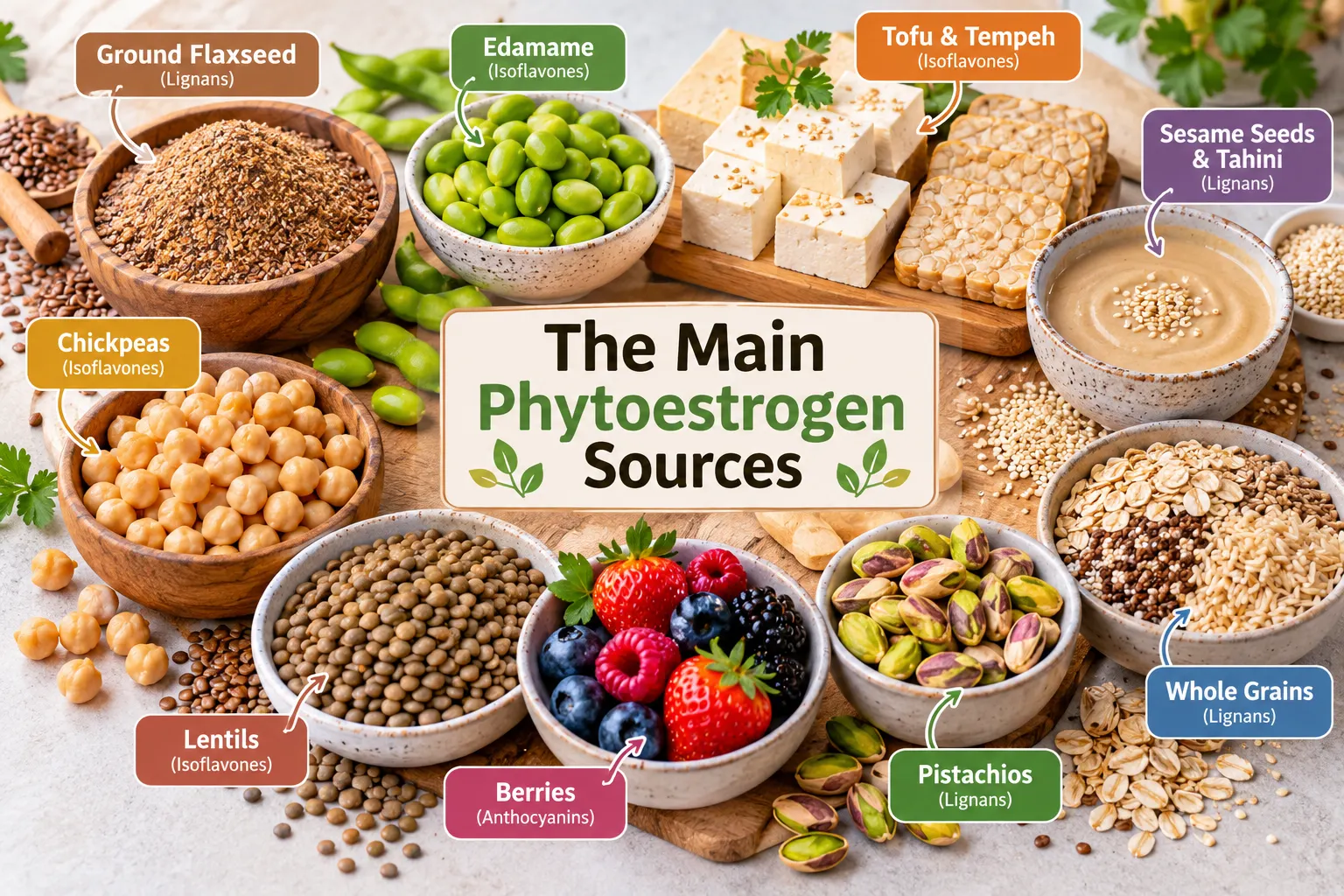
When I talk about “estrogen-rich foods,” I do not put every food in the same category. Flaxseed and soy deserve more attention because they are genuinely important dietary sources of specific phytoestrogens. Other foods contribute smaller amounts but still make sense as part of a varied plant-rich diet. The goal is not to eat all 10 every day , it is to understand where phytoestrogens come from and choose foods that also make sense for your protein, fiber, heart, bone, and metabolic health.
1. Ground Flaxseed
If I had to choose one food that clearly deserves its place on almost every phytoestrogen list, flaxseed would be near the top. Flaxseed is particularly rich in lignans, which gut bacteria can convert into enterodiol and enterolactone , metabolites with weak estrogen-like activity. What makes flaxseed different from most fruits and vegetables is the concentration: the Linus Pauling Institute’s lignan database lists approximately 85.5 mg of total lignans in 1 ounce of flaxseed, far more than most other commonly eaten plant foods. In one randomized trial involving postmenopausal women, adding ground flaxseed increased urinary enterodiol and enterolactone in a dose-dependent manner.
Why I Prefer Ground Flaxseed
Whole and ground flaxseed are not quite the same practically. Studies looking at flax processing have found that crushing and milling improve the bioavailability of enterolignans compared with leaving the seed intact. Flaxseed oil is different: it is a source of ALA but should not be assumed to provide the same lignan and fiber profile as the whole ground seed.
Easy Ways to Use It
Add ground flaxseed to oatmeal, Greek yogurt, smoothies, overnight oats, soups, or homemade muffins or breads. There is no need for large amounts in every meal; if your diet is currently low in fiber, increasing flaxseed gradually is usually more comfortable for the digestive system.
|
Dr. Kashyap’s Tip
Flaxseed is a good example of why I prefer looking beyond the word “estrogen.” You are not eating it simply for lignans , you are also getting fiber and plant omega-3 fats. That makes it useful even if your main goal has nothing to do with changing estrogen levels.
|
2. Soybeans and Edamame
Soy gets more attention than almost any other food in conversations about estrogen. Soybeans are rich in isoflavones, particularly genistein and daidzein. According to the Linus Pauling Institute’s soy-isoflavone data, a half cup of boiled mature soybeans contains about 56 mg of total isoflavones, while a half cup of boiled edamame contains about 16 mg. These figures vary with variety, processing, and brand.
Edamame works easily into everyday meals , as a snack, in salads, grain bowls, soups, or alongside a meal. Soybeans also provide protein, which matters because maintaining muscle becomes increasingly important during perimenopause and menopause. So even if a woman notices no change in hot flashes from soy, a good-quality protein source may still be useful.
Does More Soy Mean More Estrogen?
Not necessarily. Isoflavones can interact with estrogen receptors, but consuming soy should not be interpreted as directly increasing estradiol. I would rather tell a woman “soy is a useful source of isoflavones and protein” than “soy raises your estrogen.” Those are not equivalent statements.
3. Tofu and Tempeh
Tofu and tempeh come from soy, so they provide many of the same isoflavones found in soybeans. I group them together rather than pretending they are entirely different “estrogen foods.” The Oregon State soy database lists about 51.5 mg of isoflavones in 3 ounces of tempeh and around 19.2 mg in 3 ounces of soft tofu, although values differ substantially between products.
Tofu
Tofu is mild in flavor, making it easy to use in stir-fries, curries, soups, wraps, salads, and grain bowls. Some tofu is prepared using calcium salts and can contribute calcium, but the amount depends on manufacturing , check the label rather than assuming every product is the same.
Tempeh
Tempeh is fermented soy with a firmer texture, good in stir-fries, sandwiches, tacos, grain bowls, and salads. Fermentation changes the food, but I would not turn that into a claim that fermented soy “boosts hormones” better. The simpler point is that both tofu and tempeh are practical ways to get soy protein and isoflavones into the diet.
4. Sesame Seeds and Tahini
Sesame receives much less attention than soy or flaxseed, but it is an interesting lignan-containing food, with lignans such as sesamin and sesamolin. In a randomized crossover study involving postmenopausal women, sesame intake increased urinary mammalian lignan excretion, and another study found whole sesame seed could produce urinary enterolignans in amounts comparable with whole flaxseed under the study conditions. That does not make sesame and flaxseed nutritionally identical , their lignan profiles differ, and flaxseed remains an especially concentrated source , but sesame deserves a place on the list.
Tahini Makes Sesame Easier to Use
Most women are not going to eat a bowl of sesame seeds. Tahini is simply ground sesame, easier to use regularly , in hummus, salad dressing, sauces, grain bowls, toast, and vegetable dips. Sesame also adds unsaturated fats and minerals, so its value extends beyond phytoestrogens.
5. Chickpeas and Hummus
Chickpeas are often on estrogen-rich lists, but here we need precision: chickpeas contain phytoestrogens, but not in the same concentration category as soy or flaxseed. Food-composition research examining Western diets found that legumes provide phytoestrogens, including isoflavones and lignans, but soy foods remain much richer in isoflavones. Chickpeas are still worth including because they contribute plant protein, fiber, complex carbohydrates, minerals, and a range of plant compounds , and unlike a supplement, they improve the overall quality of the meal.
Easy Ways to Use Chickpeas
Hummus with vegetables, chickpea salad, roasted chickpeas, soups, grain bowls, or curries. I would not tell someone to eat hummus because it will raise her estrogen , I would say it is a practical way to add legumes, fiber, protein, and some phytoestrogens to the diet.
6. Lentils and Beans
Lentils, black beans, kidney beans, split peas, and other legumes contribute smaller amounts of phytoestrogens along with substantial nutritional value. Research measuring phytoestrogens across foods consistently identifies legumes as a contributing group, though amounts vary between species and preparations. Their biggest advantage is that they solve several nutritional problems at once, providing fiber, plant protein, potassium, magnesium, folate, and slowly digested carbohydrate.
You Do Not Need a Special “Hormone Bean”
You do not need one exotic legume because someone labelled it the best food for estrogen. If you enjoy lentil soup, black beans, kidney beans, chickpea curry, or split-pea soup, you are already getting many of the advantages we are looking for. Variety matters more than finding a single miracle food.
7. Dried Apricots, Dates, and Prunes
Dried fruits appear on high-estrogen lists because fruits contain lignans and other phytoestrogen-related compounds , but I would keep the claim in proportion. Fruits are not as concentrated a source of lignans as flaxseed or sesame. Studies of dietary lignan intake show fruits and berries contribute lignans, but generally in much smaller amounts per serving than the leading seed sources. Dried fruit is more concentrated simply because water has been removed, making dried apricots, dates, and prunes easy ways to add fruit and plant compounds to a meal.
Portion Still Matters
Dried fruit is compact and easy to over-eat compared with fresh fruit. I would not avoid it for its natural sugar, but I also would not treat a large bag of dates as a phytoestrogen supplement. A few pieces alongside nuts, yogurt, oatmeal, or a balanced meal usually makes more sense than eating large amounts because the food appears on a list.
8. Peaches, Berries, and Grapes
Fresh fruits such as peaches, strawberries, raspberries, blueberries, and grapes can contribute lignans and other polyphenols. They are worth including, but belong in the supporting-source category, not alongside flaxseed or soy. Population studies examining lignan intake identify fruit and berries as meaningful contributors to total dietary lignan exposure, largely because people eat them regularly even though each serving is modest. A food does not have to contain the highest concentration of one compound to matter in the overall diet.
What About Red Wine?
Some lists include red wine because grapes contain compounds such as resveratrol. I would not recommend drinking alcohol to obtain a phytonutrient available from food. If you enjoy grapes, eat the grapes , there is no need to start drinking wine because it appeared on a list of estrogen-rich foods.
9. Pistachios and Peanuts
Nuts and oilseeds can contribute lignans and other phytoestrogens, and food-composition studies have found this category to be an important source of total dietary phytoestrogens , but amounts vary tremendously. Flaxseed and sesame are far more relevant for concentrated lignans; pistachios and peanuts belong lower on the list. I still like them nutritionally for unsaturated fats, protein, fiber, minerals, and plant compounds. A small handful works as a snack, or added to yogurt, oatmeal, salads, and bowls.
A Practical Caution
If you have a peanut or tree-nut allergy, there is no reason to include these foods for phytoestrogens , there are plenty of other sources. This illustrates an important point: no individual food on this list is essential.
10. Whole Grains
Whole grains are sometimes overlooked because they do not sound like a classic “estrogen food,” but cereals and whole-grain foods are established dietary sources of lignan precursors. Research looking at lignan exposure identifies cereals and whole grains among the regular contributors to dietary lignan intake , oats, barley, rye, whole wheat, and whole-grain breads and cereals. Their main contribution is not simply phytoestrogens: they also provide fiber, which matters for bowel regularity, cholesterol, blood-sugar regulation, satiety, and the gut microbiome.
Which Estrogen-Rich Foods Should You Prioritize?
Rather than giving all 10 foods equal weight, a simpler way to think about them:
|
Food
|
Main Phytoestrogen Angle
|
Simple Way to Add It
|
|
Ground flaxseed
|
Particularly rich source of lignans
|
Add to oatmeal, yogurt, or smoothies
|
|
Soybeans and edamame
|
Rich in isoflavones
|
Add to salads, grain bowls, or eat as a snack
|
|
Tofu and tempeh
|
Soy isoflavones plus plant protein
|
Use in stir-fries, soups, wraps, or bowls
|
|
Sesame seeds and tahini
|
Dietary source of lignans
|
Add tahini to dressings, dips, or toast
|
|
Chickpeas and hummus
|
Legume phytoestrogens plus fiber and protein
|
Add to salads, soups, or use as a dip
|
|
Lentils and beans
|
Plant compounds, fiber, and plant protein
|
Use in soups, chili, salads, or bowls
|
|
Dried apricots, dates, prunes
|
Lignans and other plant polyphenols
|
Use in modest portions with meals or snacks
|
|
Peaches, berries, grapes
|
Smaller amounts of lignans and phytonutrients
|
Eat fresh or add to yogurt or oatmeal
|
|
Pistachios and peanuts
|
Plant compounds plus healthy fats and protein
|
Use as snacks or toppings
|
|
Whole grains
|
Lignans plus dietary fiber
|
Choose oats, barley, rye, and whole-grain foods
|
A breakfast with oatmeal, berries, and ground flaxseed; a lunch with chickpeas or edamame; and a dinner including tofu, lentils, or another legume can bring several of these foods into the diet without making every meal about hormones.
|
Dr. Kashyap’s Tip
You do not need all 10 foods every day. I would rather see two or three fit naturally into meals you already enjoy than force a long list of “estrogen foods” into your diet for a few weeks and then stop.
|
And more is not automatically better. There is no established recommended daily intake for total phytoestrogens, and the amounts used in clinical studies should not automatically become a home dosing guide. The better goal is a varied diet built around whole foods.
One Important Distinction Before We Move On
You may have noticed that broccoli, kale, Brussels sprouts, cabbage, and cauliflower are not in the main 10, even though they appear on many competitor lists. That was deliberate. These vegetables can contain small amounts of lignans and other plant compounds, but they are not among our strongest dietary phytoestrogen sources. They are interesting for a different reason: cruciferous vegetables are often discussed in relation to estrogen metabolism , which is not the same thing as being rich in estrogen or phytoestrogens.
Not Every “Estrogen Food” Works the Same Way
One problem with many estrogen-food lists is that very different foods are grouped together without explaining why they are there. Flaxseed belongs because it is exceptionally rich in lignans. Soy stands out because it provides substantial isoflavones. Legumes, nuts, fruits, and whole grains contribute varying amounts of phytoestrogens while also providing fiber, protein, and other nutrients. Then there are foods such as broccoli, kale, and Brussels sprouts , often described as “estrogen-balancing,” but more relevant to estrogen metabolism than as concentrated sources of phytoestrogens.
|
Food Group
|
Why It Matters in This Discussion
|
|
Soy foods
|
Major dietary sources of isoflavones
|
|
Flaxseed
|
Particularly concentrated source of lignans
|
|
Sesame seeds
|
Useful dietary source of lignans
|
|
Beans and lentils
|
Smaller amounts of phytoestrogens plus fiber and plant protein
|
|
Fruits, nuts, whole grains
|
Contribute lignans and other plant compounds in varying amounts
|
|
Cruciferous vegetables
|
More relevant to the broader discussion of estrogen metabolism
|
What About Broccoli, Kale, and Other Cruciferous Vegetables?
Broccoli, cauliflower, cabbage, kale, and Brussels sprouts often appear on hormone-balancing lists. They are excellent foods , but I would be careful with claims that they “detox estrogen” or remove “bad estrogen.” Cruciferous vegetables contain glucosinolates, which can be broken down into biologically active compounds including indoles, and researchers have studied whether these may influence how estrogen is metabolized. For example, a clinical study in healthy postmenopausal women found that higher Brassica vegetable intake was associated with changes in urinary estrogen-metabolite patterns. That tells us diet may interact with estrogen metabolism, but it does not prove broccoli can lower estrogen, clear “excess” estrogen, or treat a hormone imbalance. I still encourage cruciferous vegetables for their fiber, vitamins, minerals, and plant compounds , they do not need a hormone-detox claim to earn their place.
|
Dr. Kashyap’s Tip
I do not want women choosing broccoli because they have been told it will “flush out bad estrogen.” Estrogen metabolism is a normal physiological process involving the liver, gut, and several enzymatic pathways. No single vegetable controls that process.
|
Phytoestrogens Are Only Part of the Estrogen–Food Story
So far we have focused on what comes into the body through food. But estrogen has its own life cycle inside the body. Estrogens are metabolized through several pathways, particularly in the liver. Some metabolites are modified so they can eventually leave the body through urine or bile. When metabolites enter the intestine through bile, gut bacteria can become part of what happens next.
Certain intestinal bacteria produce enzymes such as beta-glucuronidase, which can deconjugate some estrogen metabolites, potentially allowing some to be reabsorbed rather than eliminated. Researchers sometimes use the term estrobolome for the collection of gut microbial genes and enzymes involved in estrogen metabolism. A recent review describes this gut–estrogen interaction but makes clear the biology is still being worked out and is far more complex than many “hormone gut health” claims suggest.
This is an interesting area of research. It is not yet a reason to buy a probiotic marketed as an estrogen-balancing product. We do not currently have a single ideal gut-microbiome pattern that can be prescribed for hormone balance, and we cannot look at one stool test and reliably determine how much estrogen a woman is recycling. The practical advice is much less dramatic: a diet providing adequate fiber and a variety of plant foods supports regular bowel movements and overall gut health , and many foods already discussed do exactly that.
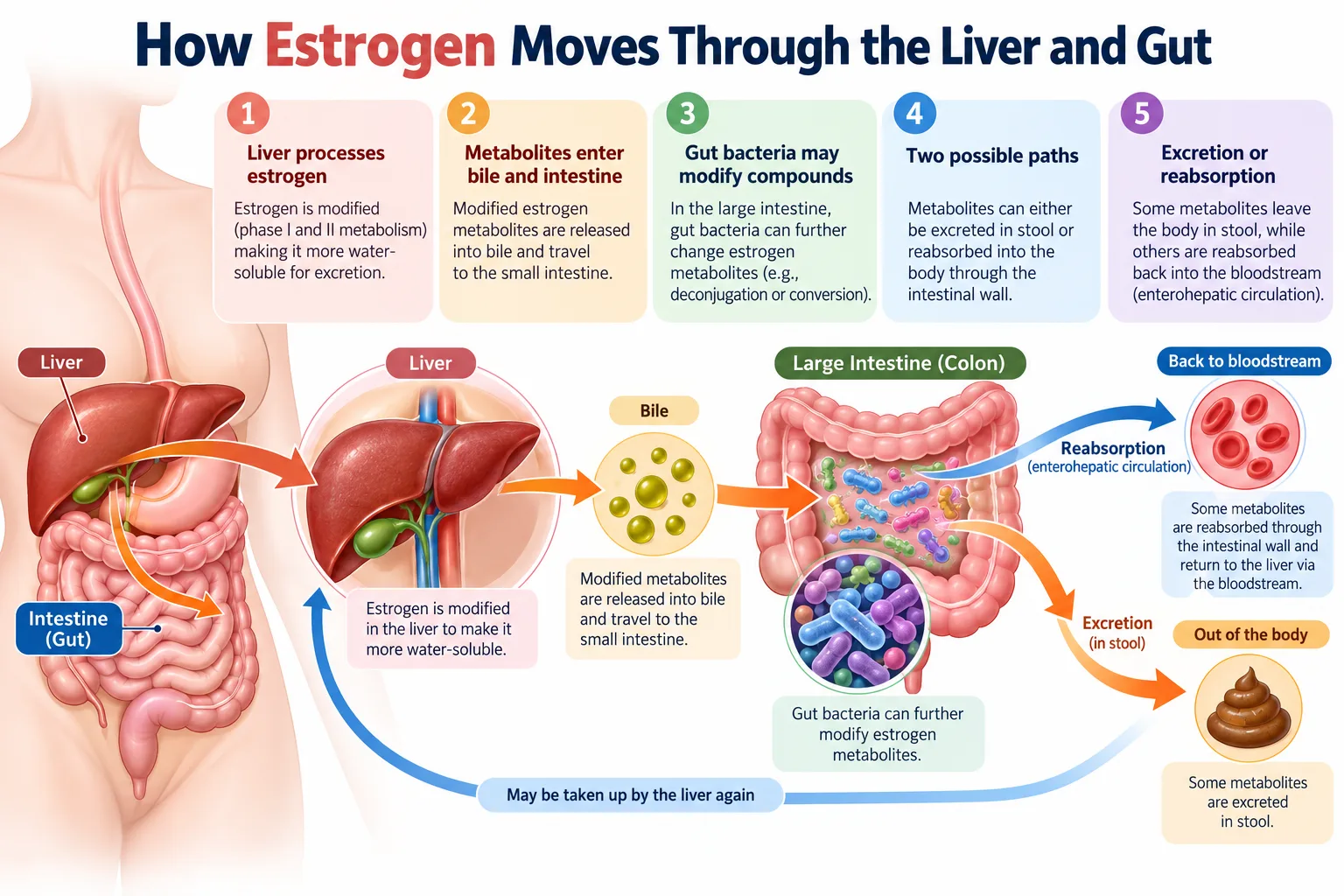
Dr. Deepali Kashyap on Estrogen Clearance and the Gut
When I explain this process, I keep the language simple. The liver helps process estrogen. Some metabolites reach the intestine. Gut bacteria can modify some of those compounds, and a portion may be excreted or reabsorbed. That is very different from saying “constipation causes estrogen toxicity” or “a gut cleanse will remove excess estrogen.” Those statements take a real biological pathway and stretch it much further than the evidence allows. For most women, the useful advice remains familiar: eat enough fiber, drink enough fluids, include a variety of plant foods, and pay attention to persistent changes in bowel habits.
Can Estrogen-Rich Foods Help During Menopause?
Women may look for phytoestrogens because they want help with hot flashes, night sweats, sleep disruption, or other changes as estrogen declines. Soy has received the most attention, but the evidence is not consistent enough for me to present it as a reliable menopause treatment. The 2025 systematic review and meta-analysis found a small improvement in overall menopausal symptoms but no significant benefit for hot flashes, excessive sweating, insomnia, or vasomotor symptoms specifically. A 2024 systematic review reached a similarly cautious conclusion.
This is also reflected in the 2023 Nonhormone Therapy Position Statement from The Menopause Society, in which soy foods, soy extracts, and the soy metabolite equol were not recommended as evidence-based treatments for vasomotor symptoms because the available evidence was limited or inconsistent.
That does not mean soy is a bad food. It means we should separate two questions. Is soy nutritious? Yes. Can I promise soy will treat hot flashes? No. If a woman enjoys tofu, tempeh, edamame, or soy milk, these fit well into a balanced menopause diet and provide protein and other nutrients regardless of any change in hot flashes. What I would not do is ask a woman with severe vasomotor symptoms to keep increasing soy while delaying a treatment with much stronger evidence.
|
Dr. Kashyap’s Insight
Nutrition and symptom treatment do not have to compete. A woman can eat a healthy, plant-rich diet and still use menopausal hormone therapy or an appropriate nonhormonal treatment when her symptoms need it.
|
What About Bone Health?
The relationship between menopause and bone deserves attention because estrogen decline accelerates bone loss. Soy isoflavones have been studied here, and the National Center for Complementary and Integrative Health notes that soy isoflavones probably have a beneficial effect on bone density, although the effect varies with the product and population studied. I still would not translate that into “eat soy to prevent osteoporosis.” Bone health after menopause depends on much more than phytoestrogens , protein, calcium, vitamin D, resistance and weight-bearing exercise, smoking, alcohol, medications, age, family history, and bone-density screening all matter. Soy may be one useful part of the diet; it is not a substitute for assessing fracture risk.
Why Soy May Affect One Woman Differently From Another
Two women can eat similar amounts of soy and process its isoflavones differently. This may partly involve equol. Daidzein is one of the major isoflavones in soy, and certain gut bacteria can convert it into equol, another biologically active compound. Not everyone produces meaningful amounts. Differences in gut microbial composition are one reason researchers have investigated whether equol producers respond differently to soy; the broader research on the gut microbiome and phytoestrogen metabolism supports the idea that microbial metabolism can influence how these compounds are handled.
This does not mean every woman needs an equal test, and it certainly does not mean a woman who does not produce equol should avoid soy. For me, this research is useful mainly because it reminds us why nutrition studies often give mixed results. The better question is rarely just “Does soy work?” It is: for whom, in what form, in what amount, and for which outcome?
Is Soy Safe If You Are Worried About Breast Cancer?
This is an important question because soy isoflavones can interact with estrogen receptors, which understandably creates concern for women who have had an estrogen-sensitive breast cancer. The first distinction I make is between soy foods and concentrated isoflavone supplements.
Current guidance from the American Cancer Society is reassuring about food: eating soy foods does not appear to increase breast-cancer recurrence risk, and some observational research has even suggested a possible association with lower recurrence , though there is not enough evidence to tell women to eat soy specifically to prevent recurrence. So foods such as tofu, tempeh, edamame, soybeans, and soy milk should not automatically be removed from the diet simply because they contain phytoestrogens.
Supplements deserve a different level of caution. Soy or isoflavone supplements can provide much more concentrated exposure than ordinary food. The American Cancer Society notes the evidence around these supplements is less clear and recommends discussing them with the healthcare team. The NIH takes a similar position: soy foods are considered safe for women who have had breast cancer or are at increased risk, while the safety of concentrated isoflavone supplements is less certain.
|
Dr. Kashyap’s Tip
If you have a history of breast cancer, I would not automatically remove tofu or edamame because you have heard that soy “contains estrogen.” I would be more cautious about starting a concentrated isoflavone supplement, particularly if you are receiving endocrine therapy or other cancer treatment. That is a decision to review with your oncology team.
|
Whole Foods vs Phytoestrogen Supplements
A soy-isoflavone capsule and a serving of edamame may contain related compounds, but they are not nutritionally equivalent.
|
Whole Phytoestrogen Foods
|
Concentrated Supplements
|
|
Tofu, tempeh, edamame, flaxseed, sesame
|
Isoflavone, soy-extract, or lignan supplements
|
|
Provide phytoestrogens within a whole-food matrix
|
Provide isolated or concentrated compounds
|
|
May also provide protein, fiber, healthy fats, vitamins, and minerals
|
Do not necessarily provide the nutrients found in the original food
|
|
Amounts vary naturally between foods
|
Dose can be substantially concentrated
|
|
Fit into an overall dietary pattern
|
More similar to a targeted intervention
|
|
Generally appropriate for people who tolerate the food
|
May require caution with medications or certain medical conditions
|
This is why my usual starting point is food first. The NIH notes that long-term safety information for phytoestrogen supplements remains limited, and supplements may cause adverse effects or interact with medications. The word natural on a bottle does not tell us whether the dose is necessary, effective, or appropriate for a particular woman.
How to Add Phytoestrogen Foods Without Rebuilding Your Diet
You do not need to design every meal around estrogen. I would rather see these foods fit naturally into meals you already enjoy. Breakfast could be oatmeal topped with berries and ground flaxseed. At lunch, chickpeas, lentils, or edamame can be added to a salad or grain bowl. Tahini works easily in dressings or dips. A snack might include pistachios or hummus, while tofu, tempeh, beans, or lentils can provide plant protein at dinner. The pattern matters more than creating a perfect “hormone plate.”
A woman who eats fish, eggs, dairy, or meat does not need to become vegetarian to include phytoestrogen foods , they can simply be incorporated alongside the rest of her diet.
What If You Do Not Eat Soy?
Soy is one of the richest dietary sources of isoflavones, but it is not compulsory. If you dislike soy or cannot eat it, you can still include ground flaxseed, sesame and tahini, chickpeas, beans, lentils, whole grains, nuts, fruits, and vegetables. The goal is dietary quality and variety, not checking soy off a checklist.
How Much Phytoestrogen Should You Eat?
There is no established daily requirement for total phytoestrogens. You may see specific milligram amounts quoted online because clinical trials use defined doses of soy isoflavones, but that does not create a Recommended Dietary Allowance. Research studies also use very different products , whole soy foods, soy protein, or purified isoflavone capsules , which should not be treated as interchangeable. For most women, I would not recommend counting daily phytoestrogen milligrams. A more practical goal is to include a variety of whole plant foods regularly and let soy, flaxseed, legumes, seeds, and whole grains fit into that overall pattern.
|
Dr. Kashyap’s Tip
More phytoestrogen is not automatically better. A dose used in a research study is not necessarily a dose you need to reproduce at home.
|
When Food Is Not Enough
There is one situation where I do not want a woman to keep experimenting with food: when she is using diet to postpone evaluation of symptoms that are persistent, significant, or unusual for her age. A few mild hot flashes are very different from waking repeatedly through the night drenched in sweat. Occasional vaginal dryness is different from persistent burning, recurrent urinary symptoms, or pain with sex. And periods stopping unexpectedly in the early 40s or younger deserve a different conversation from the typical transition around the usual age.
The goal is not to jump automatically to hormone therapy. It is to understand what is happening first. Depending on symptom, age, and medical history, treatment may involve changes in nutrition and lifestyle, menopausal hormone therapy, vaginal estrogen or other local therapy, a nonhormonal medication, treatment of another condition, or sometimes simply reassurance and monitoring.
At Galleria Women’s Health, menopause treatment is individualized around symptoms, age, medical history, and treatment goals rather than assuming every woman needs the same plan. Food can support that plan. It should not have to carry the entire plan.
The Bottom Line
Soy foods and flaxseed deserve much of the attention they receive in discussions about phytoestrogens. Soy is a meaningful source of isoflavones, while flaxseed stands out for lignans. Sesame, legumes, whole grains, nuts, fruits, and vegetables can broaden that intake while bringing other nutrients to the plate.
What I do not recommend is building a diet around the promise of “boosting estrogen.” For most women, the better goal is enough protein, fiber, healthy fats, and plant variety, with phytoestrogen-containing foods included where they fit naturally.
Some women may notice benefits from soy or other dietary changes during menopause. Others may notice no difference. That is not a failure of the diet , food has important roles in cardiovascular, metabolic, digestive, muscle, and bone health even when it does not behave like hormone therapy. And when symptoms are persistent, severe, or appearing earlier than expected, that is the point where I want women to stop asking “What else should I eat?” and start asking “Do I need to understand what is causing this?”
Key Terms Explained
- Estrogen: A group of hormones involved in reproductive health as well as bone, cardiovascular, brain, vaginal, and urinary health.
- Estradiol: The predominant estrogen during most of the reproductive years, and an estrogen commonly used in menopausal hormone therapy.
- Phytoestrogens: Plant compounds that can interact with estrogen receptors but are not the same as human estrogen.
- Isoflavones: Phytoestrogens found particularly in soy; genistein and daidzein are common examples.
- Lignans: Plant compounds found especially in flaxseed and sesame, as well as whole grains, legumes, fruits, and vegetables.
- Enterodiol and enterolactone: Compounds formed when intestinal bacteria metabolize certain dietary lignans.
- Equol: A compound that some gut bacteria can produce from the soy isoflavone daidzein.
- Estrobolome: A research term for gut microbial genes and enzymes involved in estrogen metabolism.
- Estrogen receptors: Proteins in different tissues that respond to estrogen and can also interact with some phytoestrogens.
- Menopausal hormone therapy (MHT): Treatment using estrogen, with a progestogen when needed, for appropriate menopause-related symptoms and indications.
References and Further Reading
1. Linus Pauling Institute, Oregon State University. Lignans.
2. Linus Pauling Institute, Oregon State University. Soy Isoflavones.
3. National Center for Complementary and Integrative Health. Menopausal Symptoms: In Depth.
4. National Center for Complementary and Integrative Health. Soy.
5. National Center for Complementary and Integrative Health. Menopausal Symptoms and Complementary Health Approaches: What the Science Says.
6. The Menopause Society. The 2023 Nonhormone Therapy Position Statement.
7. Soy isoflavones in perimenopausal women: systematic review and meta-analysis (2025).
8. Soy isoflavones and menopausal symptoms: systematic review and meta-analysis (2024).
9. Isoflavone supplementation and estradiol: systematic review and meta-analysis of randomized trials (2022).
10. Ground flaxseed and urinary lignan excretion in postmenopausal women: randomized trial.
11. Flaxseed processing and enterolignan bioavailability.
12. Sesame lignans and urinary lignan excretion in postmenopausal women: randomized crossover study.
13. Phytoestrogen content of foods consumed in Western diets.
14. Dietary lignan intake and food sources.
15. Cereals and whole grains as contributors to dietary lignan intake.
16. The gut microbiome, estrobolome, and estrogen metabolism: review.
17. Brassica vegetable intake and urinary estrogen metabolites in postmenopausal women.
18. American Cancer Society. Can I Lower My Risk of Breast Cancer Progressing or Coming Back?
This article is for educational purposes and does not replace individualized medical advice, diagnosis, or treatment. Nutrition, supplements, and menopause treatment decisions should be made with a qualified healthcare professional who can review your personal history, symptoms, medications, and goals.

 Meet Your Doctor

Leave a Comment