Menopause Symptoms: The Complete Guide by Age and Stage , From a Menopause Specialist
When a woman sits down in my exam room and starts describing her symptoms, she almost always ends with the same worried question: "Is this normal , or is something wrong with me?"
After more than fifteen years caring for women through this transition, here is what I can tell you: menopause symptoms are far more varied, start far earlier, and last far longer than most women are ever told. There is much more to menopause than hot flashes. And almost every symptom on the long list you're about to read has one more thing in common: it is manageable , once it's recognized.
In this guide, I'll walk you through every major menopause symptom the way I assess them in my clinic , by body system, by age, and by stage, including the symptoms after hysterectomy, the unusual ones nobody warns you about, and the red flags that should never be blamed on menopause.
|
Menopause Symptoms at a Glance
|
|
|
The 3 I see most in my clinic
|
Hot flashes, brain fog, vaginal dryness
|
|
When symptoms usually begin
|
Perimenopause , often the early-to-mid 40s, while you still have periods
|
|
How long they last
|
Median ~7.4 years, per the SWAN study1; for many women, 10+
|
|
How many symptoms exist
|
Dozens , you may have seen "34 symptoms" lists; the real number varies by woman
|
|
Do they go away?
|
Most fade in time; vaginal and urinary symptoms usually don't without treatment
|
|
Can you have menopause without symptoms?
|
Yes , roughly 1 in 5 women sails through with few or none
|
The Three Symptoms I See Most
Every woman's transition is different, but after thousands of patients, three symptoms dominate my exam room conversations:
● Hot flashes , and the night sweats that wreck sleep
● Foggy thinking , "I cannot think straight. I cannot remember things which I used to."
● Vaginal dryness , the one women mention last, and suffer from most silently
Close behind them: bloating, weight that won't budge, loss of desire, and irritability.
Why such different symptoms in one condition? Because menopause is not a single-hormone story. Several hormone systems , estrogen, progesterone, and testosterone , shift during this transition, and stress biology can influence how strongly any individual woman experiences her symptoms. Understanding which factors drive which symptom is exactly how I untangle a confusing picture in clinic, and it's how I've organized this guide.
|
DR. KASHYAP'S TIP
Before reading the list below, grab your phone and note your top 3 most bothersome symptoms. Symptom lists can feel overwhelming , but treatment always starts with what's stealing the most quality of life from you.
|
The Complete List of Menopause Symptoms, by Body System
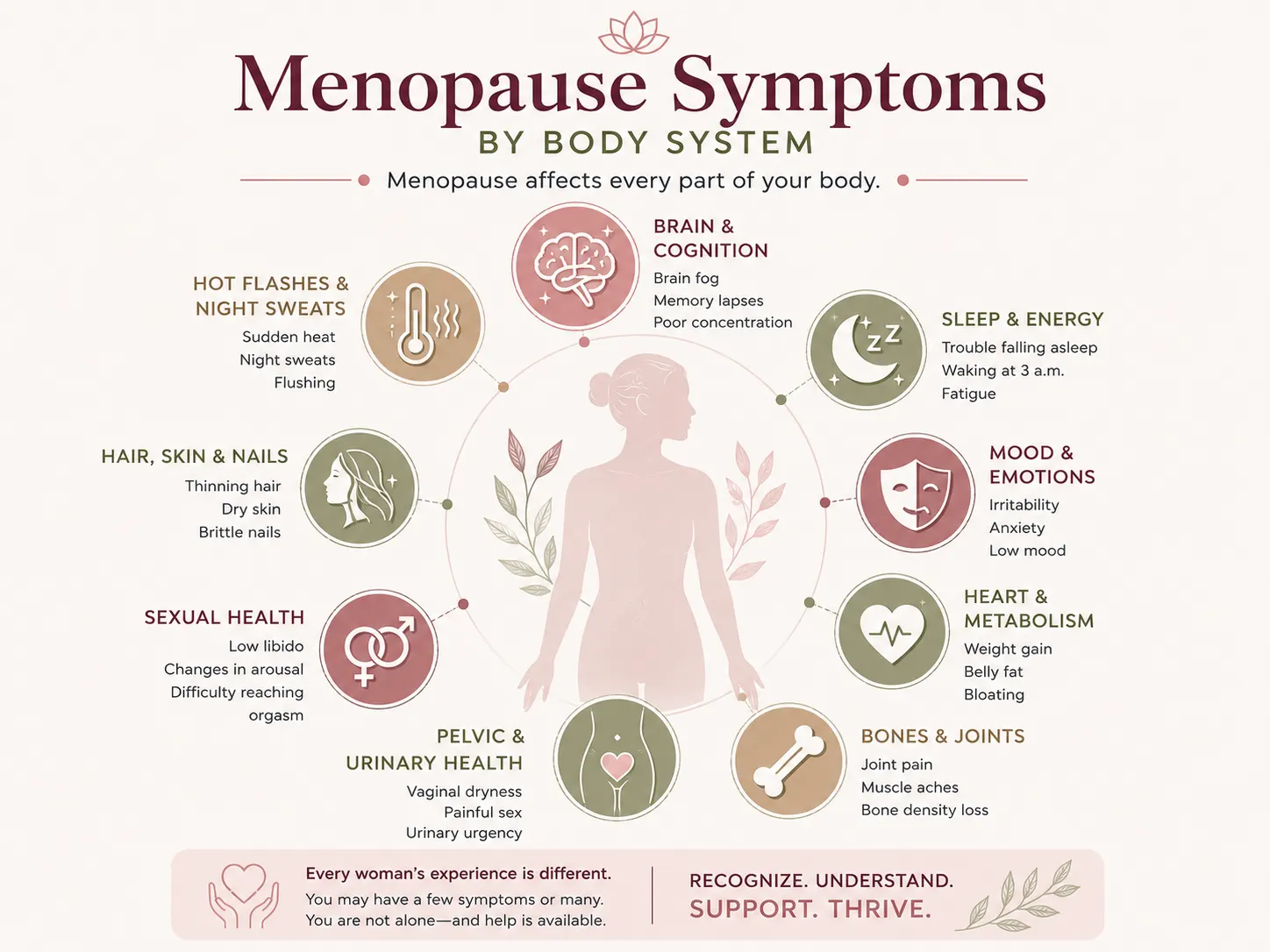
You may have seen viral "34 symptoms of menopause" checklists , some count 50 or even 100. The honest truth: because these hormones touch nearly every organ system, the list is long, and no two women get the same combination. Here is the full picture, organized the way I actually assess it.
Hot Flashes and Night Sweats (Vasomotor Symptoms)
Doctors call these vasomotor symptoms, and here's what's actually happening: declining estrogen confuses the brain's internal thermostat, which starts overreacting to tiny temperature changes as if they were emergencies. Up to 80% of women experience them, per a SWAN research summary2, making this the most recognized symptom of menopause , though, as you'll see, far from the only one. What they typically look like:
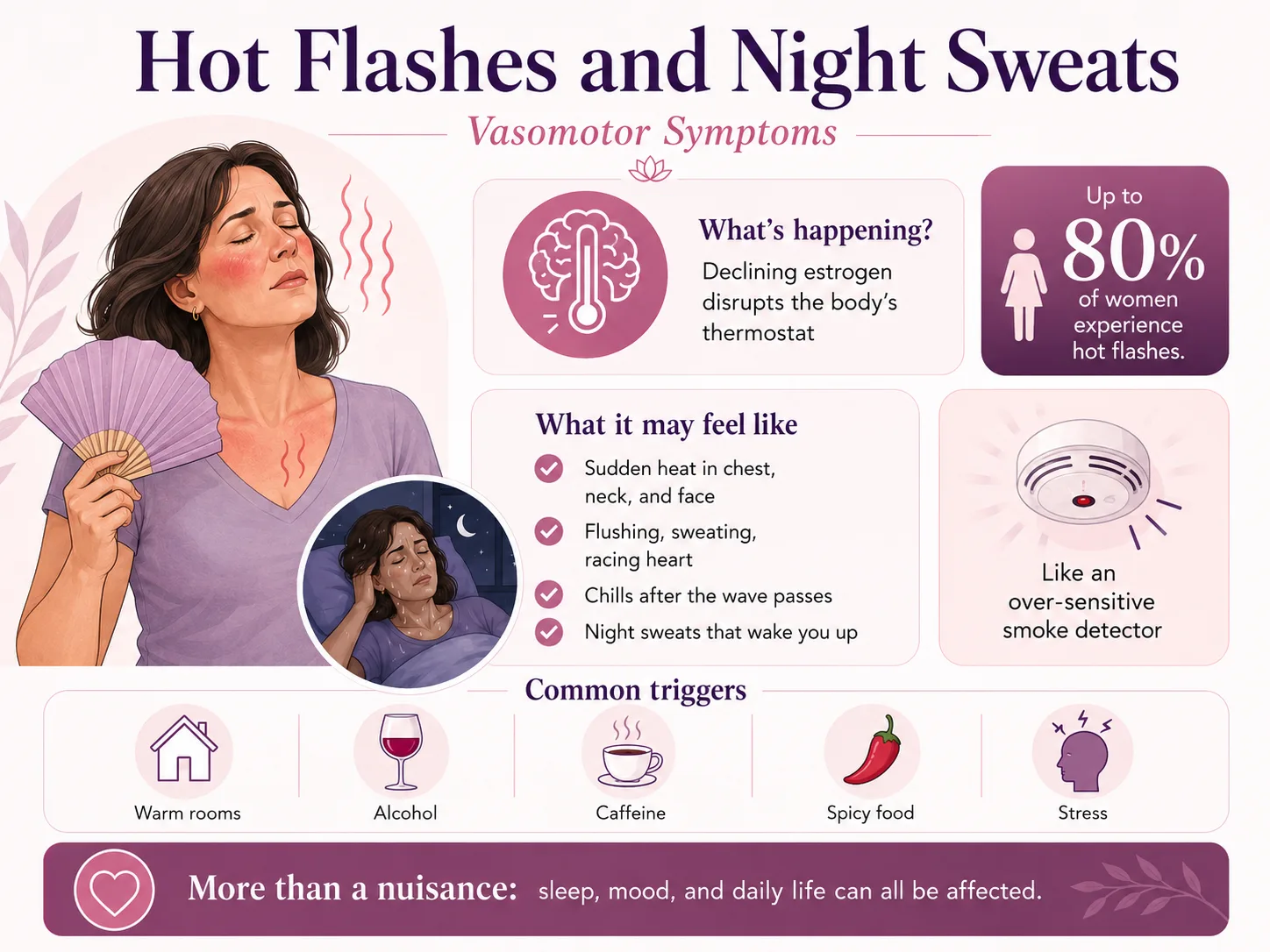
I describe it to patients like a smoke detector that's lost its calibration. It used to take real smoke to set it off. Now the faintest hint of warmth trips the alarm, full volume, no warning. The alarm going off doesn't mean the house is on fire , it means the detector is overreacting. That's good news, actually, because a miscalibrated alarm can be recalibrated.
● A sudden wave of heat rising through the chest, neck, and face , often out of nowhere
● Flushing, a racing heart, and sweating, sometimes followed by chills as the wave passes
● Night sweats that soak your nightwear and sheets, jolting you awake
● Episodes lasting one to five minutes, anywhere from a few times a week to many times a day
● Common triggers: warm rooms, alcohol, caffeine, spicy food, and ,stress
They're more than a nuisance. Night after night of fragmented sleep spills into mood, memory, weight, and everything else ,so I treat them seriously, not as something to fan away.
Brain Fog, Memory Lapses, and Poor Concentration
My patients describe this one best: "I cannot think straight. I cannot remember things which I used to." Research published in JAMA3 suggests roughly 40–60% of women in the menopause transition notice cognitive changes. Several things tend to converge here: hormonal fluctuations, fragmented sleep, and the accumulated effect of stress , and poor sleep in particular is one of the biggest contributors to the foggy, slowed-down feeling women describe. If any of these sound familiar, you're in very large company:
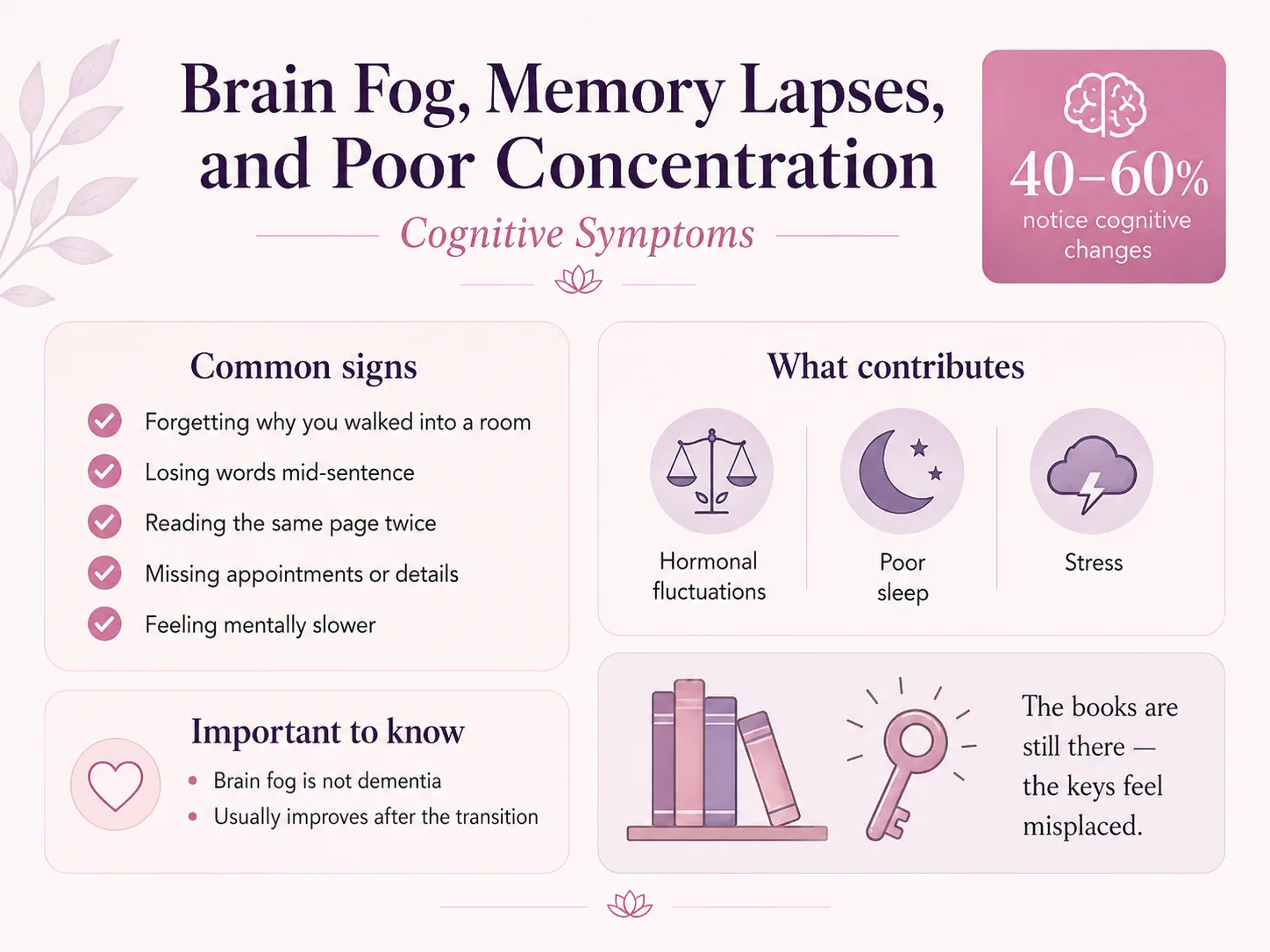
● Walking into a room and forgetting why you came
● Losing words mid-sentence , the name, the date, the thing on the tip of your tongue
● Reading the same page twice because nothing stuck the first time
● Missing appointments or details you'd never have missed before
● Feeling mentally slower in meetings or conversations , and quietly scared about it
Hold onto this: menopause brain fog is not dementia. For the vast majority of women it stays within the normal range and improves after the transition. Frightening, yes. Permanent, usually not.
I like to put it this way: imagine your brain is a librarian who has always known exactly where every book lives. Right now, she's still the same librarian , she hasn't forgotten how to do her job. She's just misplaced the keys to a few shelves. The books are still there. With the right support, she finds her keys again.
Sleep Problems and the 3 A.M. Wake-Up
Midlife insomnia is one of the most life-draining symptoms I treat , and one of the most responsive to the right plan. Night sweats are one culprit, and shifting progesterone levels are commonly linked with sleep disruption as well. The pattern my patients report:
● Trouble falling asleep, even when you're exhausted
● The infamous 2–3 a.m. waking , eyes open, mind racing, sleep gone
● Night-sweat wake-ups that require changing clothes or sheets
● Waking unrefreshed no matter how many hours you logged
Mood Changes: Anxiety, Irritability, Rage, and Low Mood
Hormonal shifts directly affect brain chemistry , estrogen and progesterone both interact with the systems that regulate mood, and the midlife load amplifies everything. If your mood feels foreign to you, it deserves real medical attention, not just "self-care." What this can look like:
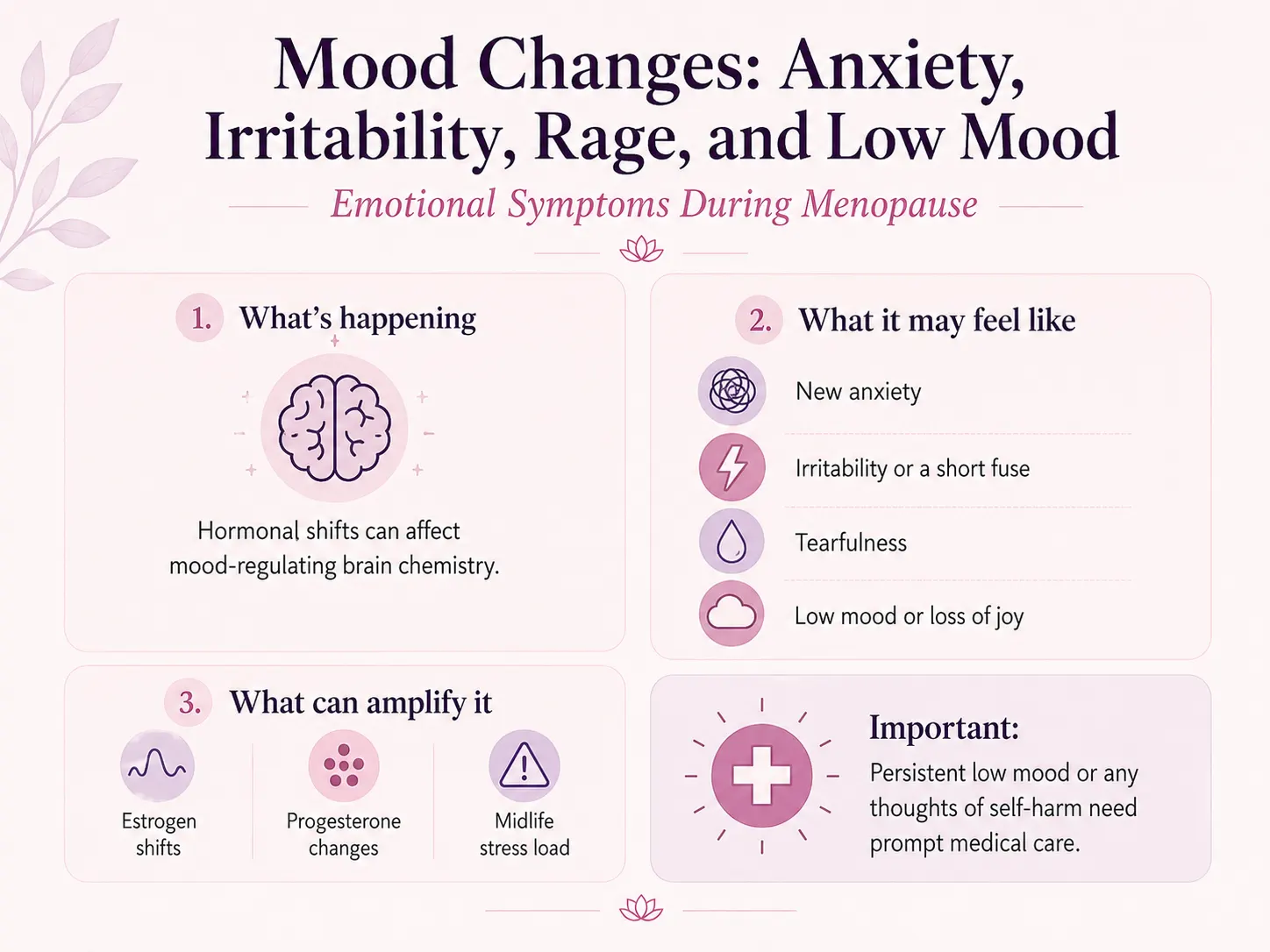
● New anxiety in a woman who has never been anxious in her life
● A short fuse , even rage , that surprises everyone, including you
● Tears without a clear reason, sometimes at the smallest things
● Flat, low mood or losing joy in things you usually love
One line I will repeat anywhere: if low mood becomes persistent, or you have any thoughts of self-harm, please seek help promptly. That is never "just menopause," and it always deserves immediate care.
Weight Gain, Belly Fat, and Bloating
"I'm eating the same, exercising the same, and the weight goes straight to my middle." I hear this almost daily, usually delivered with guilt , and the guilt is misplaced, because the science backs these women up completely. What's actually happening in the transition:
● The rate of fat gain has been shown to increase, while lean muscle mass tends to decline, per a SWAN cohort study published in JCI Insight4
● Deep belly (visceral) fat tends to accumulate more in the years around the final period , a pattern that appears at least partly independent of aging alone4
● The scale can stay the same while your body composition and waistline change , muscle out, fat in
● Bloating adds insult, fluctuating through the day as hormones and digestion shift
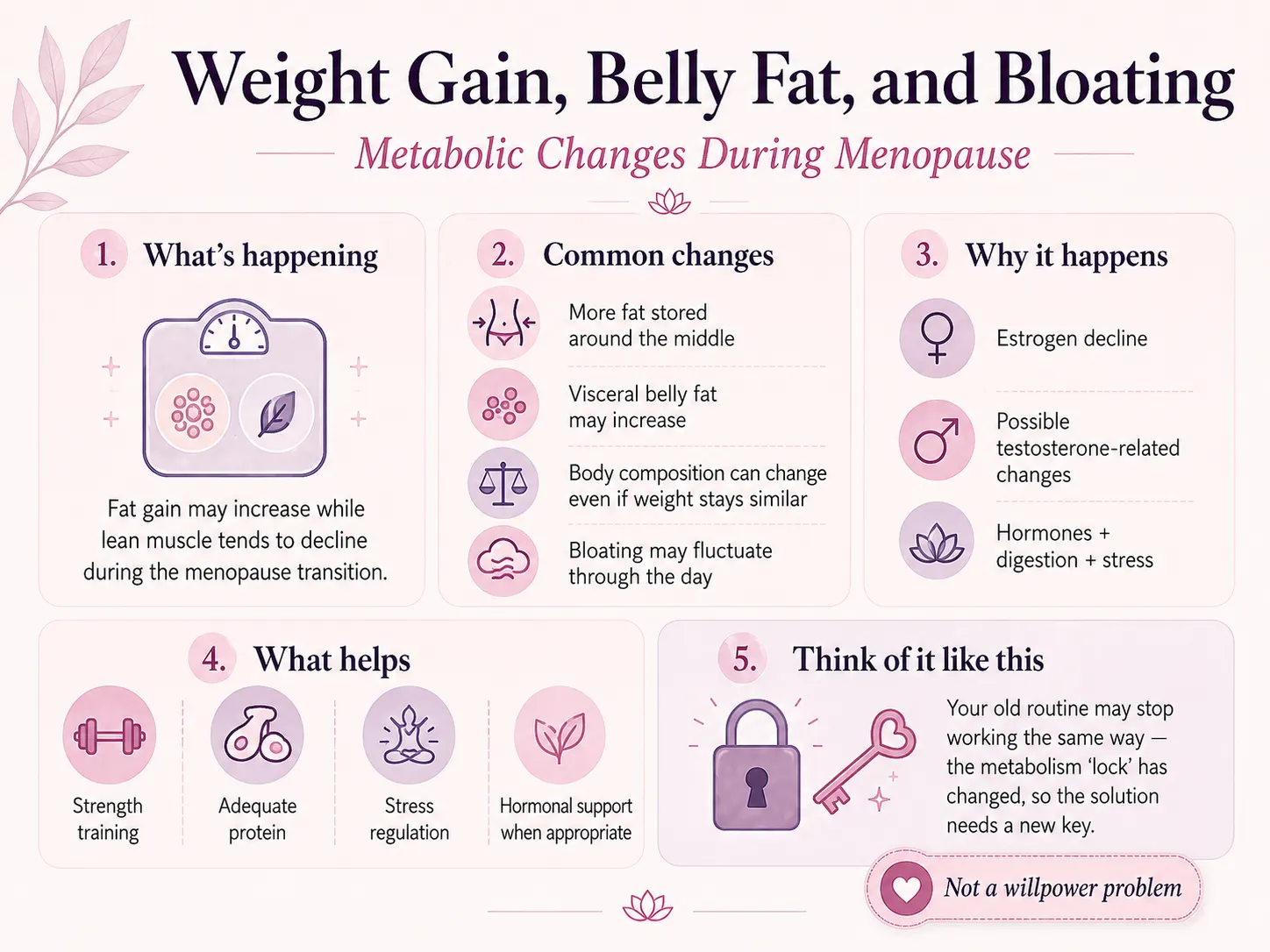
Declining estrogen plays a role in this shift, and testosterone is suggested to be involved as well, though the evidence on testosterone's exact contribution is still developing. The answer is not starving yourself , it's strength training to protect muscle, adequate protein, stress regulation, and in the right candidates, hormonal support.
I tell my patients it's like someone changed the locks on your metabolism overnight without handing you the new key. The same key , the same eating habits, the same workouts , doesn't open the door the way it used to. That's not a willpower problem. That's a different lock. So we stop jiggling the old key harder and start cutting a new one.
Joint Pain, Hip Pain, Frozen Shoulder, and Muscle Aches
One of the most under-recognized symptom groups , what researchers now call the musculoskeletal syndrome of menopause. Estrogen is anti-inflammatory and supports your tendons, cartilage, and muscle; as it falls, all that quiet protection fades at once. If your joints "aged overnight" in your late 40s, this may be the missing explanation your doctors haven't connected. The classic pattern:
● Morning stiffness -joints feel rusted shut for the first 20–30 minutes of the day
● Migrating aches -knees one week, fingers the next, shoulders after that
● Outer-hip pain at night-worse when lying on that side
● Frozen shoulder - a progressively stiff, locked shoulder that strikes women aged 40–60 far more than anyone else
● Stiffness after sitting that takes a few steps to "unlock"
I think of estrogen here like the oil in a car engine , quietly protecting moving parts you never think about until it's gone. Take the oil away and the same engine that ran smoothly for decades suddenly grinds. The joints didn't break overnight. The lubrication just left the building.
Vaginal Dryness, Painful Sex, and Urinary Symptoms
This is the cluster women suffer through in silence , mentioned last in my exam room, hand on the doorknob, if it's mentioned at all. Estrogen loss thins the vaginal tissue and changes the urinary tract, and the medical name for the whole picture is genitourinary syndrome of menopause (GSM). The North American Menopause Society5 reports that GSM affects approximately 27% to 84% of postmenopausal women , and most of them never bring it up. What it includes:
● Vaginal dryness, burning, or itching that doesn't resolve
● Painful sex , many women describe it to me as feeling "like sandpaper"
● Recurrent urinary tract infections, one after another
● Urgency and leaks , suddenly needing to go, or leaking with coughs and laughs
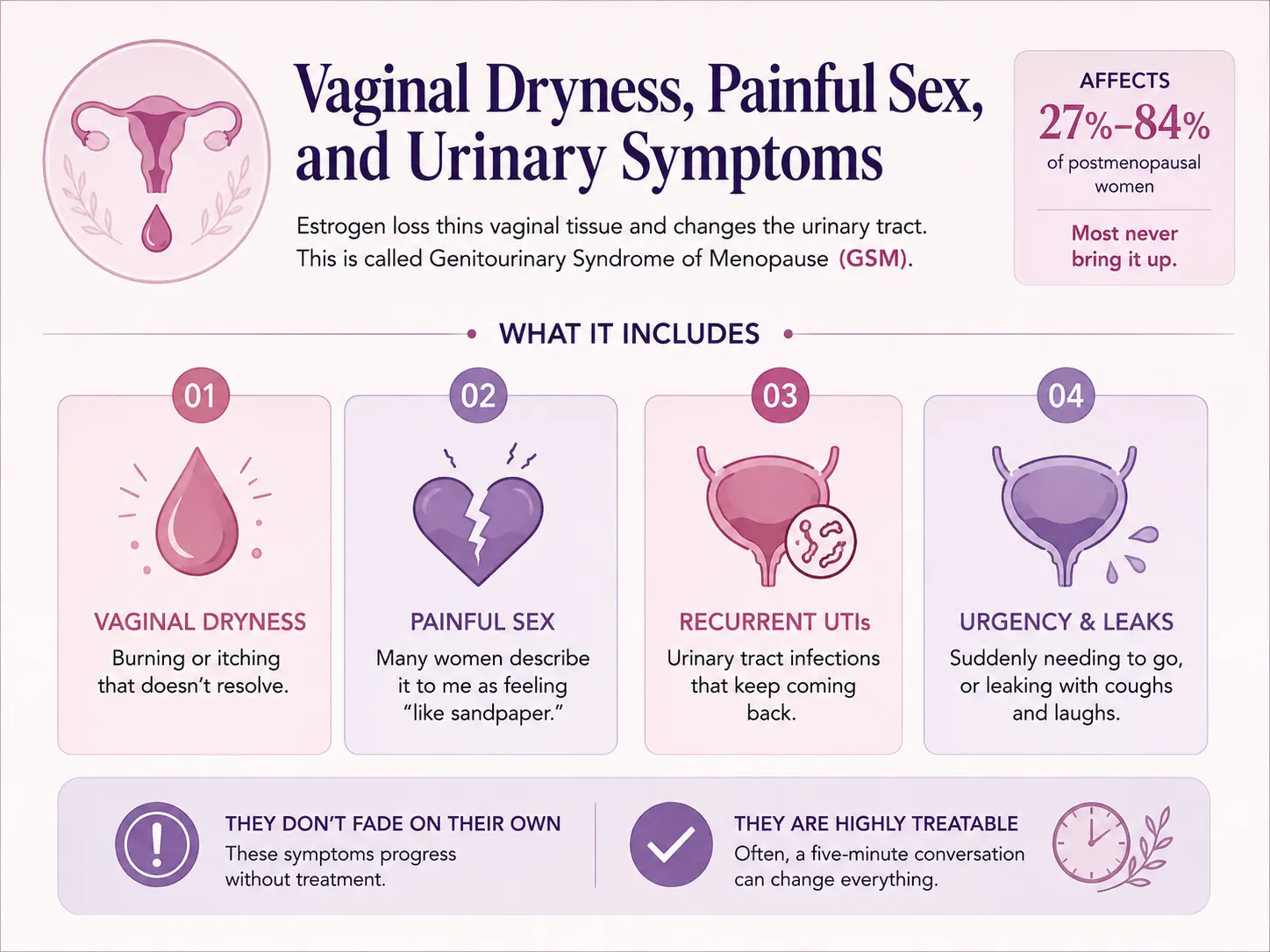
Two things to remember. Unlike hot flashes, these symptoms do not fade on their own , they progress without treatment. And they are among the most treatable symptoms in all of menopause medicine , a five-minute conversation can fix what years of silence couldn't.
Low Libido and Changes in Sexual Response
Testosterone changes may play a role, but low desire is usually multifactorial , vaginal pain, poor sleep, stress, mood, relationship factors, medications, and hormone shifts can all contribute. And because nobody brings it up, women assume it's just them, or just age, or just the marriage. It's usually none of those, or not just one of those. What it looks like:
● Desire that quietly disappears , you don't miss it until you realize it's gone
● Arousal that takes longer and feels harder to reach
● Orgasms that feel muted compared to before
● A pain-avoidance cycle , when sex hurts, desire learns to switch itself off
This is a medical conversation worth having. Evidence-based options exist , from treating the tissue to, for appropriate postmenopausal candidates, carefully dosed testosterone, which is best supported for low desire specifically.
Hair, Skin, Nail, and Breast Changes
Estrogen supports collagen, hair density, and tissue fullness , so as it falls, the changes show up in the mirror before they show up in any lab test. These changes are common, usually benign, and far more emotionally loaded than medicine tends to admit:
● Thinning hair, a widening part, and more shedding in the brush and drain
● Drier, less elastic skin and new fine lines
● Brittle nails that split and peel
● Breast changes , tenderness that strikes unpredictably in perimenopause, then loss of fullness and density as estrogen falls
One non-negotiable: see a doctor promptly for any of these breast findings :
● A new lump or firm, thickened area
● Skin puckering or dimpling
● Nipple discharge or a newly inverted nipple
● Any one-sided change that doesn't match the other breast
The Unusual Symptoms Nobody Warns You About
These surprise my patients the most , and they're all real:
● Heart palpitations , fluttering or pounding, often with hot flashes (new or severe palpitations still deserve a cardiac check)
● Dizziness and lightheadedness
● Headaches and migraines , often worsening with hormonal swings
● Itchy or crawling skin (formication) and itchy ears
● Burning mouth or altered taste, dry eyes, and even changes in body odor
● Nausea, new food sensitivities, and digestive changes
● Electric-shock sensations, tingling hands and feet
● Fatigue that rest doesn't fix
|
QUICK QUESTION , Are the "34 symptoms of menopause" real?
The number 34 comes from popular checklists, not a medical definition , but yes, virtually all the symptoms on those lists are genuine and hormonally explainable. The real point isn't the count; it's that any combination you have deserves to be taken seriously.
|
Menopause Symptoms by Age: 40, 45, 47, 50, 55
"Am I too young for this?" is one of the most common questions I'm asked , so let me walk through the transition the way it actually unfolds, age by age. (These are patterns, not rules; your timeline is your own.)
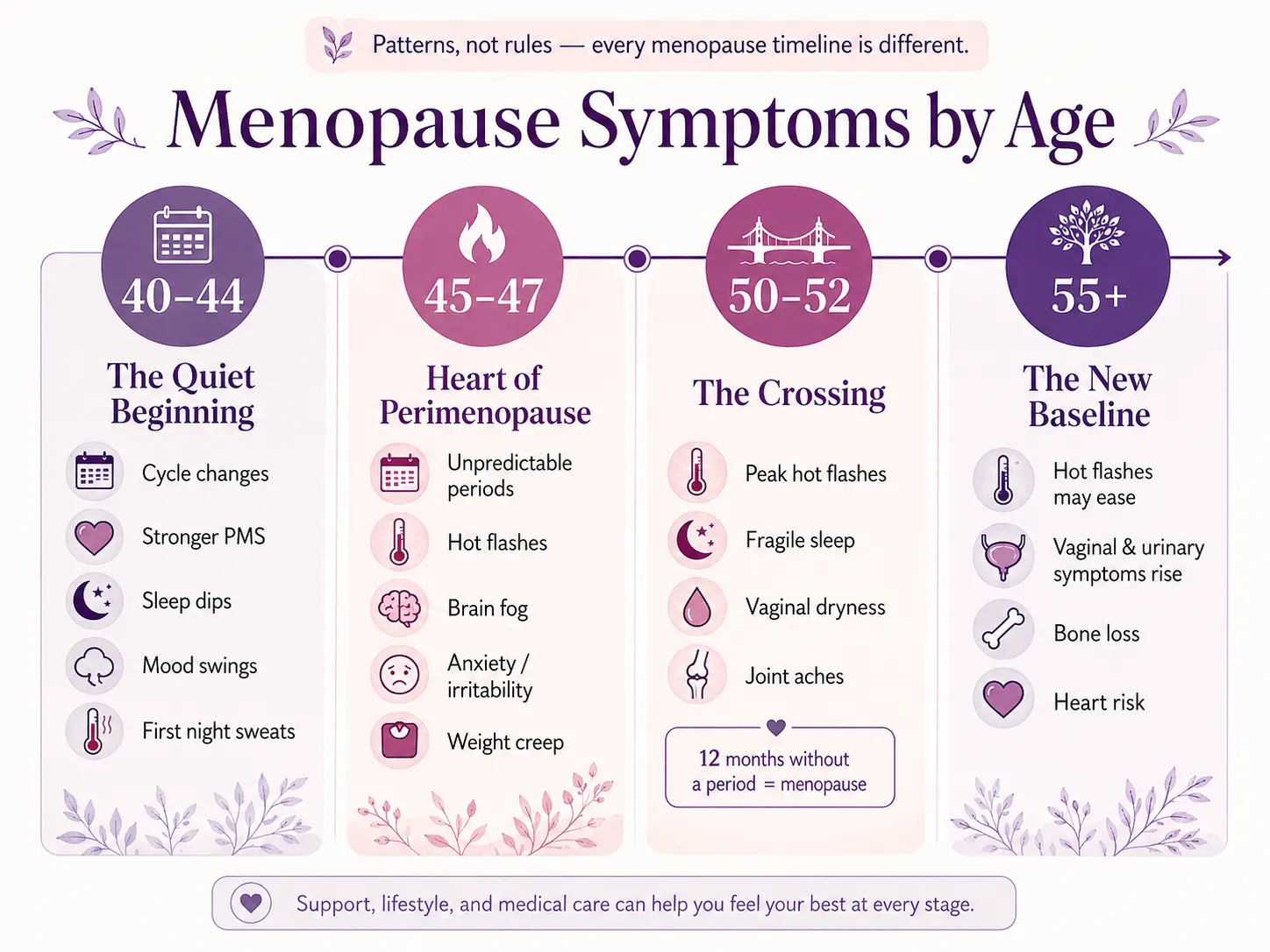
Symptoms at 40–44: The Quiet Beginning
Perimenopause can absolutely begin here, and this is the window where women get dismissed the most. Hormones are only beginning to waver, so the changes are subtle and easy to blame on stress, kids, or a busy job. But the body is already whispering. The first clues:
● Periods shifting closer together or further apart
● New PMS intensity , worse than your twenties ever were
● Sleep quality quietly dipping
● Mood swings and a shorter fuse
● The first occasional night sweats
Most women , and many doctors , don't connect the dots this early. If this is you, you are not too young, and you're not imagining it.
Symptoms at 45–47: The Heart of Perimenopause
This is when search engines light up with "menopause symptoms age 47" , because this is when the transition typically gets loud. Hormone levels fluctuate most violently in this window, swinging high and crashing low within the same month, which is why symptoms often feel worse now than after menopause itself. What the heart of perimenopause looks like:
● Unpredictable periods , skipped months, heavy floods, or both
● Hot flashes arrive in earnest, day and night
● Brain fog peaks as hormones swing wildly
● Anxiety and irritability surge , often the most distressing change
● The scale starts creeping despite unchanged habits
If this is your age and your list , you are not falling apart. You are mid-transition, and this is the single most important window to get evaluated and supported.
Symptoms at 50–52: The Crossing
The average American woman has her final period around 52, which makes these the crossing years , the body settling out of the perimenopausal storm and into its new hormonal baseline. Many women find symptoms peak right around this milestone before slowly beginning to ease. In this window:
● Hot flashes and night sweats often hit their peak frequency
● Sleep is at its most fragile
● Vaginal dryness becomes noticeable for many women
● Joint aches and stiffness are common
Once you've gone 12 straight months without a period, you've officially crossed into menopause.
Symptoms at 55 and Beyond: The New Baseline
Past 55, the transition isn't over , it changes character. The loud symptoms often begin to quiet down, while the quiet ones grow louder, and the long-term health stakes (bone and heart) move to center stage. Here's the shift:
● Hot flashes begin to ease for many, though about a third still have them well past 55, some past 60
● Vaginal dryness and urinary symptoms tend to increase*** rather than fade
● The silent shifts , bone loss and rising heart risk , are fully underway
This is the age where treatment focus often shifts from "surviving symptoms" to protecting long-term health.
|
DR. KASHYAP'S TIP
Whatever your age, track your cycle even when it's irregular. The pattern of your periods is the single most useful piece of information you can bring me , it tells me where you are in the transition better than any single blood test.
|
Postmenopause Symptoms: Your 50s, 60s, and 70s
A myth I correct weekly: "menopause ends, and then you're back to normal." Once you're postmenopausal, you're postmenopausal for life, and the symptom picture changes shape rather than simply disappearing:
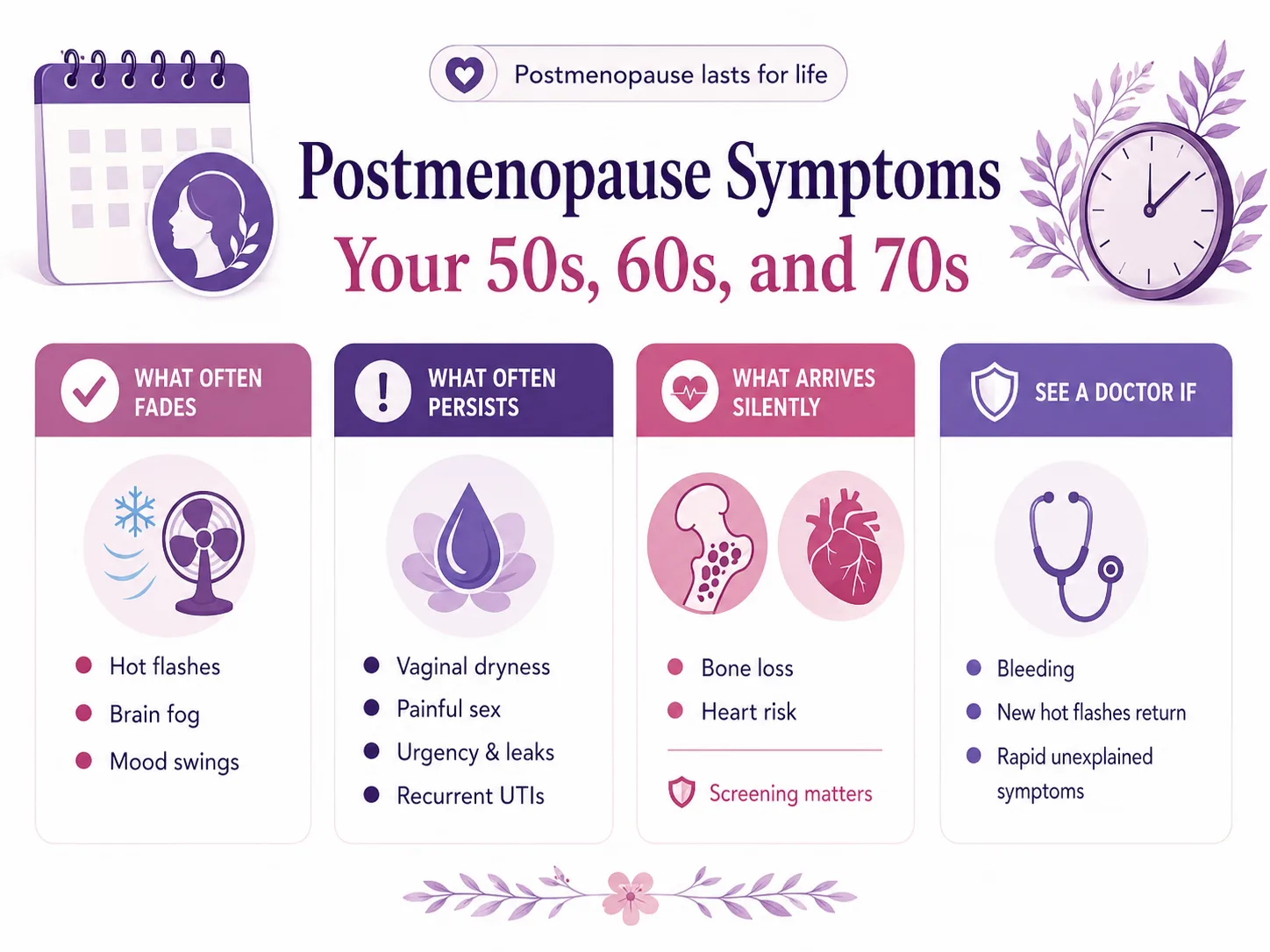
● What usually fades: hot flashes and night sweats (gradually, over years), brain fog, and the wild mood swings of perimenopause, because hormones are no longer swinging, just settled at a lower level.
● What usually persists or worsens without treatment: vaginal dryness, painful sex, urinary urgency, leaks, and recurrent UTIs (GSM). At 60 and 70, these are the most common , and most under-treated , symptoms I see.
● What arrives silently: accelerated bone loss (osteopenia → osteoporosis) and rising heart risk. You won't feel either one , which is exactly why postmenopausal women need DEXA scans and cardiovascular screening, not reassurance.
● A special note for your 60s and 70s: new hot flashes returning after years of quiet, any vaginal bleeding, or rapid unexplained symptoms are not "menopause again" , they need medical evaluation.
|
QUICK QUESTION , I'm 60 and still having symptoms, is that normal?
Yes, more normal than most women realize. About a third of women have hot flashes a decade or more after their final period, and vaginal/urinary symptoms typically increase with time. Normal, but not something you have to live with. Both are treatable at any age.
|
Early and Premature Menopause Symptoms
Menopause before 45 is called early menopause; before 40, it's premature menopause (premature ovarian insufficiency, or POI). The symptoms are the same as typical menopause , irregular then absent periods, hot flashes, sleep and mood changes, vaginal dryness , but they arrive when nobody, sometimes including your doctor, is expecting them. Two things matter enormously here:
● It always deserves a workup. Causes range from genetics and autoimmune conditions to surgery, chemotherapy, and smoking , and the diagnosis should never be guessed at.
● Treatment is usually strongly recommended, not optional. Losing estrogen decades early raises long-term bone and heart risks, so hormone therapy until at least the natural age of menopause is typically advised unless there's a clear reason not to.
Menopause Symptoms After Hysterectomy
This is one of the most confusing situations in all of menopause , and one of the most searched. The key question is what happened to your ovaries, because the uterus controls your periods, but the ovaries control your hormones:
Hysterectomy with Ovaries Intact
If your uterus was removed but your ovaries stayed, you did not enter menopause that day , your ovaries keep making hormones. But here's the catch:
● With no periods to track, you lose the clearest signpost of the transition
● Menopause arrives on its own schedule , often 1–2 years earlier than average after hysterectomy
● Symptoms become your only signal: hot flashes, night sweats, sleep changes, brain fog, vaginal dryness
If those symptoms are appearing, don't let "but you've had a hysterectomy" end the conversation , that's exactly when hormone evaluation matters most.
Surgical Menopause (Ovaries Removed)
If both ovaries were removed, menopause began the moment surgery ended , at any age. Symptoms are often more sudden and more intense than natural menopause because hormones drop off a cliff rather than declining over years. Women who have surgical menopause young deserve proactive treatment planning, ideally before the operation.
"It's Been 20 Years Since My Hysterectomy , Why Do I Have Symptoms Now?"
A question I hear surprisingly often. Two usual answers: your ovaries (if kept) eventually reached natural menopause , possibly quietly, years ago , and what you're feeling now is the postmenopausal picture: vaginal dryness, urinary symptoms, bone and joint changes, which build with time. Or, less commonly, something unrelated to menopause is going on. Either way: new symptoms decades after a hysterectomy deserve evaluation, not assumption.
Why Stress Biology Makes Some Symptom Days Worse
Search engines tell me women are looking up "cortisol poisoning menopause symptoms." That's not a formal medical diagnosis, but the experience behind the search is real, and it's worth explaining carefully.
Cortisol is the body's main stress hormone. It is not bad , we need it, and it helps the body respond to pressure, deadlines, and sudden demands. The problem begins when the body stays in that "alert mode" for too long. Cortisol is not technically one of the hormones that defines menopause, and menopause itself does not directly raise cortisol levels.
What it does do is share the stage. At the same time estrogen, progesterone, and testosterone are shifting, many women are also carrying years of stress from work, family responsibilities, caregiving, poor sleep, and emotional overload. The body is trying to adjust hormonally while also managing a high stress load , and that combination of life stage and aging can shape how strongly any individual woman experiences her symptoms.
Even when two women have similar lab results, their menopause experience can feel very different. One may have mild symptoms, while another struggles with intense hot flashes, poor sleep, anxiety, weight gain, or brain fog. Hormones are part of the picture, but stress biology can influence how strongly those symptoms are felt.
Signs that stress biology may be part of your symptom story:
● "Wired but tired" , exhausted all day, mind racing at night
● Belly-centered weight gain and sugar cravings
● Anxiety and a hair-trigger stress response
● Brain fog that worsens on stressful weeks
● Feeling unable to bounce back the way you used to
If that list reads like your life, hormones alone don't explain you , your current lifestyle, stress load, and the demands of this life stage might be amplifying things further. So I do not treat menopause as a prescription-only problem. Hormone therapy, when appropriate, can be very helpful, but it works best alongside support for the nervous system: protected sleep, breathwork, movement you enjoy, saying no, and a treatment plan that takes your whole life into account.
Which Factors Tend to Track With Which Symptom? A Clue Chart
Patients find this map clarifying , it's how I mentally sort a symptom story in clinic.
|
Hormone or Factor
|
Classic Symptom Clues
|
|
Low estrogen
|
Hot flashes, night sweats, vaginal dryness, painful sex, recurrent UTIs, dry skin and eyes, joint aches, bone loss
|
|
Low/fluctuating progesterone
|
Poor sleep and 3 a.m. waking, anxiety, irritability, heavier or erratic periods in perimenopause
|
|
Low testosterone
|
Reduced desire most clearly; muscle, strength, and fat-distribution changes are suggested but less firmly established
|
|
High stress / poor sleep (cortisol-related)
|
"Wired but tired," belly-centered weight, sugar cravings, racing mind at night, feeling unable to bounce back
|
|
QUICK QUESTION , Can you have menopause without symptoms?
Yes. Roughly one in five women transitions with few or no noticeable symptoms , lucky genetics. One caveat: the silent changes (bone loss, heart risk) happen even without symptoms, so screening still matters.
|
Do Menopause Symptoms Go Away?
The honest, specific answer:
● Symptoms last a median of about 7.4 years in the landmark SWAN study1 , and women whose symptoms start early in perimenopause often experience them for over a decade.
● Hot flashes, night sweats, brain fog, and mood swings typically fade gradually in the years after your final period.
● Vaginal dryness and urinary symptoms do not fade , they persist or progress without treatment, at any age.
● Bone loss and heart risk never announce themselves at all , they simply continue.
And one more thing, because I say it to every patient: there is no medal for enduring this. "Waiting it out" costs women years of sleep, intimacy, confidence, and health , for nothing. Every symptom in this article has a treatment path.
Red Flags: Symptoms That Should Never Be Assumed to Be Menopause
Menopause is common , but it must never become the automatic explanation for every midlife symptom. Some symptoms can signal conditions that have nothing to do with hormones, including cancers whose risk rises after menopause. See a doctor promptly , and do not wait , if you have:
● Any vaginal bleeding after menopause , always evaluated, without exception
● Persistent bloating, feeling full quickly, or pelvic pressure lasting more than a few weeks , these can be symptoms of ovarian cancer, which is exactly why they should never be waved off as "menopause bloating"
● Unexplained weight loss
● A new breast lump, skin dimpling, or nipple discharge
● Recurrent urinary infections , treatable, but they need proper medical evaluation, not home management
● Severe or worsening fatigue, or significant mood changes including persistent low mood or any thoughts of self-harm
Most of the time, the workup is reassuring. But the women who get checked are the ones who catch the exceptions early , and that is exactly what a careful approach to midlife health looks like.
When to See a Menopause Specialist?
Come in , to me, or to a certified menopause practitioner near you , if:
● Your symptoms are interfering with sleep, work, mood, or intimacy
● You're under 45 with changing periods
● You've had a hysterectomy and new symptoms have appeared
● You've been told "your labs are normal, it's just aging" , while you know something is wrong
In women over 45, menopause is diagnosed by your story and your symptoms , not a single lab number , which means being heard is the test.
At Galleria Women's Health in Henderson, my evaluation covers the whole picture: a detailed symptom and lifestyle assessment, comprehensive labs, bone density (DEXA), and heart-health screening where appropriate , and then a plan built for your symptom story, refined together over time. That's the process.
Symptom Terms Explained: A Simple Glossary
Plain English for the terms you'll meet in this guide and in your doctor's office:
- Perimenopause — The transition years before your final period , often starting in the early-to-mid 40s , when hormones fluctuate and most symptoms begin.
- Postmenopause — All the years after 12 consecutive months without a period. Some symptoms fade; vaginal, urinary, bone, and heart changes need ongoing attention.
- Progesterone —A hormone that fluctuates and declines through the transition. Its shifts are commonly linked with disrupted sleep, which can in turn contribute to fatigue and brain fog.
- Testosterone — Not just a male hormone , women produce it too. Current evidence most clearly supports its role in sexual desire; a connection to muscle and fat distribution is suggested but less firmly established.
- Cortisol—The body's main stress hormone. It is not one of the hormones that defines menopause, and menopause does not directly raise cortisol , but the stress and life demands many women carry during this transition can shape how intensely symptoms are experienced.
- Vasomotor symptoms (VMS) — The medical term for hot flashes and night sweats , the brain's thermostat misfiring as estrogen declines.
- GSM (genitourinary syndrome of menopause) —The umbrella term for vaginal dryness, painful sex, and urinary symptoms caused by estrogen loss. Progressive without treatment , and very treatable.
- Brain fog , The everyday name for menopause-related memory lapses, word-finding trouble, and reduced focus. Common, usually temporary, and not dementia.
- Musculoskeletal syndrome of menopause —The newly named cluster of joint pain, muscle aches, tendon problems, and frozen shoulder driven by estrogen loss in connective tissue.
- Frozen shoulder (adhesive capsulitis) — A progressively stiff, painful shoulder that overwhelmingly affects women aged 40–60. Strongly linked to the menopause transition; early physical therapy shortens it.
- Premature ovarian insufficiency (POI) —Menopause before age 40. Always deserves a full workup and usually hormone treatment to protect bones and heart.
- Surgical menopause , Immediate menopause caused by removal of both ovaries , symptoms are often sudden and intense, at any age.
- Hysterectomy vs. oophorectomy —Hysterectomy removes the uterus (periods stop; hormones continue if ovaries remain). Oophorectomy removes the ovaries , that's what triggers surgical menopause.
- Visceral fat , Deep fat around the abdominal organs that tends to increase around the final period , part of the biology behind the "menopause belly."
- Formication— The crawling, itching skin sensation some women feel during the transition , strange, real, and hormonal.
- Palpitations —The fluttering or pounding heartbeat that can accompany hot flashes. Usually benign in menopause , but new or severe palpitations deserve a cardiac check.
- SWAN study—The Study of Women's Health Across the Nation , the landmark U.S. study that tracked thousands of women through menopause and gave us the 7.4-year median symptom duration.
Dr. Deepali Kashyap, MD, FACOG, IFMCP, MSCP, is a board-certified OB/GYN, certified Functional Medicine practitioner, and Menopause Society Certified Practitioner. She is the founder of Galleria Women's Health in Henderson, Nevada, an educator at the UNLV School of Medicine training the next generation of OB/GYN physicians in menopause care.
This article is for educational purposes and is not a substitute for personalized medical advice. Always consult your physician about your individual situation.
References
1. Avis NE, Crawford SL, Greendale GA, et al. "Duration of Menopausal Vasomotor Symptoms Over the Menopause Transition." JAMA Internal Medicine, 2015;175(4):531-539 , the SWAN study; median total VMS duration of 7.4 years, persisting a median of 4.5 years after the final menstrual period. https://pmc.ncbi.nlm.nih.gov/articles/PMC4433164/
2. Study of Women's Health Across the Nation (SWAN). "Changes in Body Composition and Weight During the Menopause Transition" research summary , cites vasomotor symptom prevalence affecting up to 80% of women during the menopause transition. https://www.swanstudy.org/changes-in-body-composition-and-weight-during-the-menopause-transition/
3. Greendale GA, Karlamangla AS, Maki PM. "The Menopause Transition and Cognition." JAMA, 2020;323(15):1495-1496 , review estimating that roughly 40–60% of women report cognitive difficulty ("brain fog") during the menopause transition. https://jamanetwork.com/journals/jama/articlepdf/2763134/jama_greendale_2020_it_200007.pdf
4. Greendale GA, Sternfeld B, Huang M, et al. "Changes in Body Composition and Weight During the Menopause Transition." JCI Insight, 2019;4(5):e124865 , SWAN cohort data showing accelerated fat gain and lean mass decline around the final menstrual period, independent of chronological aging. https://insight.jci.org/articles/view/124865
5. The North American Menopause Society (NAMS). "The 2020 Genitourinary Syndrome of Menopause Position Statement." Menopause, 2020;27(9):976-992 , reports GSM affects approximately 27% to 84% of postmenopausal women and is likely underdiagnosed and undertreated. https://www.menopause.org/docs/default-source/default-document-library/2020-gsm-ps.pdf
Citations are provided for major statistics referenced in this article. As with all medical literature, individual study populations and methods vary; your physician can help interpret how this evidence applies to your specific situation.


 Meet Your Doctor


 03 Jul, 2026
 10:13 AM



Leave a Comment