Estrogen Patch Shortage: What to Do When Your HRT Patch Is Unavailable
“My Pharmacy Says My Patch Is Backordered. What Do I Do?”
By the time a patient reaches me about this, she has often called several pharmacies and has only a few patches left. Nobody can tell her exactly when her prescription will arrive, and she is wondering whether to ration what she has, switch products, or stop.
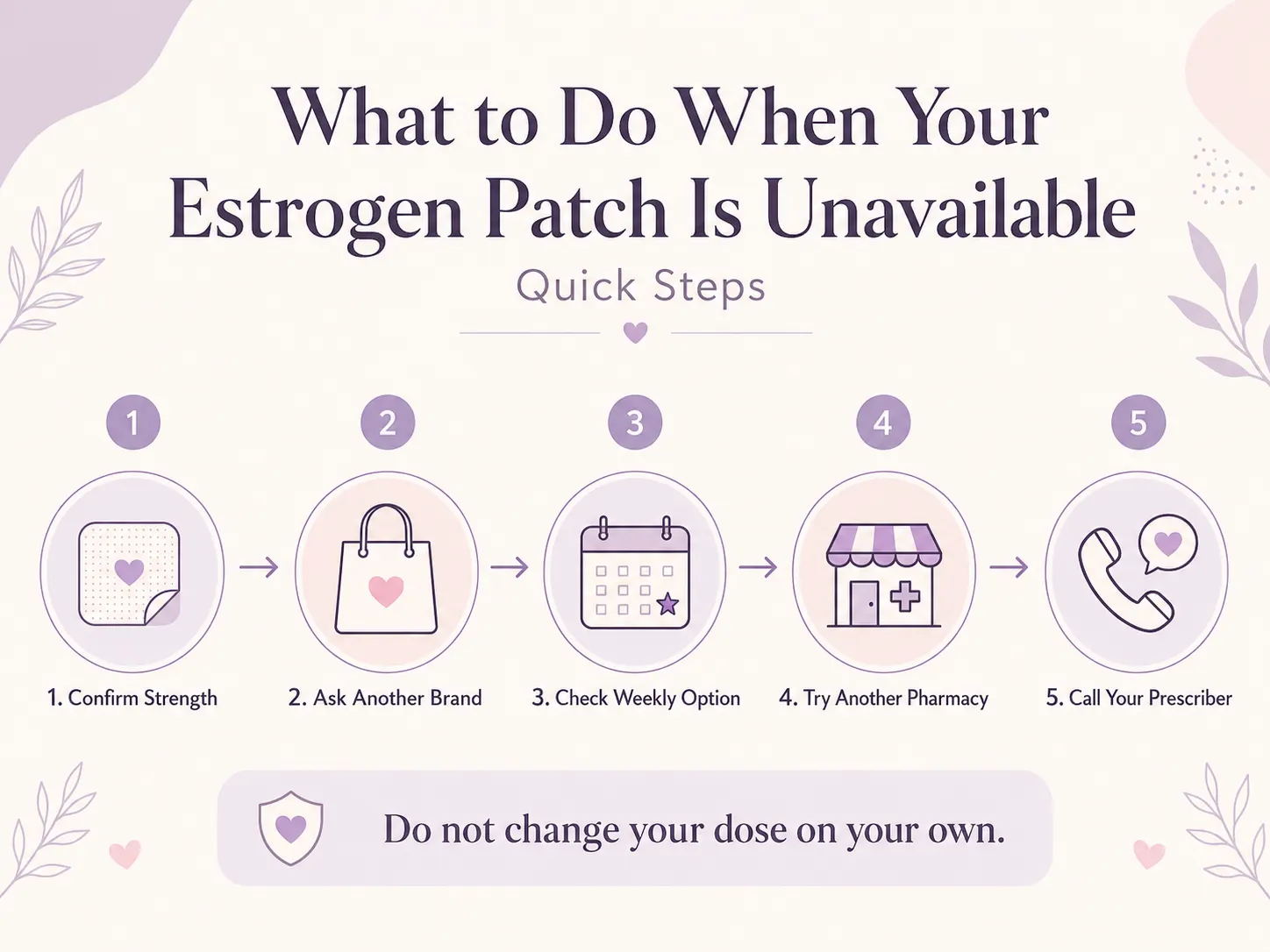
My first message is simple: do not change your hormone therapy on your own. Start by identifying the exact product, strength, schedule, and pharmacy problem. If transdermal estradiol has been working well, the solution may be as small as using the same strength from another manufacturer.
This guide follows the order I use in practice: confirm what is unavailable, try to preserve the current route when appropriate, compare alternatives, and then review the full estrogen/progestogen plan before making a change.
Estrogen Patch Shortage at a Glance: August 2026
|
Question
|
Answer
|
|
Is there still an estrogen patch shortage?
|
Yes. ASHP continues to list estradiol transdermal systems as a current shortage.
|
|
Are all patches unavailable?
|
No. Availability differs by manufacturer and strength.
|
|
Is FDA calling it a national shortage?
|
FDA and ASHP use different shortage criteria and reporting processes.
|
|
Why is this happening?
|
Demand has increased sharply while several manufacturers report back orders, allocation, or intermittent supply.
|
|
Should I stop my HRT?
|
Do not intentionally stop or alter therapy without speaking with your clinician.
|
|
Are there alternatives?
|
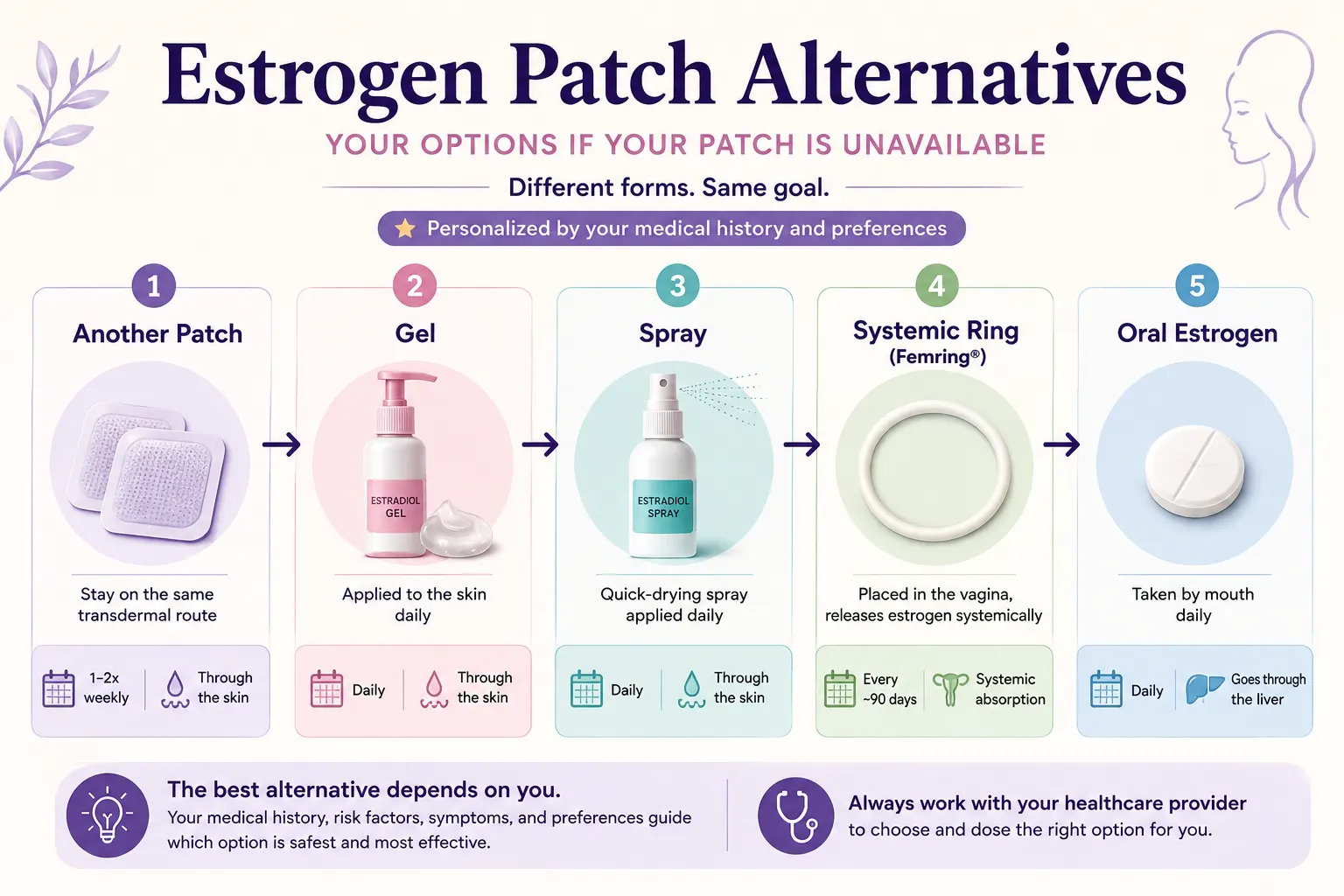
Yes. Another patch, gel, spray, systemic vaginal ring, or oral estrogen may be appropriate depending on your medical history.
|
Note: Supply Update — August 12, 2026
Availability can change quickly and may vary by patch strength, manufacturer, and pharmacy. Confirm your exact prescription with your pharmacist. The ASHP shortage bulletin was most recently updated on August 12, 2026.
Is There Still an Estrogen Patch Shortage in the U.S.?
Yes. ASHP continues to list estradiol transdermal systems as a current shortage. But a shortage does not mean every patch is unavailable everywhere. Specific strengths and manufacturers may be back-ordered while others remain available, and local pharmacy inventory can differ even within the same city.
Why Does ASHP Say “Shortage” When the FDA Doesn’t?
The FDA and ASHP use different definitions and reporting processes. FDA generally considers a drug in shortage when manufacturers cannot meet overall U.S. market demand. ASHP also evaluates supply disruptions reported at the healthcare-provider level and verifies shortage information with manufacturers. As a result, ASHP may list a shortage even when FDA does not.
For patients, the practical question is still local: can your pharmacy obtain your exact product and strength today?
Why Is There an Estrogen Patch Shortage?
Demand Rose Much Faster Than Supply
Demand for menopausal hormone therapy has risen substantially. Estrogen patch fills increased from roughly 594,000 in June 2024 to approximately 1.6 million in May 2026, according to HealthVerity data reported by CNBC.
Menopause Hormone Therapy Has Re-Entered the Conversation
Awareness of menopause care has expanded among patients and clinicians, and hormone therapy prescribing has broadened. FDA began revising long-standing menopause hormone therapy labeling in late 2025, and the first updated labels were approved in February 2026. Those changes removed boxed-warning statements related to cardiovascular disease, breast cancer, and probable dementia from affected products; the endometrial-cancer warning for systemic estrogen-alone therapy was not removed.
Demand continued to rise sharply during the same period, against a backdrop of increasing awareness of menopause treatment and broader prescribing of hormone therapy.
Patch Manufacturing Is Not Easy to Scale Quickly
Transdermal patches require specialized manufacturing. Expanding coating-line capacity takes time, and several manufacturers have reported back orders, allocation, or intermittent releases. Reuters has reported industry estimates suggesting that full supply stabilization could take an extended period. That is not a confirmed end date for any individual product.
Which Estradiol Patch Brands and Strengths Are Affected?
Availability is manufacturer- and strength-specific. The table below summarizes the status reflected in the ASHP bulletin updated August 12, 2026. It does not represent the stock at any individual pharmacy.
| Product / Manufacturer |
Reported Status |
| Dotti — Amneal |
0.0375 and 0.1 mg/24 hour twice-weekly patches back-ordered; no estimated release date. Other Dotti strengths listed as available. |
| Lyllana — Amneal |
Currently listed as available. |
| Climara — Bayer |
Once-weekly strengths listed as available. |
| Sandoz once-weekly estradiol |
0.0375 and 0.1 mg/24 hour back-ordered with no estimated release date; other presentations on allocation. |
| Noven / Grove estradiol |
All presentations on intermittent back order with weekly releases. |
| Zydus generic estradiol |
All presentations on allocation. |
| Viatris / Mylan generic estradiol |
One 0.05 mg/24 hour twice-weekly 8-count presentation intermittently back-ordered; other listed presentations available. |
Important: National shortage reporting and local inventory are not the same thing. Two pharmacies in the same city can have different stock on the same day. Confirm your exact strength, manufacturer, and package with the pharmacy.
Before You Change HRT: Ask Your Pharmacist These 6 Questions
Before assuming you need a different route, ask your pharmacist:
1. Is my exact strength unavailable, or is the entire product unavailable?
2. Can you fill the same prescribed strength from a different manufacturer?
3. Is an appropriate once-weekly or twice-weekly version available instead?
4. Can another location in your pharmacy network fill it?
5. Is mail order or a 90-day supply available through my insurance?
6. If my usual product cannot be obtained, what alternatives are actually in stock that my prescriber should know about?
That final question can save time because it gives your clinician a realistic list of fillable options instead of forcing repeated calls between the office and pharmacy.
What Can I Use Instead of an Estrogen Patch?
If transdermal estradiol is working well, I first try to preserve what is already working. The Menopause Society notes that blood-clot risk is higher with oral hormone therapy and may be lower with transdermal estrogen. The logical next step is often to determine whether the transdermal route can be maintained with another patch, gel, or spray before considering a change in route.
Option 1: Another Estradiol Patch
A different manufacturer, dosing schedule, or available strength may be the simplest bridge, under your clinician’s direction. A different manufacturer’s patch at an equivalent strength may be the simplest solution. Whether a new prescription is required depends on how the original prescription was written and applicable pharmacy substitution rules.
Option 2: Estradiol Gel
Gel keeps estrogen delivery transdermal and is generally applied daily. The main practical difference from a patch is application technique rather than route.
|
Gel application: Allow the gel to dry as directed and follow the specific product instructions regarding dressing, washing the application site, and avoiding skin-to-skin transfer. Contact precautions vary somewhat by product.
|
Option 3: Systemic Estrogen Vaginal Ring
A systemic vaginal ring can be a whole-body estrogen option, but it is important to distinguish systemic from local vaginal estrogen.
|
|
Femring
|
Estring
|
|
Type
|
Systemic
|
Local / low-dose
|
|
Treats hot flashes and night sweats?
|
Yes
|
No
|
|
Treats vaginal symptoms?
|
Yes
|
Yes
|
|
Potential substitute for systemic patch?
|
Potential option
|
No
|
Femring delivers systemic estrogen and can treat vasomotor symptoms such as hot flashes and night sweats. Estring, in contrast, is a low-dose local vaginal estrogen product.
Option 4: Estradiol Spray
Estradiol spray is another daily transdermal option.
|
Spray application: Estradiol spray is flammable until dry, so keep it away from open flames, cigarettes, and sparks during application and until the site has dried. Follow the product-specific instructions regarding skin contact; for Evamist, others should avoid contact with the application site for at least 30 minutes.
|
Option 5: Oral Estrogen
Oral estrogen is an effective and appropriate option for many women, but its risk profile differs from transdermal estrogen. Because oral estrogen undergoes first-pass liver metabolism, route selection should take your individual VTE, cardiovascular, liver, and other risk factors into account rather than defaulting to a pill simply because the patch is unavailable.
Other Options That May Come Up
• Combination estrogen/progestogen products may simplify a two-prescription regimen for selected patients.
• Conjugated estrogens combined with bazedoxifene can provide systemic estrogen with endometrial protection without a separate progestogen.
• Compounded hormone therapy is generally not my first-line response to a shortage when an appropriate FDA-approved alternative is available. Compounded products do not undergo the same FDA approval, standardization, and quality-control process as FDA-approved hormone therapies.
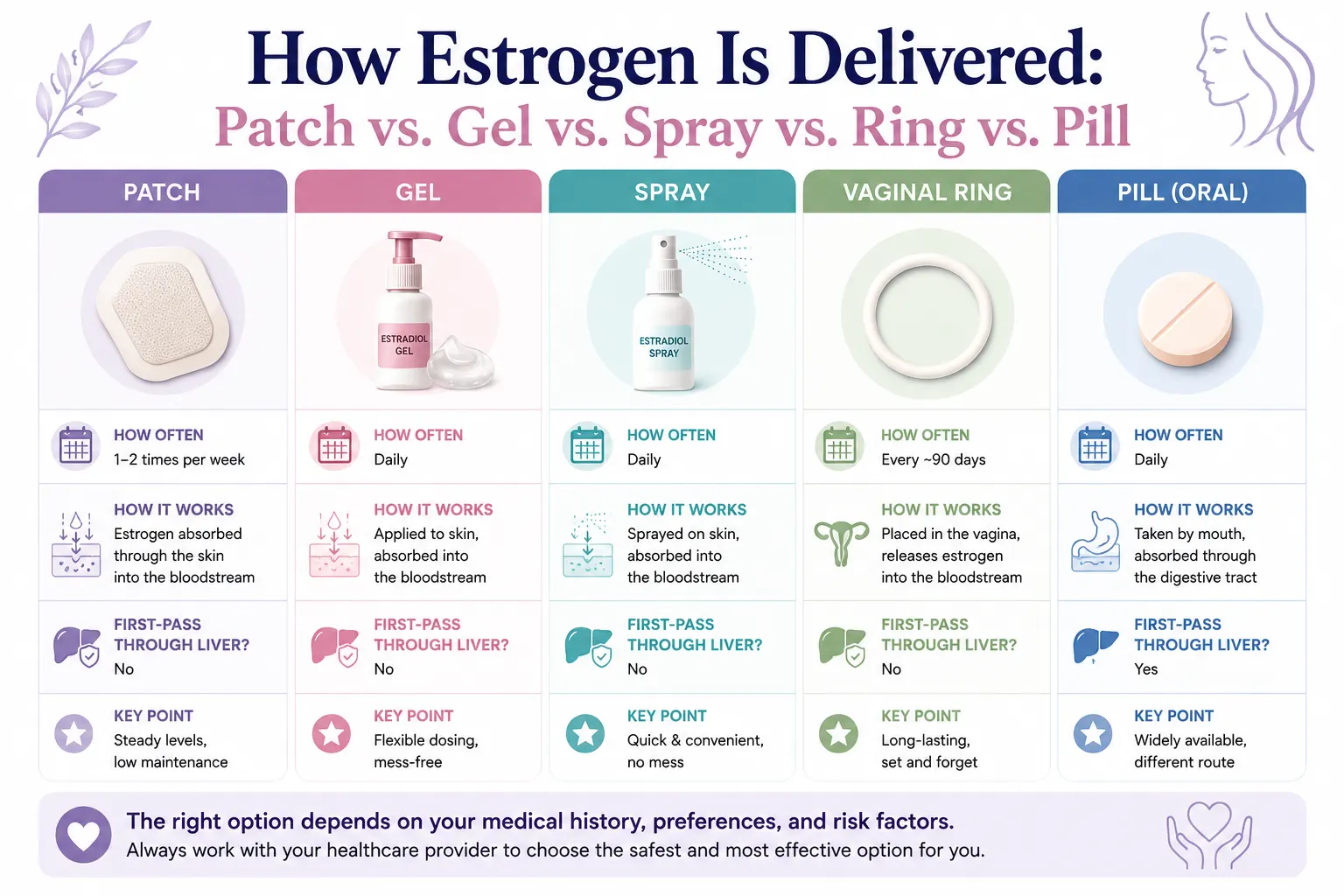
Patch vs. Gel vs. Spray vs. Ring vs. Pill: What Actually Changes?
|
Route
|
Frequency
|
Systemic?
|
First-pass liver?
|
Main practical consideration
|
|
Patch
|
1-2x/week
|
Yes
|
No
|
Adhesion, skin irritation, supply
|
|
Gel
|
Daily
|
Yes
|
No
|
Potential skin-to-skin transfer; product-specific application and contact precautions
|
|
Spray
|
Daily
|
Yes
|
No
|
Drying time, flammability until dry, product-specific contact precautions
|
|
Systemic ring
|
About every 90 days
|
Yes
|
No
|
Insertion, local tolerance, cost/coverage
|
|
Oral tablet
|
Daily
|
Yes
|
Yes
|
Requires more careful consideration in women with VTE or certain cardiovascular risk factors
|
Why You Shouldn’t Use an Online Dose Conversion by Yourself
A chart that claims a specific patch dose equals a fixed amount of gel, spray, ring, or oral estradiol can be misleading. Patches are labeled by delivery over time, gels and sprays have product-specific dosing systems, systemic rings release estrogen at different rates, oral estradiol is processed differently, and absorption can vary between formulations and between women.
|
Dr. Kashyap’s tip: When I switch a patient because a patch is unavailable, I do not simply match numbers on two packages. I review her current dose, symptoms, route, medical history, response to treatment, and whether the progestogen regimen also needs adjustment. The goal is appropriate symptom control and safe estrogen exposure, not identical package numbers.
|
The Progesterone Question Most Women Forget to Ask
If I Have a Uterus, Do I Still Need Progesterone?
For most women with a uterus who use systemic estrogen, adequate endometrial protection with a progestogen is required, regardless of whether estrogen is delivered by patch, gel, spray, ring, or pill. An exception is a regimen that provides endometrial protection another way, such as conjugated estrogens combined with bazedoxifene.
Does My Progesterone Dose Need to Change?
Not automatically, but the entire regimen should be reviewed when the estrogen product or exposure changes. Do not assume your current progesterone or progestin plan should stay identical without checking with your clinician.
|
Supply note: Some oral progesterone products have also experienced supply constraints reported by ASHP in 2026, although FDA has not designated progesterone as being in shortage. It is therefore worth confirming availability of both parts of your regimen when you call the pharmacy.
|
What NOT to Do When Your Estrogen Patch Is Running Out
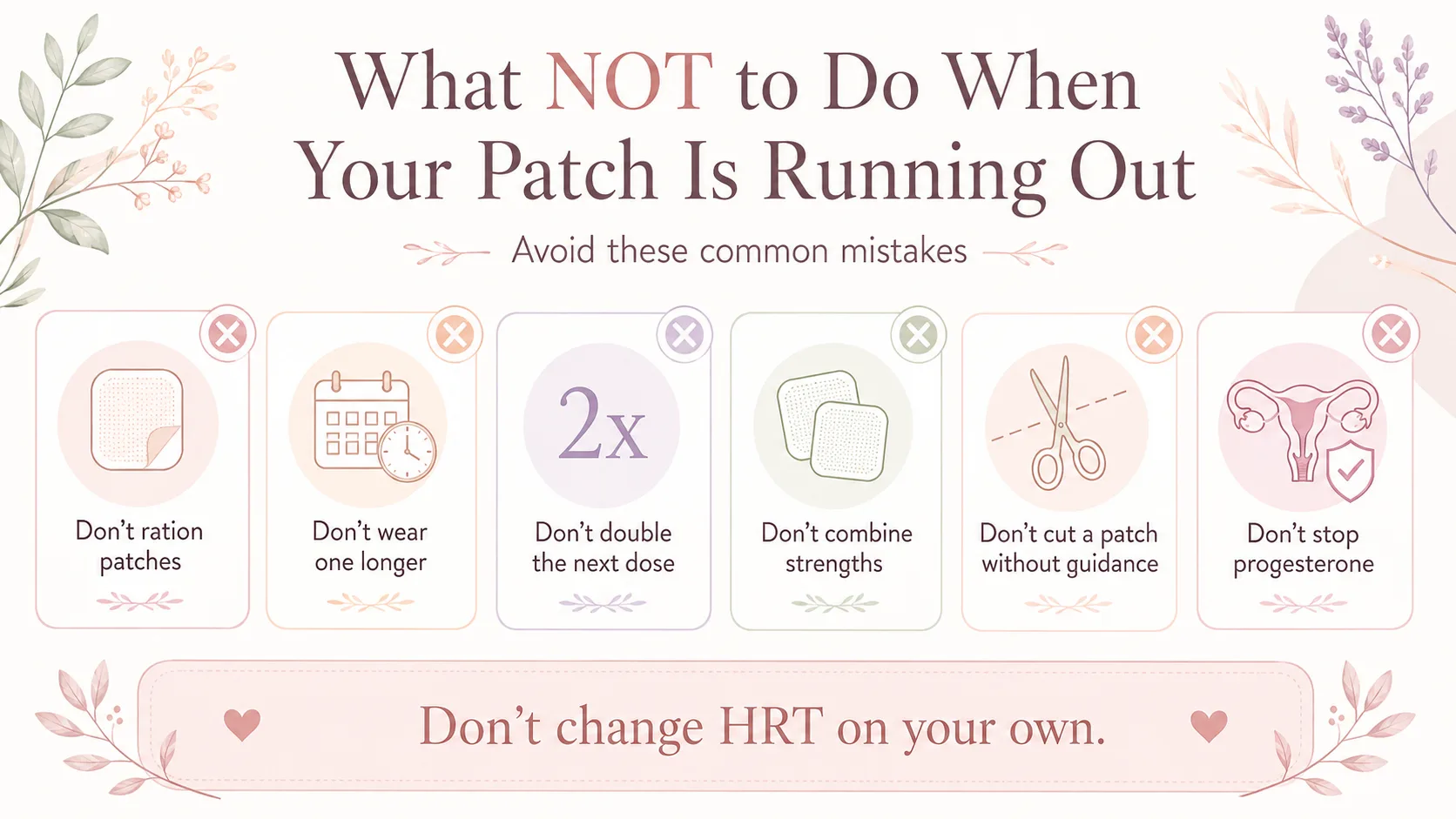
• Do not ration patches, extend wear time, double a later dose, or combine strengths unless your clinician specifically instructs you to do so.
• Do not cut an estradiol patch unless your clinician or pharmacist has confirmed that doing so is appropriate for that specific product. Cutting some patches can alter dose delivery.
• Do not borrow another person’s prescription.
• Do not stop prescribed progesterone or progestin on your own.
What Happens If I Miss a Patch or Run Out Completely?
If estrogen is interrupted, symptoms such as hot flashes, night sweats, and sleep disruption may return. How quickly this happens varies from person to person.
Missed-dose instructions depend on the specific product. A brief, planned bridge to another formulation is very different from an unplanned gap. Contacting your clinician and pharmacist early may help prevent an interruption in treatment.
Specific Shortage Questions Women Are Asking
Can I use two lower-dose patches to make up my usual dose?
Not on your own. Combining strengths should be directed by your clinician.
Can I cut an estrogen patch?
Do not cut an estradiol patch unless your clinician or pharmacist confirms that it is appropriate for your exact product. Cutting some patches can alter dose delivery.
Can I switch from a twice-weekly to a once-weekly patch?
Often, under your clinician’s direction. A different patch schedule may be one of the simplest ways to bridge a shortage.
Can my pharmacist substitute another brand?
Depending on how the prescription was written and applicable pharmacy rules, your pharmacist may be able to substitute an equivalent product within the same delivery method. Switching to a different route, such as from a patch to a gel, generally requires prescriber authorization.
Is low-dose vaginal estrogen enough if my systemic patch is unavailable?
Not if you mean low-dose local vaginal estrogen, such as Estring. It is intended to treat vaginal and urinary symptoms and should not be used as a substitute for systemic estrogen when treatment of hot flashes, night sweats, or another systemic indication is the goal.
What If the Alternative Feels Different?
After a formulation change, some women notice a return of vasomotor symptoms, breast tenderness, spotting or breakthrough bleeding, headache, bloating, changes in sleep, or application-site problems. Some adjustment can occur, but persistent or significant symptoms, concerning bleeding, clear intolerance, or poor symptom control should prompt follow-up rather than indefinite waiting.
Who Needs a More Careful Review Before Changing Route?
Please involve a clinician who knows your full medical history before changing therapy if you have any of the following:
• Unexplained vaginal bleeding
• A history of venous thromboembolism, stroke, or heart attack
• A personal history of breast cancer or another hormone-sensitive malignancy
• Significant liver disease
• Migraine with aura or other factors that may influence the safest estrogen dose or route
• A previous instruction to avoid systemic estrogen
• Uncertainty about why systemic hormone therapy was prescribed in the first place
The Insurance Problem Nobody Mentions Until the Prescription Is Rejected
Before changing prescriptions, ask whether the alternative is covered, whether prior authorization is required, whether another brand is preferred, whether the pharmacy can run a test claim, and whether mail order or a 90-day fill is allowed. A clinically reasonable substitute is not very useful if it cannot be filled or is unaffordable.
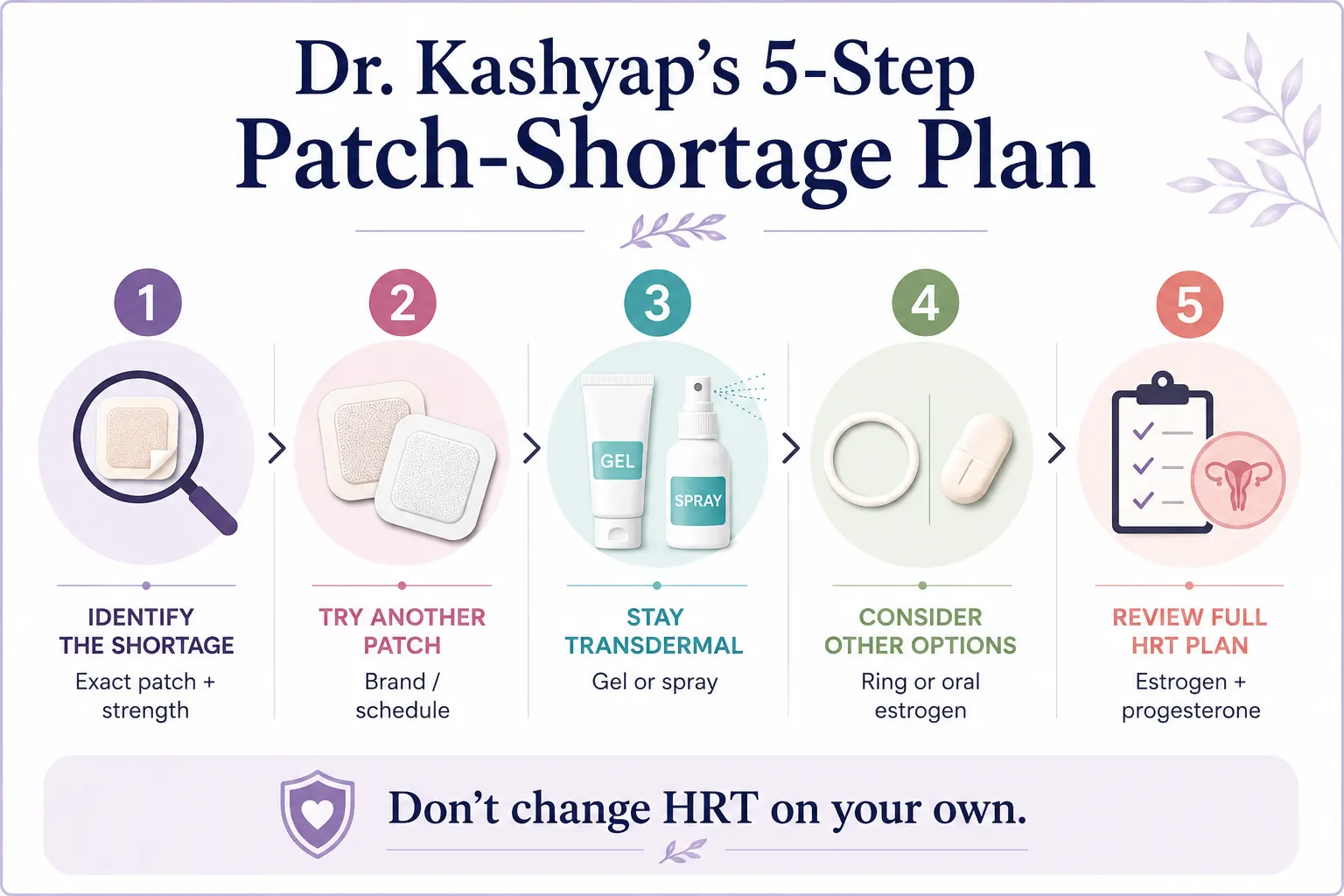
Dr. Kashyap’s Patch-Shortage Plan
1. Identify exactly what is unavailable: product, strength, schedule, and pharmacy.
2. Try another appropriate manufacturer or patch schedule before changing the route.
3. If a patch cannot be sourced, consider preserving the transdermal route with gel or spray.
4. Consider other systemic options, including a systemic ring or oral estrogen, when appropriate for your history.
5. Recheck the complete regimen: estrogen, endometrial protection when needed, symptoms, risks, insurance, and follow-up.
When Will the Estrogen Patch Shortage End?
There is no confirmed national end date. ASHP reports that some products are back-ordered without an estimated release date, while others are on allocation or being released intermittently. Reuters has cited industry estimates suggesting that broader stabilization could take a prolonged period, but that should not be read as a guaranteed timeline for any individual patch.
Key Terms
- Estrogen vs. estradiol: Estrogen is the hormone class; estradiol is the specific form delivered by most menopausal patches.
- HRT / MHT: Hormone replacement therapy / menopausal hormone therapy.
- Transdermal: Delivered through the skin, such as by patch, gel, or spray.
- Systemic: Circulates through the body rather than acting only at a local site.
- Local vaginal estrogen: Low-dose vaginal estrogen intended primarily for vaginal and urinary symptoms.
- First-pass metabolism: Liver processing that occurs after an oral medication is absorbed.
- Progestogen: Umbrella term for progesterone and progestins used for endometrial protection in appropriate regimens.
- Compounded hormone therapy: Custom-prepared hormone therapy that does not undergo the same FDA approval and standardization process as an FDA-approved product.
References
1. American Society of Health-System Pharmacists (ASHP). Drug Shortage Detail: Estradiol Transdermal System. Updated August 12, 2026.
2. U.S. Food and Drug Administration. FDA Approves Labeling Changes to Menopausal Hormone Therapy Products. February 12, 2026.
3. CNBC. “Estrogen patches are hard to find, and it may not be resolved any time soon.” June 26, 2026.
4. NBC News. “FDA claims there’s no estrogen patch shortage as women struggle to get prescriptions filled.” May 11, 2026.
5. Reuters, via AOL. “Patients scramble to find estrogen patches as shortage worsens.” April 2026.
6. Reuters. “US progesterone supplies tighten as menopause treatment demand grows.” June 17, 2026.
7. The Menopause Society. Hormone Therapy: benefits, risks, and route considerations.
8. U.S. Food and Drug Administration. Evamist (estradiol transdermal spray) and estradiol gel prescribing information.
Medical disclaimer: This article is for educational purposes and is not a substitute for personalized medical advice. Every woman’s history and risk factors differ. Talk with your physician or a clinician experienced in menopause care before changing hormone therapy.



 Meet Your Doctor


 03 Jul, 2026
 10:13 AM




Leave a Comment