When Does Menopause Start?
“My mom went through menopause at 48. Does that mean I will too?”
I hear this often from women in their late 30s or early 40s, usually after a cycle, sleep pattern, or symptom suddenly feels unfamiliar. Family history genuinely matters, but it is rarely the whole answer.
The most important distinction to make at the outset is this: perimenopause is the transition that begins first, often years before anything is “official.” Menopause itself is a single point, your final menstrual period and it can be identified only retrospectively, after 12 consecutive months without any further bleeding or spotting. Much of the confusion around “when menopause starts” comes from using one word for both.
So when people ask when menopause “starts,” they’re usually really asking about perimenopause , when the body begins changing. This guide covers when that transition usually begins, the average age of the final period, the factors that shift timing, what early menopause and POI mean, and how to estimate your own timeline.
|
If you want the broader picture of what menopause is, its stages, symptoms, and treatment options, our complete guide What Is Menopause?
|
The Menopause Timeline at a Glance
| Stage |
Typical Timing |
What It Means |
| Perimenopause begins |
Usually mid-40s; sometimes late 30s or early 40s |
Ovarian hormone patterns and ovulation become variable; cycles or symptoms may change |
| Symptoms may begin |
Several years before the final period |
Cycle changes, hot flashes, sleep disruption, mood or vaginal/urinary changes may appear |
| Menopause (final period) |
Average 51–52; most women between 45 and 55 |
Confirmed only in hindsight, after 12 months without bleeding or spotting |
| Early menopause |
Ages 40–44 |
Permanent natural menopause earlier than average; deserves individualized evaluation |
| Primary ovarian insufficiency |
Before age 40 |
Reduced or intermittent ovarian activity requiring medical assessment |
| Later menopause |
After age 55 |
Less common; any postmenopausal bleeding still requires evaluation |
When Does the Transition Usually Begin?
Most articles answer with a single average age and stop there , but that flattens three genuinely different moments into one. Separating them is what actually helps you place yourself:
- When hormonal changes begin — during perimenopause, often years before anything feels obviously different.
- When symptoms begin — sometimes before periods become clearly irregular; subtle cycle changes, sleep disruption, mood changes, or hot flashes may be early clues.
- When menopause is officially reached — only in hindsight, after 12 consecutive months without bleeding or spotting.
These timelines can be years apart for the same woman, and that gap , between when the body starts changing and when it’s ‘official’ , is where most of the confusion, and most of the underdiagnosis, happens.
|
Dr. Kashyap’s Insight
The question I’d rather answer than “what’s the average” is “what’s likely for you.” Averages describe a population; they don’t describe your ovaries. Your family history, your health history, and the pattern of changes you’re already noticing tell me far more than a national average ever will.
|
If hot flashes and night sweats are among your first changes, our dedicated guide explains common triggers, duration, and treatment options.
Perimenopause: the transition itself
-
Usually begins during the mid-40s, though some women notice changes in their late 30s or early 40s
-
Estrogen and progesterone don’t decline smoothly, they fluctuate, sometimes sharply. These hormonal changes can contribute to many of the noticeable symptoms.
-
Usually lasts 4 to 8 years, though it can run shorter or considerably longer
-
The clearest early sign is a change in your cycle: closer together, farther apart, heavier, lighter, or skipped entirely
-
Can affect sleep, mood, cognition, and vaginal and urinary health , not only menstrual cycles
Why sleep and mood changes may appear early
Hormonal shifts may play a role in sleep and mood changes even before hot flashes appear, though this is a multifactorial picture rather than a single settled mechanism. These symptoms do not, on their own, diagnose perimenopause: hormonal variability, hot flashes, aging, caregiving stress, alcohol, thyroid disease, sleep apnea, and pre-existing mood vulnerability may all contribute, and other causes must be considered.
|
Dr. Kashyap’s Insight
When a woman in her late 30s or early 40s tells me she’s suddenly anxious in a way she’s never been, or waking at 3 a.m. for no clear reason, I consider hormonal change as one possible contributor while also evaluating other causes , rather than assuming it’s automatically hormonal or automatically unrelated.
|
Menopause and the years after
Menopause is your final menstrual period, confirmed retrospectively once 12 months pass without bleeding or spotting (average age 51–52 in the U.S.). You only know you’ve reached it after the fact. If bleeding restarts after several months without a period, the 12-month clock resets.
In the postmenopausal years that follow, many of the more disruptive perimenopausal symptoms (like unpredictable cycles) resolve. Vaginal dryness may persist or emerge later, while bone loss may accelerate and requires attention, bone loss is generally silent and is a health consequence to monitor, not a symptom you feel. Long-term priorities shift toward bone, heart, and metabolic health.
Why Does Menopause Happen?
Menopause happens because the ovaries gradually have fewer functioning follicles and ovulate less consistently. As ovarian activity changes, estrogen and progesterone production becomes more variable and eventually stays low enough that menstrual cycles permanently stop.
This is a normal part of reproductive aging, not a disease. Timing is influenced strongly by genetics and may also be affected by smoking, ovarian surgery, chemotherapy, pelvic radiation, and some genetic or autoimmune conditions. Surgical removal of both ovaries causes menopause immediately rather than through a gradual transition.
What Age Does Menopause Start? A Breakdown by Decade
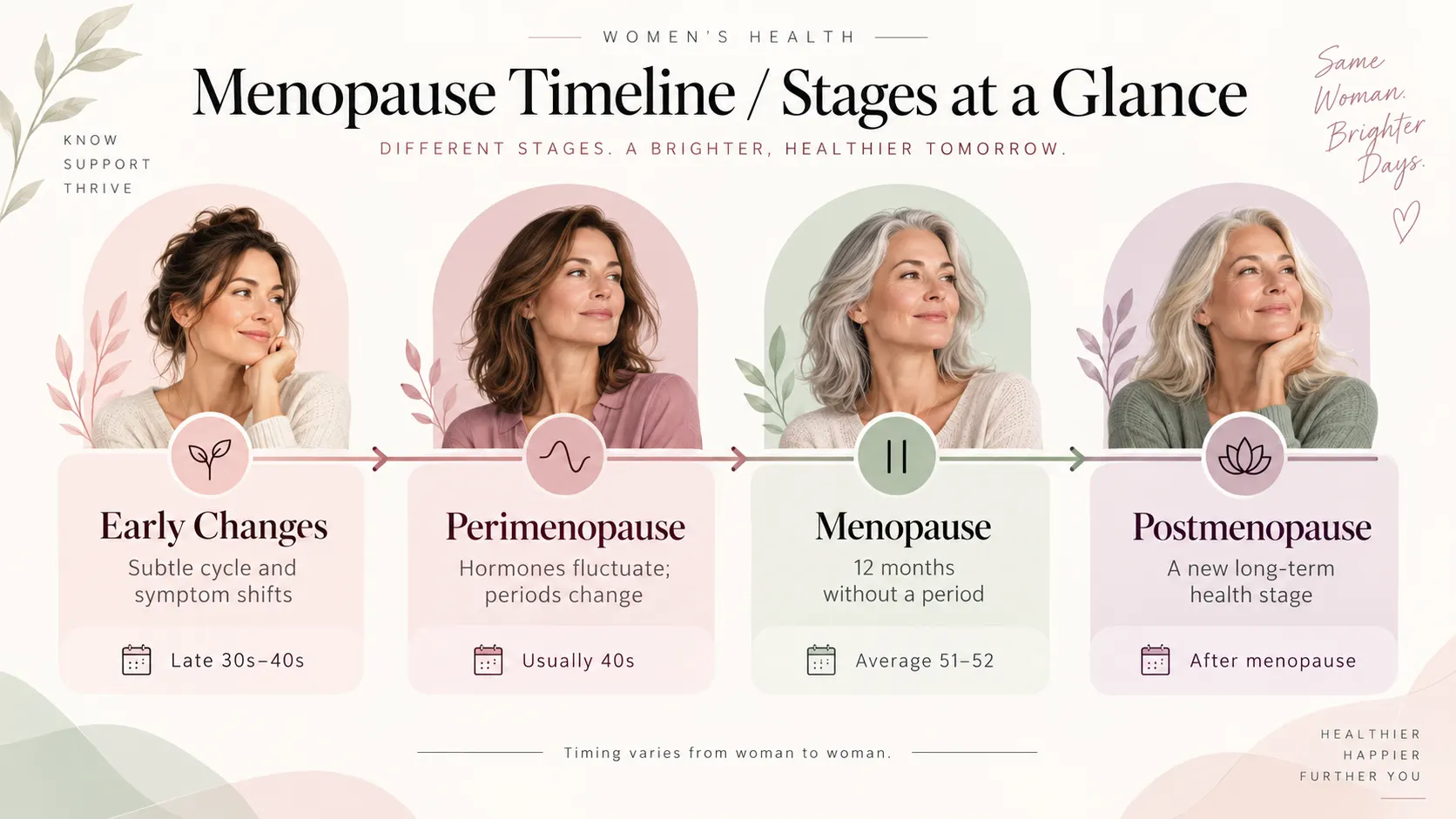
The average age is useful, but your age, cycle pattern, symptoms, family history, and health history together determine what is typical , and what deserves a closer look , for you.
In your late 30s
Possible, but this is the age when I look carefully for other explanations before concluding perimenopause. Pregnancy, thyroid disorders, high prolactin, medication effects, hypothalamic causes (from stress, weight change, or over-exercise), and primary ovarian insufficiency should be ruled out first. A cycle change alone at this age is a reason to look closer , not to assume the worst, and not to dismiss it.
Ages 40 to 44
Perimenopause can begin naturally in this range. If periods stop completely for 12 months during this window, that is classified as early menopause and deserves a real evaluation, not just reassurance.
Ages 45 to 49
The most common period for noticeable cycle variability and classic perimenopause symptoms. Other causes such as thyroid disease can still overlap and should be considered when the picture is atypical.
Ages 50 to 52
Where the U.S. average sits, and where most women actually reach their final period. Symptoms may have already been present for several years by this point.
After age 55
Later natural menopause can and does occur. Any bleeding after menopause, at this age or any other, requires prompt evaluation and should never be assumed to be ‘just late perimenopause.’
What Can Offer Clues About Your Timing?
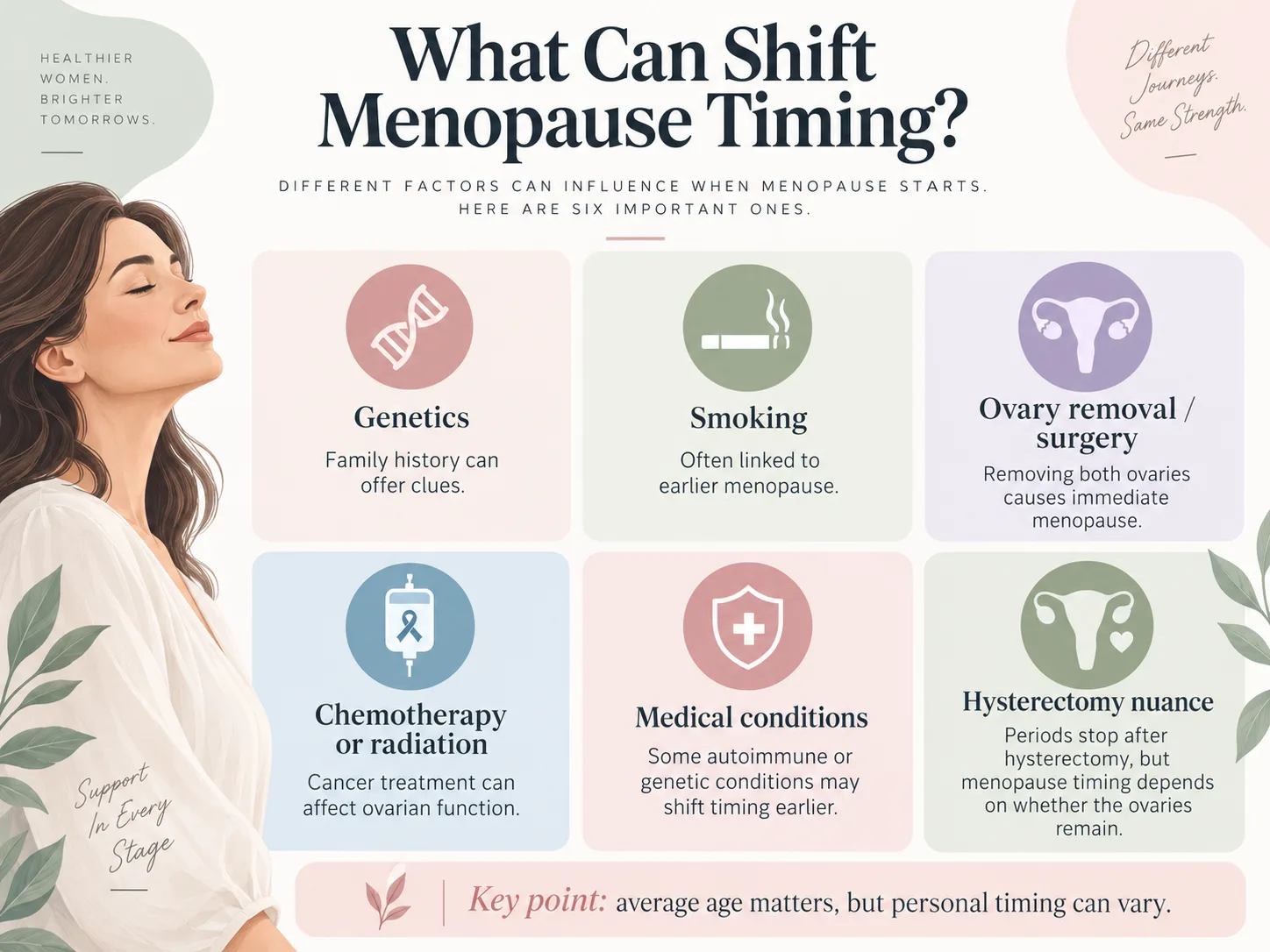
The strongest practical clue: family history
Ask your mother, or an older sister, what age she was at menopause. Timing is substantially influenced by genetics, and mother-daughter studies show meaningful heritability, so this offers a broad estimate. It is not a countdown clock , your own final period may occur several years earlier or later than hers. Family history is a useful clue to bring to a conversation with your provider, not a number to plan your calendar around.
Factors linked to earlier menopause
| Factor |
Why It Shifts Timing Earlier |
| Smoking |
Chemicals in cigarette smoke are directly toxic to ovarian follicles; smokers reach menopause roughly 1–2 years earlier on average |
| Family history of early menopause |
Genetics influence ovarian reserve and the rate at which it declines |
| Nulliparity (never having given birth) |
Associated with earlier menopause in observational studies, but the effect is modest and not deterministic |
| Chemotherapy or pelvic radiation |
Can directly damage ovarian tissue, sometimes causing immediate or accelerated menopause |
| Removal of both ovaries |
Causes immediate surgical menopause because both principal sources of ovarian hormones are removed |
| Certain autoimmune conditions |
Can lead the immune system to affect ovarian tissue, contributing to earlier ovarian insufficiency |
| Some chromosomal or genetic conditions |
For example, Turner syndrome or an FMR1 premutation can meaningfully increase the risk of POI |
Factors associated with later menopause
-
A family history of later menopause, in the same way earlier menopause runs in families
-
Higher body mass index has shown a modest association with later menopause in some studies, though the evidence is inconsistent; this should not be read as a protective effect of excess weight
-
Later menarche and having given birth have been associated with somewhat later natural menopause in population studies , observational associations, not individual predictors
|
Dr. Kashyap’s Practical Tip
When a new patient asks me to estimate her timeline, I ask three questions first: What age were your mother or maternal relatives at menopause? Do you smoke, or have you smoked? Have you had any ovarian surgery, chemotherapy, or radiation?
These give useful context , but none of them, alone or together, can predict the exact date of menopause.
|
Early Menopause and Primary Ovarian Insufficiency Before Age 40
Not all early timing is the same, and the distinction matters for how it should be evaluated.
Early menopause: ages 40 to 44
• Slightly higher lifetime risk of osteoporosis and cardiovascular disease due to more years spent with lower estrogen
• Often runs in families, and can also follow smoking, certain medical treatments, or ovarian surgery
• Evaluation is individualized and generally less extensive than a full POI workup, but the diagnosis should still trigger a discussion of symptoms, fertility, bone health, cardiovascular risk, and hormone therapy. In the absence of contraindications, hormone therapy is generally recommended or strongly considered until approximately the usual age of natural menopause, given the bone and cardiovascular implications of early estrogen loss.
Primary ovarian insufficiency (POI): before age 40
• Absent or irregular periods before 40 deserve evaluation; prevalence varies by population, but the important point is that this should not be dismissed
• Evaluation includes FSH testing; repeat testing may be appropriate when the diagnosis remains uncertain. It may also include pregnancy testing, thyroid function, prolactin, and selected genetic or autoimmune assessment based on the clinical history.
• Hormone therapy is generally recommended for women with POI until the usual age of natural menopause when no contraindication exists , for long-term health protection, not only symptom relief
• “You are too young for menopause” is not a complete evaluation. If periods stop or become persistently irregular before 40, ask for a proper assessment
|
An Important Distinction
POI is not always equivalent to permanent menopause. In natural menopause, ovarian follicular activity has declined to the point that cycles permanently cease.
With nonsurgical POI, ovarian activity may be intermittent, and natural conception remains possible for some women, though the overall likelihood is reduced. Contraception is still needed when pregnancy is not desired.
|
What About Menopause After Age 55?
Menopause after 55 is less common. In observational research, later menopause has been associated with lower risks of osteoporosis and fracture, while longer lifetime exposure to endogenous estrogen has been associated with higher risks of some estrogen-sensitive cancers. These associations do not make later menopause inherently healthy or unhealthy.
• Continue age- and risk-appropriate breast and cervical cancer screening, and seek evaluation for any abnormal bleeding.
• Later menopause on its own is not usually a red flag , but any bleeding after 12 months without a period requires evaluation at any age
Your Period Pattern May Be the Earliest Clue
“Periods become irregular” is accurate but not very specific. The STRAW+10 framework describes measurable cycle patterns that help clinicians stage reproductive aging more precisely.
• A persistent difference of seven or more days in the length of consecutive cycles , often the earliest measurable sign
• Cycles may initially become shorter before longer gaps appear, an easy pattern to miss if you’re only watching for longer gaps
• Heavier or longer bleeding than your usual pattern
• Skipped cycles , one or more months with no period at all
• A gap of 60 days or longer without a period, which suggests the later stage of the transition, closer to your final period
|
But Don’t Assume
Unusual bleeding should not automatically be chalked up to perimenopause. Pregnancy, fibroids, polyps, thyroid conditions, and endometrial problems can all cause similar changes, and some need their own specific treatment. A pattern that fits the STRAW+10 picture is a useful clue, not a self-diagnosis.
|
Can Birth Control Hide When Menopause Starts?
Yes. Hormonal contraception may suppress ovulation, alter bleeding, and reduce or mask some symptoms, depending on the method , different methods work differently and not all provide a steady combined hormone dose.
• A lack of periods while using hormonal contraception does not, by itself, confirm you’ve reached menopause
• Pregnancy can still occur during perimenopause, even with irregular cycles, so contraception is not optional at this stage if you don’t want to conceive
• Don’t stop contraception solely because you assume menopause has started , talk to your provider about how and when to confirm it
When Does Menopause Start After Hysterectomy or Ovary Removal?
Removing your uterus does not automatically mean you’ve reached menopause.
Uterus removed, ovaries retained
• Periods stop immediately, but if your ovaries are left in place, they can continue producing hormones on their own timeline
• You may still experience natural perimenopause and menopause , you just won’t have periods to mark the transition. Menopause may also occur somewhat earlier than average after hysterectomy even when the ovaries are retained.
Both ovaries removed (bilateral oophorectomy)
• Causes immediate surgical menopause regardless of age; hormone levels drop abruptly, which often makes symptoms more sudden and intense than natural menopause
• This is an important conversation to have before surgery, not after, whenever planning ahead is medically possible
One ovary removed
• The remaining ovary usually continues functioning, although menopause may occur somewhat earlier on average.
Can a Test Tell What Age Menopause Will Start?
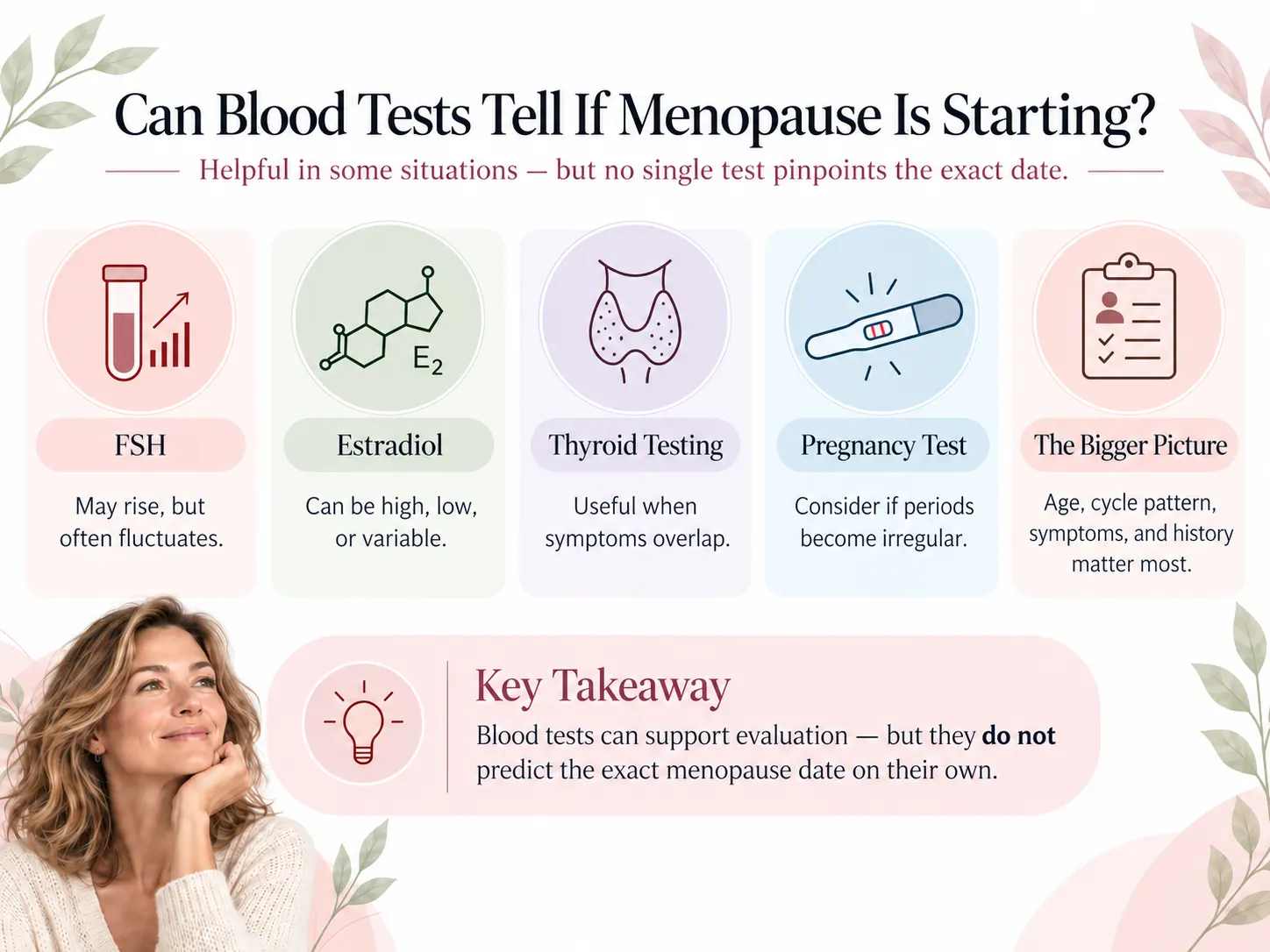
Not precisely , which surprises many patients who assume there’s a simple blood test for it.
FSH (follicle-stimulating hormone)
• Highly variable across the cycle and even day to day during perimenopause
• A single ‘normal’ or ‘elevated’ result doesn’t reliably confirm or rule out perimenopause on its own
• Most useful alongside your symptom and cycle history, not as a stand-alone answer
AMH (anti-Müllerian hormone)
• Correlates with ovarian reserve; very low or undetectable levels are associated with menopause in the coming years
• ACOG and other major bodies do not recommend routine AMH testing to pinpoint an exact menopause date in women who aren’t having fertility concerns
• AMH is more established for estimating ovarian response during fertility treatment than for predicting menopause or natural fertility
For most women 45 or older with a typical symptom and cycle pattern, perimenopause is assessed clinically rather than through routine hormone testing. Testing becomes more useful when symptoms occur before 45 (especially before 40), when bleeding is atypical, or when pregnancy, thyroid disease, high prolactin, or another condition is possible. After hysterectomy, testing may sometimes help assessment when menstrual patterns are unavailable, but no single result precisely dates menopause.
Most at-home menopause tests measure urinary FSH. They may show FSH is elevated at one moment, but they cannot reliably confirm the stage of perimenopause or predict the date of the final period. Treat the result as a reason to speak with your clinician, not as a menopause calendar.
How Will I Know the Transition Is Starting?
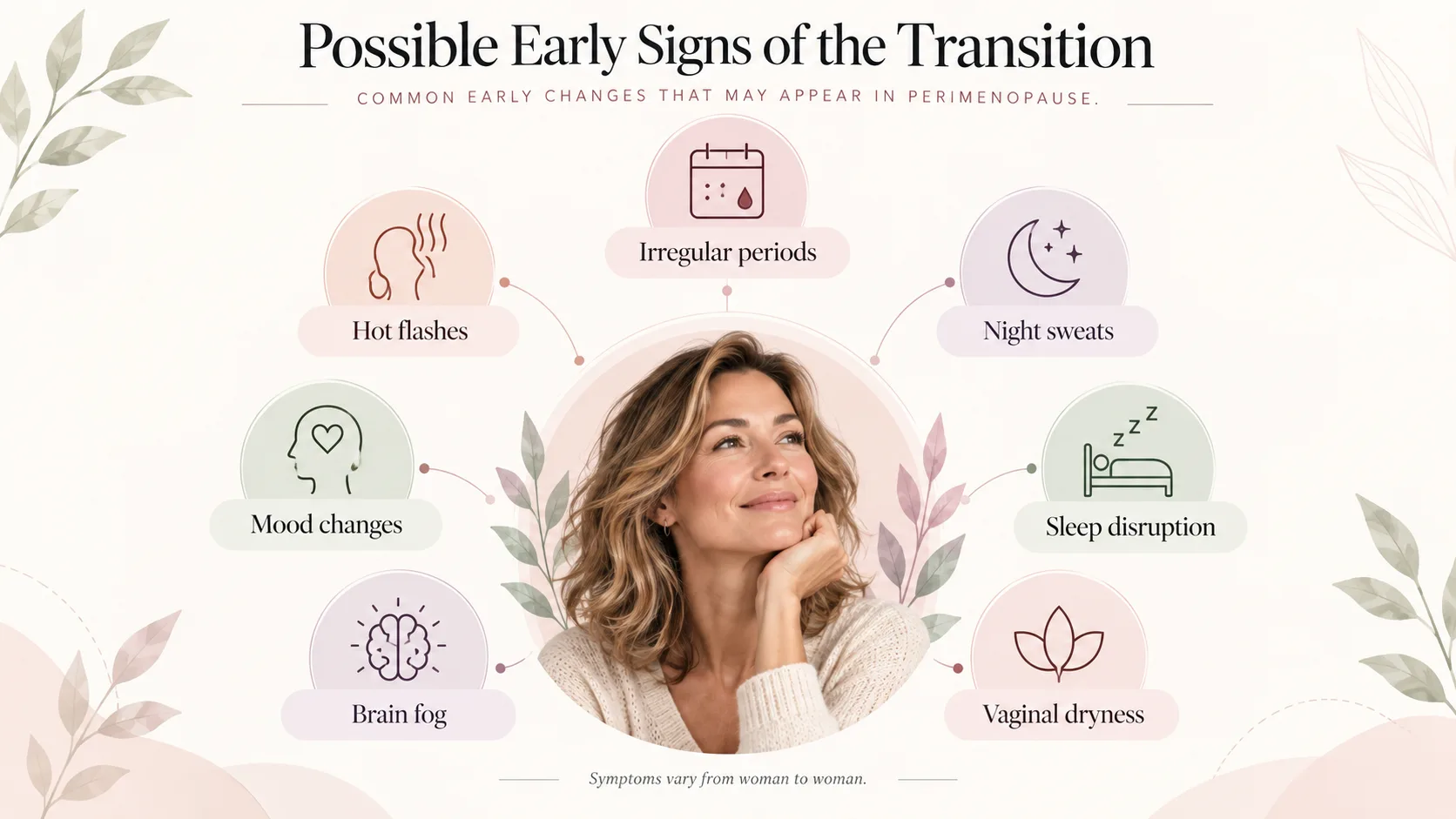
Possible symptoms during the transition include the following. These are nonspecific and cannot establish the diagnosis by themselves:
• Cycle length changes
• Stronger PMS-like symptoms than you’re used to
• New waking at 2 or 3 a.m.
• Anxiety or noticeably reduced stress resilience
• Night sweats
• Brain fog
• Headaches or migraines changing in pattern
• Vaginal dryness
• Urinary changes
• Reduced sexual comfort or desire
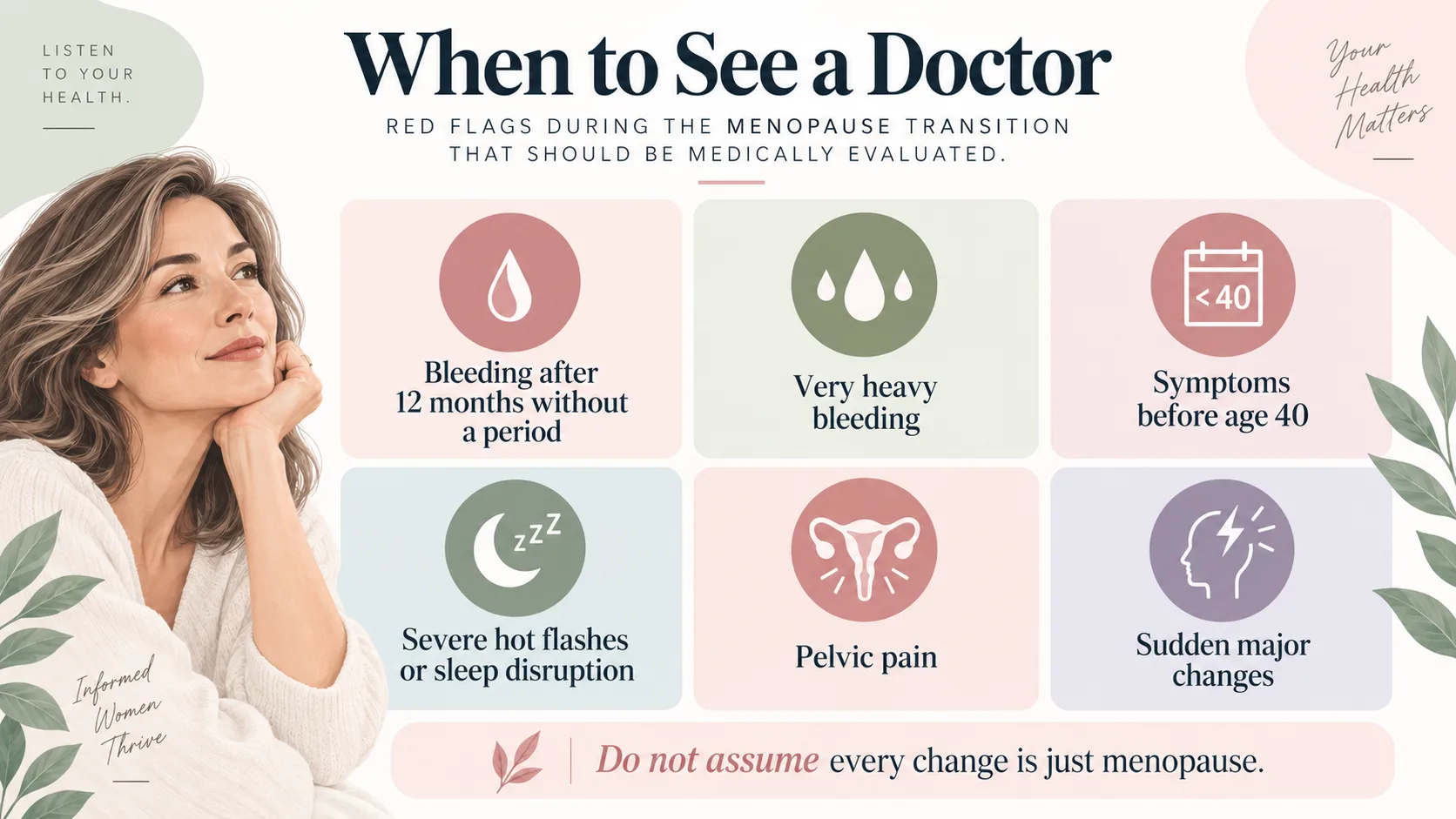
Red Flags: Do Not Assume It Is ‘Just Menopause’
Most changes during this transition are normal. Some aren’t, and shouldn’t be waved off as hormonal without a look.
|
Seek Evaluation For
Bleeding after 12 months without a period; extremely heavy or unusually long bleeding; bleeding after sex; new pelvic pain or pressure; persistent bloating or early fullness; unexplained weight loss; periods stopping before age 40; or severe mood symptoms.
New, persistent, or concerning palpitations , particularly with chest pain, fainting, marked breathlessness, or with exertion , require medical assessment and are not primarily a gynecologic symptom.
|
Bleeding after menopause , any bleeding or spotting after 12 consecutive months without a period , should be evaluated rather than assumed to be part of the normal transition.
Can Treatment Start Before Menopause?
Yes. You don’t need to wait for 12 months without a period, or until symptoms become unbearable, before receiving care. Depending on the cause and your health history, perimenopause care may include sleep and stress support, resistance and weight-bearing exercise, nutrition and metabolic evaluation, contraceptive options (which can also manage bleeding and symptoms), menopausal hormone therapy when appropriate, nonhormonal prescription options, vaginal moisturizers and local vaginal hormonal treatment, and evaluation for overlapping thyroid, gynecologic, or mental-health conditions. Our Menopause Treatment: A Comprehensive Personalized Guide covers these options and individualized decision-making in depth.
When to See a Doctor About Menopause Timing
• Your periods stop before age 40 , this warrants a full evaluation, not reassurance alone
• Your periods stop between 40 and 45 and you want to understand whether it’s early menopause or something else
• You have any bleeding after 12 full months without a period, at any age
• Perimenopause symptoms are disrupting your sleep, work, or daily life, regardless of age
• You’re planning a pregnancy and want a realistic sense of your reproductive timeline
The Bottom Line: Menopause Is a Timeline, Not a Birthday
Menopause does not begin on one universal birthday. For many women, the transition starts quietly , with a shorter cycle, disrupted sleep, hot flashes, greater anxiety, vaginal changes, or the feeling that the body is responding differently than before. You do not need to wait for periods to stop, or symptoms to become unbearable, before asking for help.
| If you’re in the Henderson or Las Vegas Valley area and want a personalized look at where you actually stand , explore our personalized menopause care at Galleria Women’s Health. We can review your history, symptoms, cycle changes, and next steps together. |
References and Further Reading
1. The Menopause Society. Menopause Symptoms.
2. The Menopause Society. Perimenopause.
3. National Institute on Aging. What Is Menopause?
4. Harlow SD, Gass M, Hall JE, et al. Executive Summary of the Stages of Reproductive Aging Workshop +10 (STRAW+10). 2012.
5. American Society for Reproductive Medicine, ESHRE, International Menopause Society, et al. Evidence-Based Guideline: Premature Ovarian Insufficiency. 2024.
6. American College of Obstetricians and Gynecologists. Do I Need Hormone-Level Testing During Perimenopause?
7. American College of Obstetricians and Gynecologists. The Use of Antimüllerian Hormone in Women Not Seeking Fertility Care. 2019.
8. U.S. Food and Drug Administration. Menopause Home-Use Tests.
9. American College of Obstetricians and Gynecologists. Perimenopausal Bleeding and Bleeding After Menopause.
10. Office on Women’s Health, U.S. Department of Health and Human Services. Menopause Basics.
11. Roman Lay AA, et al. Reproductive Factors and Age at Natural Menopause: A Systematic Review and Meta-Analysis. 2020.
12. Depmann M, et al. Can We Predict Age at Natural Menopause Using Ovarian Reserve Tests or Mother’s Age at Menopause? A Systematic Review. 2015.
| Term |
English Definition |
| Perimenopause |
The transition leading up to menopause, marked by fluctuating (not just declining) estrogen and progesterone |
| Menopause |
Your final menstrual period, identified retrospectively after 12 consecutive months without further bleeding or spotting |
| Postmenopause |
The stage following the final menstrual period |
| Early menopause |
Natural menopause occurring before age 45 |
| Primary ovarian insufficiency (POI) |
Reduced or intermittent ovarian activity before age 40; not always permanent menopause |
| Surgical menopause |
Immediate menopause caused by removal of both ovaries (bilateral oophorectomy), regardless of age |
| Vasomotor symptoms |
The clinical term for hot flashes and night sweats |
| Genitourinary syndrome of menopause (GSM) |
Vaginal and urinary changes — dryness, irritation, urgency — caused by declining estrogen |
| FSH (Follicle-Stimulating Hormone) |
A pituitary hormone that rises as ovarian estrogen declines; highly variable during perimenopause |
| AMH (Anti-Müllerian Hormone) |
A hormone reflecting remaining ovarian reserve; generally declines with age but varies substantially among women and is not precise enough for routine menopause-date prediction |
This article is for educational purposes and does not replace individualized medical evaluation, diagnosis, or treatment. Menopause timing and symptoms should be discussed with a qualified healthcare professional who can review your personal and family history, symptoms, medications, reproductive goals, and any indicated testing.



 Meet Your Doctor


 03 Jul, 2026
 10:13 AM


Leave a Comment