What Is Perimenopause? Understanding the Changes You’re Noticing
Perhaps your period has become less predictable. A cycle that once arrived like clockwork now comes early, then late. Or your periods seem unchanged, but you are waking at night, feeling unusually warm or noticing vaginal dryness. It is reasonable to wonder: “Could this be perimenopause,even if I am still having periods?”
Possibly. Perimenopause often begins while periods are still occurring, but not every change means the transition has started. Ovulation and hormone patterns gradually become less predictable, which may affect cycles and symptoms. The aim is not to label everything as hormonal; it is to understand what fits your experience and what deserves a closer look.
When I assess these changes, I begin with your usual menstrual pattern: what has changed, when it began, and how it affects your daily life. I also consider pregnancy, contraception, medications and medical conditions that can cause similar symptoms.
QUICK ANSWER | What Is Perimenopause?
Perimenopause is the transition surrounding the final natural menstrual period. Ovarian follicle activity, ovulation and hormone production become more variable; periods may change and symptoms can occur. Menopause is identified retrospectively after 12 consecutive months without natural menstrual bleeding, provided there is no other explanation. Perimenopause is not synonymous with menopause, a single low estrogen reading, or infertility. [1–3]
|
In everyday use, perimenopause usually refers to the years before the final period; in the STRAW+10 framework it also includes the first 12 months after.
AM I IN PERIMENOPAUSE? | A practical self-check
Use these questions to organize what you have noticed before an appointment. They are not a diagnostic test, and you do not need to match every item to be evaluated.
- My periods are noticeably shorter, longer or less predictable than my established pattern.
- I have skipped a period or had a long gap, then started bleeding again.
- I am in my 40s or older, when the transition becomes more likely.
- I have new hot flashes, night sweats or sleep disruption that seems temperature-related.
- I notice new vaginal dryness, discomfort with sex or urinary symptoms.
- My sleep, mood or concentration has changed alongside menstrual changes.
- I use hormonal birth control, a hormonal IUD or have had uterine surgery that may hide cycle clues.
HOW TO READ THIS CHECKLIST
Several cycle and symptom clues in your mid-to-late 40s make perimenopause a reasonable possibility. I also check for pregnancy, bleeding concerns and other explanations. Symptoms alone are less specific than a persistent change in your usual cycle pattern.
Under 40, absent periods or menopausal-type symptoms should not automatically be labeled perimenopause; primary ovarian insufficiency and other causes may need assessment. A normal hormone result does not rule out the transition.
WHEN TO GET CHECKED
Bleeding between periods, after sex, unusually heavy or prolonged bleeding, and any bleeding after confirmed menopause deserve medical assessment. Very heavy bleeding accompanied by fainting, marked weakness, chest pain or shortness of breath needs urgent care.
|
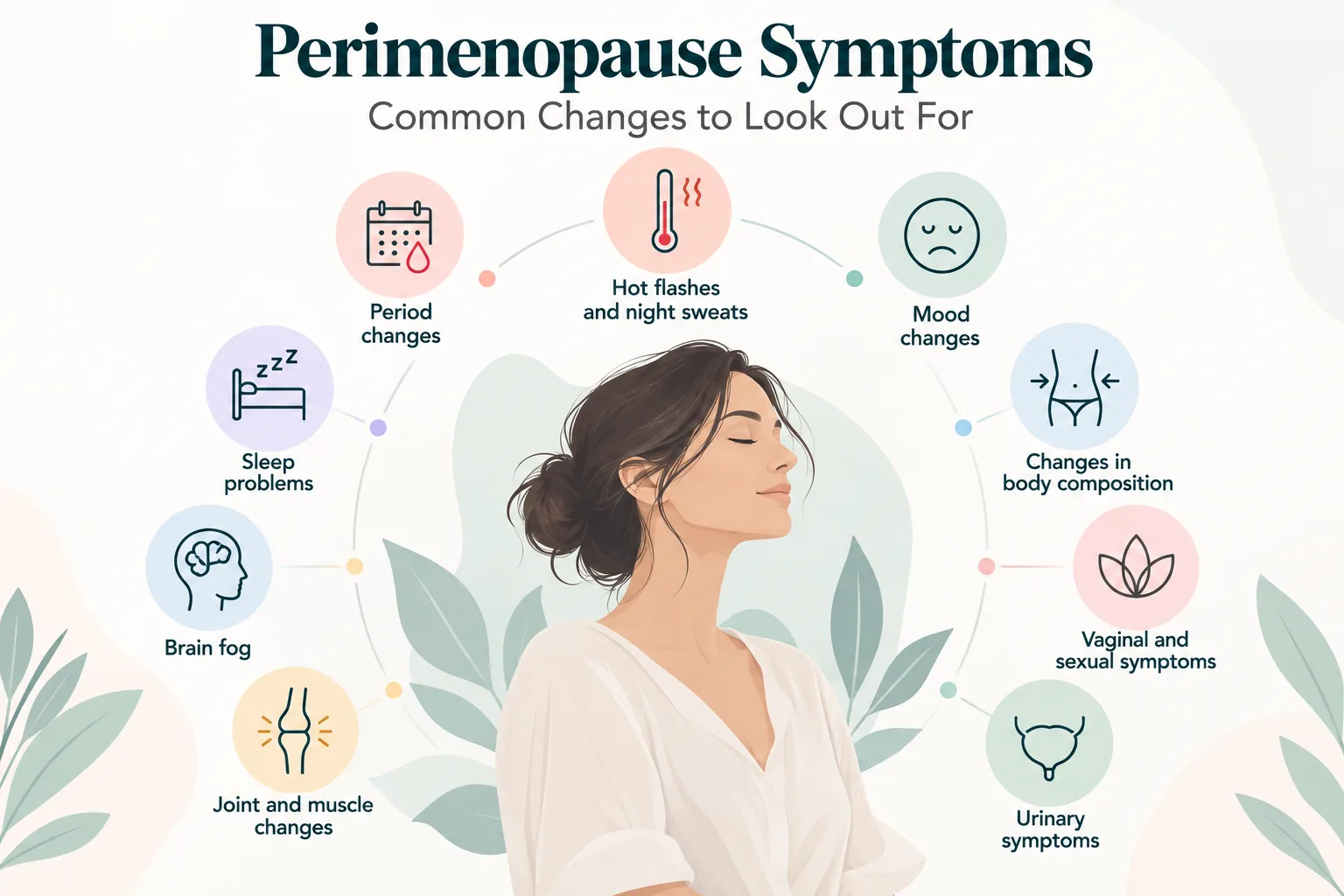
Perimenopause at a Glance
At a glance
|
Clinical answer
|
|
Definition
|
Transition around the final natural menstrual period; ovarian activity and menstrual timing become less predictable.
|
|
Usual timing
|
Often recognizable in the 40s, but there is no universal start age.
|
|
Early menstrual clue
|
Persistent change from your own established cycle pattern.
|
|
Duration
|
Often several years; the symptom timeline may be longer than the menstrual transition.
|
|
Testing
|
History is central, particularly after 45; FSH and estradiol vary from day to day.
|
|
Pregnancy
|
Still possible while ovulation occurs; menopausal hormone therapy is not contraception.
|
|
End point
|
Menopause is confirmed retrospectively after 12 months without natural bleeding when no other cause is present.
|
Perimenopause vs. Menopause: What Is the Difference?
Perimenopause can involve changing periods and symptoms while pregnancy remains possible. Menopause is identified after 12 months without a natural period. I use these distinctions when evaluating bleeding, symptoms and treatment options.
Question
|
Perimenopause
|
Menopause / postmenopause
|
|
What is it?
|
Transition leading toward the final menstrual period
|
Menopause is the final period, confirmed retrospectively; postmenopause begins at the final period, although menopause is confirmed retrospectively after 12 months
|
|
Periods
|
Usually still occur, but may become shorter, longer, skipped or unpredictable
|
No further natural periods after the confirmed final period
|
|
Hormone pattern
|
Estrogen and ovulation fluctuate; progesterone exposure may vary
|
Ovarian estrogen is generally lower and more stable over time
|
|
Pregnancy
|
Still possible when ovulation occurs
|
Natural pregnancy is no longer expected after menopause
|
|
Symptoms
|
Hot flashes, night sweats, sleep or vaginal symptoms may start or fluctuate
|
Some symptoms persist; vaginal/urinary issues may continue or progress
|
|
Diagnosis
|
Clinical history and cycle changes, especially at age 45+
|
12 consecutive months without natural bleeding when no other cause exists
|
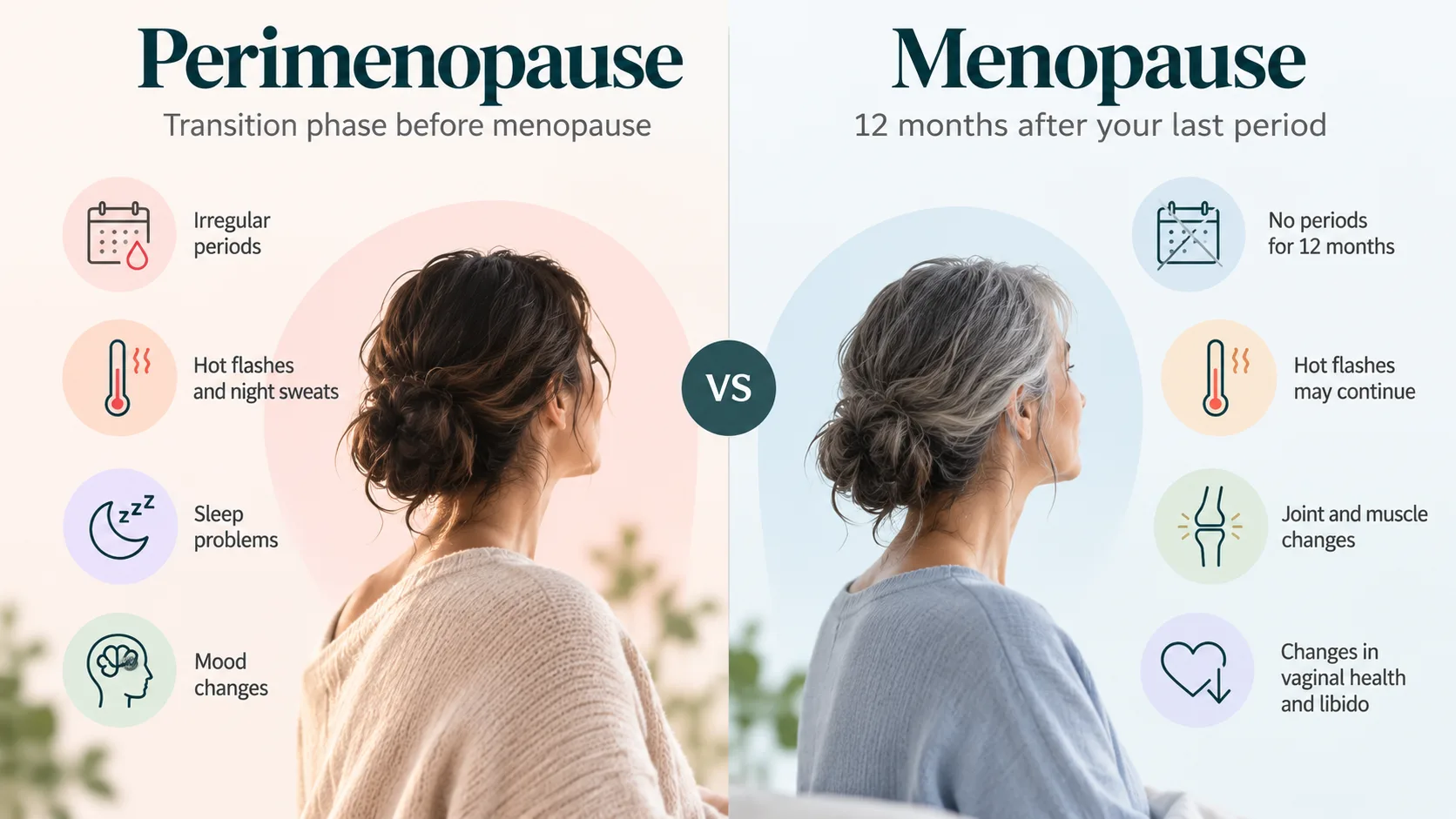
Could I Be in Perimenopause? Start with These Clues
You may recognize several of these changes in your own experience. In women in their mid-40s and beyond, I often identify the menopausal transition by looking at menstrual history and symptom patterns together. Contraception, medications, reproductive goals and other medical conditions can change that interpretation.
The questions that make the difference
- What was your usual cycle length and bleeding pattern before these changes?
- Have periods become consistently shorter, longer, or less predictable?
- Are you experiencing hot flashes, night sweats, sleep changes, or vaginal symptoms?
- Could pregnancy occur, and are you using hormonal contraception?
- Have you had a hysterectomy, endometrial ablation, or ovarian surgery?
- Do you have thyroid disease, PCOS, fibroids, anemia, or other relevant conditions?
- Which changes are affecting work, sleep, relationships, sexual comfort, or daily functioning?
I do not rule out hormonal changes simply because you still have periods, and I do not diagnose perimenopause from a generic symptom list. Your menstrual history, health, sleep and quality of life all matter.
Perimenopause Symptoms: What You Might Notice and What Helps
Perimenopause affects more than menstrual timing. Hot flashes, night sweats, sleep changes, vaginal discomfort, headaches and difficulties with concentration can arise at different times. I pay attention to which symptoms are new, how often they occur and how much they affect your daily life.
For example, waking at 3 a.m. may be associated with night sweats or changing sleep regulation, but it can also reflect sleep apnea, stress, alcohol use, medications, or another sleep disorder. Similarly, fatigue and brain fog may be worsened by poor sleep or anemia rather than explained by estrogen alone.
|
Symptom or concern
|
Useful observation
|
Why it matters
|
Practical next step
|
|
Hot flashes / night sweats
|
Frequency, severity, triggers, night waking and work impact.
|
Helps distinguish occasional symptoms from a treatment-worthy burden.
|
We can review options if disruptive; assess other causes of sweating when indicated.
|
|
Sleep disturbance
|
Time to sleep, awakenings, snoring, night sweats, daytime fatigue.
|
Insomnia and sleep apnea can coexist with hormonal changes.
|
I recommend reviewing sleep hygiene and targeted sleep assessment rather than assuming hormones alone.
|
|
Mood / concentration
|
Timing relative to cycles, sleep, stress and medication changes.
|
These symptoms are multifactorial and not specific to one hormone level.
|
Screen for mood and sleep conditions if persistent or impairing.
|
|
Vaginal dryness / painful sex
|
Dryness, pain, recurrent urinary symptoms or bleeding.
|
Genitourinary tissue changes may respond to targeted care; infection and other causes matter.
|
Discuss local treatment and evaluation of pain, infection or bleeding.
|
|
Heavy / unpredictable bleeding
|
Flow volume, clots, duration, spotting, dizziness.
|
Anovulation may contribute, but fibroids, polyps or endometrial disease may coexist.
|
Arrange an appointment so I can assess this; urgent care for severe blood-loss symptoms.
|
|
Cycle gaps / pregnancy risk
|
Dates of bleeding, intercourse, contraception and missed periods.
|
Unpredictable ovulation does not eliminate pregnancy possibility.
|
Consider pregnancy testing and contraception counseling as appropriate.
|
A symptom-by-symptom guide
Not every woman experiences the same symptoms. Some notice changes in their periods first; others report symptoms while cycles still seem regular. Here is how I interpret these concerns and what I ask you to pay attention to.
Irregular, shorter or missed periods
I start with your usual cycle pattern. Bring me the first day of each period, how long bleeding lasts and whether you have skipped cycles. I look for persistent change not one unusual month and check whether pregnancy or another condition might explain it.
|
WHAT THIS COULD MEAN
A new shift from your usual 28–30 day cycle to 23, 36 or 48 days may reflect changing ovulation. One unusual month alone does not establish perimenopause.
MY ADVICE
Record the first day of bleeding, length of each cycle, days of flow and any spotting for 2–3 months. If pregnancy is possible, test after a missed period.
|
-
Hot flashes
A hot flash may feel like a sudden rush of heat through your chest, neck or face, sometimes followed by sweating or chills. Tell me how often it happens, how long it lasts, whether your sleep or work is affected, and whether you experience palpitations or other symptoms.
|
WHAT THIS COULD MEAN
A sudden wave of heat, often over the face, neck or chest, sometimes with flushing, sweating or a racing heartbeat.
MY ADVICE
Notice whether alcohol, warm rooms, hot drinks or stress correlate with episodes. Try breathable layers and a cool bedroom. Discuss prescription options if symptoms interrupt daily life.
|
Night sweats
If you wake up overheated or with damp clothing or bedding, record how frequently it happens and whether you can return to sleep. I also want to know about fever, unexplained weight loss, medications and other causes of night sweating not just your hormone stage.
|
WHAT THIS COULD MEAN
Do you wake feeling hot, or find pajamas or bedding damp? How often does it happen, and does it disrupt the next day?
MY ADVICE
Keep a two-week record of night waking and sweating; use light bedding. Persistent drenching sweats with fever, unexplained weight loss or other systemic symptoms need assessment.
|
Trouble sleeping
Tell me whether falling asleep, staying asleep or waking too early is the main problem. I review night sweats, snoring, anxiety, caffeine, medications and daytime fatigue, because several treatable conditions can coexist with hormonal changes.
|
WHAT THIS COULD MEAN
Difficulty falling asleep, 3 a.m. awakenings, or waking unrefreshed may occur with or without hot flashes.
MY ADVICE
Use consistent sleep and wake times, reduce late caffeine and review snoring, restless legs, medications, anxiety and nighttime urination with a clinician.
|
Mood changes and anxiety
You may notice new irritability, anxious feelings or emotional sensitivity. I ask when they began, whether they follow your menstrual cycle, how well you are sleeping and whether mood symptoms affect relationships or everyday functioning. Significant symptoms deserve care, not dismissal.
|
WHAT THIS COULD MEAN
Uncharacteristic irritability, tearfulness or anxiety can coincide with disrupted sleep and cycle changes, but they are not specific proof of hormone changes.
MY ADVICE
Record mood, menstrual timing, sleep and stress together. Seek assessment for persistent depression or anxiety; urgent help is needed for thoughts of self-harm.
|
Brain fog and concentration problems
If familiar words seem harder to find or concentration feels unreliable, tell me when it happens and what else has changed. I consider sleep disruption, emotional strain, medication effects, thyroid conditions and iron deficiency rather than attributing every memory concern to estrogen.
|
WHAT THIS COULD MEAN
Losing your train of thought, searching for a familiar word or finding multitasking harder than before. Poor sleep and iron deficiency can contribute.
MY ADVICE
Assess sleep quality, medications and anemia risk. Use reminders and uninterrupted work blocks; get evaluated for new, progressive or concerning neurological changes.
|
Vaginal dryness and painful sex
You can tell me directly about dryness, burning, friction, painful penetration or bleeding with intimacy. These are common clinical concerns, not something you must endure. I assess tissue changes as well as infection, skin conditions and other sources of discomfort.
|
WHAT THIS COULD MEAN
Dryness, friction, burning or discomfort with penetration may reflect genitourinary changes, but infections and skin conditions can cause similar symptoms.
MY ADVICE
Consider fragrance-free moisturizers and lubricants; ask about vaginal estrogen or other targeted treatment if symptoms persist. Bleeding after sex deserves evaluation.
|
Urinary frequency or urgency
Increased urgency, nighttime urination, leakage and recurrent urinary discomfort may accompany midlife changes. I ask whether there is burning, fever or blood in the urine so we do not mistake an infection or another urinary condition for perimenopause.
|
WHAT THIS COULD MEAN
Urgency, burning, repeated UTIs or leakage may overlap with tissue changes, pelvic-floor symptoms or infection.
MY ADVICE
Do not assume a painful or burning urination is hormonal. Seek a urine assessment if infection is possible; discuss pelvic-floor therapy and local treatments when appropriate.
|
Joint and muscle aches
Tell me where discomfort occurs, whether there is morning stiffness, swelling, weakness or limitation of movement. I encourage movement and strength work where appropriate, while examining symptoms that may point to arthritis, injury or another condition.
|
WHAT THIS COULD MEAN
New stiffness or discomfort can coincide with midlife changes, but injuries, arthritis and inflammatory conditions also matter.
MY ADVICE
Preserve movement with tolerable strength training, mobility work and recovery. New swollen, hot or persistently painful joints merit examination.
|
Headaches or migraine changes
I pay attention to a new headache pattern, changes in migraine frequency or aura, and links to your cycle and sleep. A sudden severe headache or new neurological symptoms requires immediate medical evaluation rather than waiting for a menopause appointment.
|
WHAT THIS COULD MEAN
Some people notice migraines change around fluctuating cycles; others have no hormone-related headache pattern.
MY ADVICE
Track headache days, aura, medication use and bleeding dates. New sudden severe headache or new neurological symptoms need urgent evaluation.
|
Breast tenderness
If breast tenderness comes and goes with your cycle, hormonal variation may play a role. But I want to know about a focal persistent area of pain, a new lump, nipple discharge or skin changes because those need individual assessment.
|
WHAT THIS COULD MEAN
Breast soreness may fluctuate with hormonal cycling, especially when periods remain irregular.
MY ADVICE
Record whether tenderness is cyclical; a new lump, bloody nipple discharge or persistent one-sided breast change warrants clinical assessment.
|
Changes in weight or waistline
The way your clothes fit may change even without a large shift on the scale. I look at sleep, activity, muscle mass, medications and cardiometabolic risk, and focus our plan on strength and health rather than promising that hormone treatment alone will reverse weight gain.
|
WHAT THIS COULD MEAN
Body composition may change with aging, sleep disruption, activity patterns and the menopause transition; the number on the scale does not capture everything.
MY ADVICE
Focus on resistance exercise, adequate protein, sleep and cardiometabolic screening rather than restrictive crash diets.
|
Lower libido
A change in sexual desire can have several contributing factors, including painful sex, fatigue, stress, relationships and medications. I ask about what has changed for you, because addressing discomfort and sleep can be as important as discussing hormonal options.
|
WHAT THIS COULD MEAN
Desire may be affected by pain, poor sleep, stress, mood, medications and relationship factors, rather than any single hormone value.
MY ADVICE
If sex is uncomfortable, address dryness and pain first. Discuss medication effects, emotional well-being and sexual goals without assuming treatment is one-size-fits-all.
|
Hair and skin changes
Gradual skin dryness or hair changes can be frustrating. Tell me if hair loss is sudden, patchy or accompanied by scalp symptoms. I consider nutrition, iron status, thyroid problems, medications and dermatologic causes as well as aging.
|
WHAT THIS COULD MEAN
Hair thinning and drier skin can occur in midlife but may also relate to iron deficiency, thyroid changes or dermatologic conditions.
MY ADVICE
Use gentle skin care and discuss rapid shedding, scalp changes or persistent hair loss with a clinician; targeted tests may be appropriate.
|
Fatigue
Tiredness can follow disrupted sleep, heavy bleeding or other health changes. I ask whether you feel sleepy, physically weak or unusually exhausted, and I may evaluate anemia, thyroid function or sleep problems when your history points in that direction.
|
WHAT THIS COULD MEAN
Interrupted sleep is one explanation, but heavy bleeding-related anemia, thyroid disorders, mood disorders and sleep apnea can also cause fatigue.
MY ADVICE
Tell me whether fatigue follows poor sleep, heavy bleeding or exertion. Seek prompt care for breathlessness, fainting, chest pain or marked weakness.
|
CLINICAL INSIGHT WHEN SYMPTOMS NEED URGENT CARE : Chest pain, fainting, severe shortness of breath, sudden neurological symptoms, severe pelvic pain or very heavy bleeding with significant weakness need immediate medical assessment.
Period Changes in Perimenopause: What Is Expected and What Is Not
You may be wondering whether a shorter cycle, a skipped month or a heavier period belongs to the same story. Sometimes it does: changing ovulation can alter the timing and amount of bleeding. But not every bleeding change should be attributed to hormones. The pattern, your age, pregnancy possibility and any warning signs all matter.
Periods coming sooner than usual
Some women first notice shorter cycles. Changes in follicle development and hormone feedback may contribute. If this happens repeatedly, I recommend recording the dates and scheduling an evaluation, especially if bleeding becomes unusually frequent.
Periods becoming farther apart or disappearing temporarily
Delayed or absent ovulation can lengthen a cycle or cause a skipped period. A long gap can fit late perimenopause, but pregnancy and other causes of amenorrhea remain relevant. If pregnancy is possible, a test may be appropriate even when you suspect perimenopause.
Heavier or longer periods
Anovulatory cycles can alter progesterone exposure and the development of the uterine lining, sometimes contributing to heavier or prolonged bleeding. However, fibroids, adenomyosis, polyps, thyroid disease, medications, pregnancy-related conditions, and endometrial abnormalities can produce similar patterns. Heavy bleeding deserves its own assessment rather than an automatic hormone explanation.
Spotting between periods or bleeding after sex
These patterns are not reliable indicators of normal perimenopause. Cervical, vaginal, uterine, infectious, medication-related, and other causes should be considered. Arrange an evaluation rather than waiting for the bleeding to become more severe.
When bleeding needs urgent attention
Seek urgent care if bleeding is extremely heavy or is accompanied by fainting, marked dizziness, shortness of breath, chest pain, or other symptoms of significant blood loss. Severe pelvic pain , especially when pregnancy is possible, also requires urgent evaluation. Any bleeding after established menopause needs prompt medical assessment, even if it is only light spotting.
Bleeding pattern
|
Possible transition-related explanation
|
When to evaluate / next step
|
|
Cycles arriving sooner
|
Shortened follicular phase; changing ovulation.
|
I recommend assessing persistent very frequent bleeding or major changes.
|
|
Increasing cycle-length variation
|
Typical early-transition marker if ≥7-day differences persist.
|
Exclude pregnancy and other causes where relevant.
|
|
Gaps of 60+ days
|
Can indicate late menopausal transition.
|
Pregnancy remains possible; prolonged amenorrhea may need assessment by age.
|
|
Heavier or prolonged periods
|
Anovulatory cycles can change endometrial exposure.
|
Assess anemia, fibroids, polyps and endometrial risk; do not dismiss.
|
|
Spotting between periods
|
May occur for several reasons; not a defining stage marker.
|
Medical evaluation is recommended.
|
|
Bleeding after sex
|
May involve cervix, vagina or uterine pathology.
|
Examination and appropriate testing are indicated.
|
|
Bleeding after confirmed menopause
|
Not a return of normal cycling.
|
Always seek clinical evaluation.
|
|
Flooding with fainting / severe weakness
|
Potential significant blood loss.
|
Urgent assessment.
|
Early vs. Late Perimenopause: The Stages Explained
AN EXAMPLE TO MAKE STAGES CLEAR
Imagine that at 44 your cycles shift from a familiar 29 days to 24, 33, 25 and 36 days. That is more suggestive of early transition than one late period. Several years later, you might have a 65-day gap followed by another bleed; that can fit the late transition. Neither pattern tells us the exact date of your final period.
IMPORTANT LIMITATION : The STRAW+10 menstrual markers are useful population-based staging tools, not a home diagnosis. They can be unreliable when hormonal contraception, uterine surgery or certain medical conditions alter bleeding.
If the age range fits, the next clue is the rhythm of your periods. The STRAW+10 framework uses menstrual changes to describe early and late menopausal transition. These stages can help explain why one month feels familiar and the next does not; they cannot tell you exactly when your final period will arrive.
The +10 refers to the workshop held ten years after the original STRAW meeting, not to the number of stages. In this simplified six-part presentation, stages correspond to the following STRAW+10 markers; the formal system also includes substages.
- Stage 1 Late Reproductive Years (STRAW −3)
- Stage 2 Early Menopause Transition (STRAW −2)
- Stage 3 Late Menopause Transition (STRAW −1)
- Stage 4 Final Menstrual Period (STRAW 0)
- Stage 5 Early Postmenopause (STRAW +1)
- Stage 6 Late Postmenopause (STRAW +2)
Late reproductive stage: changes before obvious irregularity
Ovarian aging can begin while cycles remain fairly predictable. Some women notice shorter cycles or new symptoms before they meet formal criteria for the early menopausal transition. A regular period does not rule out reproductive aging, but symptoms such as fatigue or anxiety alone cannot confirm that the transition has begun.
Early menopausal transition: persistent cycle variation
A persistent difference of 7 days or more in the length of consecutive menstrual cycles is a key marker of the early transition. Imagine cycles that once ran 28, 29, 28, and 30 days now arriving after 24, 34, 26, and 36 days. The important information is the new variability, not whether any single cycle looks “normal.” One unusual month is not enough; the pattern matters.
Persistent means the variability recurs within 10 cycles.
Late menopausal transition: long gaps between periods
A gap of 60 days or more without menstruation is a characteristic marker of the late transition. A woman may go 70 days without bleeding, have another period, then experience a different-length gap. That does not mean the transition is moving backward. Ovulation has become less predictable. The late transition commonly lasts around one to three years, but the exact duration varies.
The final menstrual period and confirmed menopause
You cannot know that a period was your last period on the day it happens. Natural menopause is identified only after 12 consecutive months without further menstrual bleeding or spotting, when other explanations have been excluded. Hormonal contraception, hysterectomy, endometrial ablation, and certain medications can make the usual bleeding rule difficult to apply.
STRAW+10 stage
|
Menstrual marker
|
What is happening
|
Practical interpretation
|
|
Late reproductive (−3)
|
Often still regular cycles.
|
Subtle ovarian reserve and hormone-feedback changes.
|
Symptoms may precede obvious irregularity.
|
|
Early transition (−2)
|
Persistent ≥7-day difference between consecutive cycle lengths, recurring within 10 cycles.
|
Increasing cycle-to-cycle variability.
|
A single odd cycle does not establish the stage.
|
|
Late transition (−1)
|
At least one gap of ≥60 days without menstruation.
|
More frequent anovulation; intermittent ovarian activity.
|
Long gaps do not prove infertility.
|
|
Final period (0)
|
Recognized retrospectively after 12 months without natural bleeding.
|
Last spontaneous menstrual bleed.
|
Cannot be confirmed on the day it occurs.
|
|
Postmenopause (+1/+2)
|
Begins at the final menstrual period; confirmed retrospectively after 12 months.
|
Lower, more stable ovarian estrogen production over time.
|
Any new bleeding requires evaluation.
|
|
Term
|
What it describes
|
What happens to periods
|
Clinical takeaway
|
|
Premenopause
|
Broad informal label for time before menopause.
|
Periods may be regular; term does not define transition stage.
|
Not interchangeable with a STRAW+10 diagnosis.
|
|
Early perimenopause
|
Early menopausal transition (STRAW −2).
|
Persistent ≥7-day cycle-length difference, recurring within 10 cycles.
|
Cycle variability is the key marker.
|
|
Late perimenopause
|
Late menopausal transition (STRAW −1).
|
A gap of ≥60 days without menstruation.
|
Ovulation and pregnancy remain possible.
|
|
Menopause
|
Final menstrual period identified retrospectively.
|
12 consecutive months without natural bleeding, absent another cause.
|
A milestone, not a multi-year symptom phase.
|
|
Postmenopause
|
Time after the final menstrual period.
|
Natural menstruation has ended.
|
Any new bleeding requires clinical evaluation.
|
When Does Perimenopause Start? Signs in Your 30s, 40s and 50s
Age helps me interpret your symptoms, but it does not establish a diagnosis on its own. I assess new symptoms at 38 differently from similar symptoms at 48 because potential explanations and testing needs differ. In the United States, natural menopause occurs on average around age 51–52, though individual timelines vary.
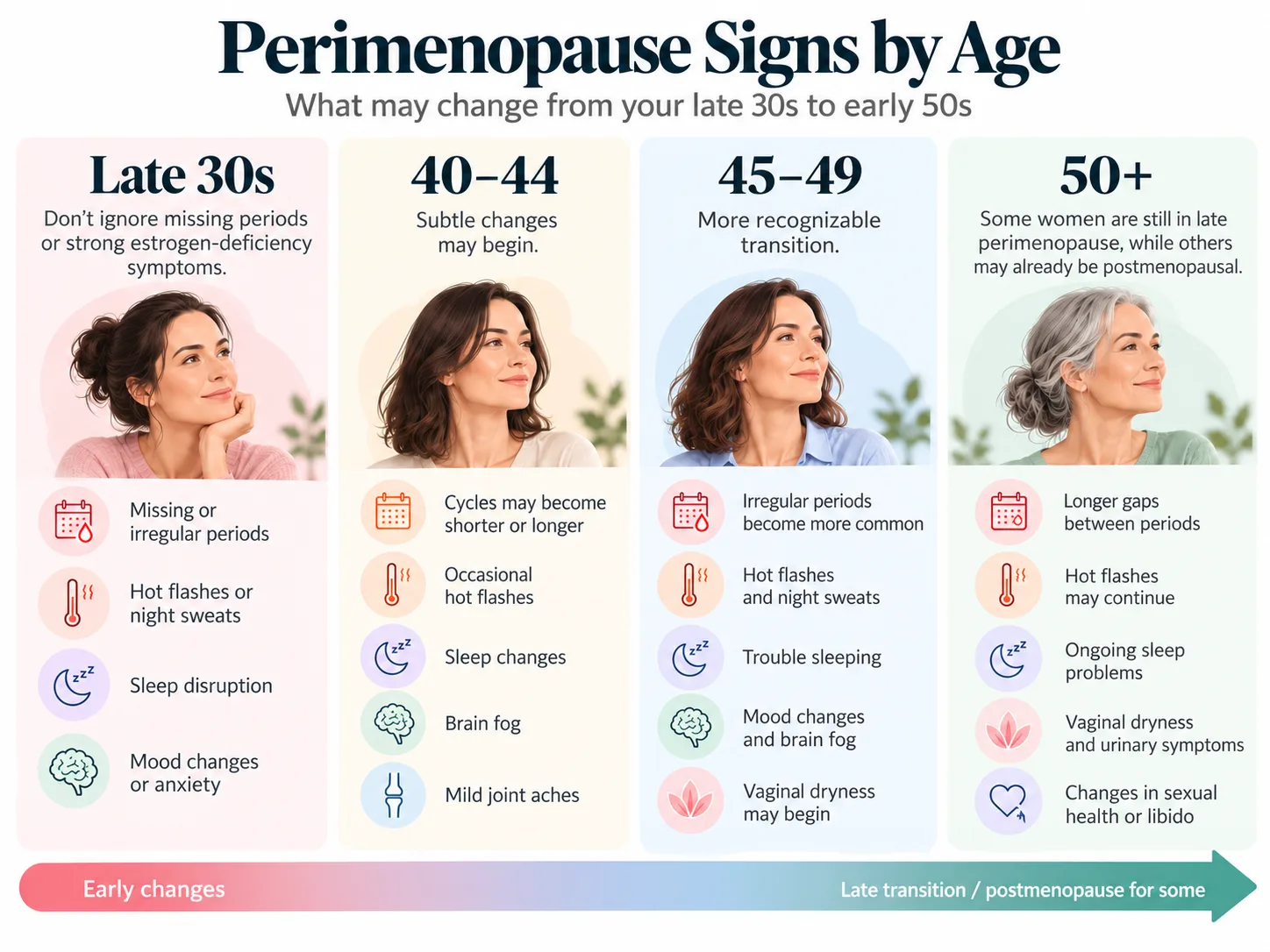
Perimenopause in the late 30s
Reproductive aging can be underway in the late 30s, but prolonged missed periods or pronounced estrogen-deficiency symptoms before 40 should not be dismissed as routine perimenopause. Pregnancy, thyroid disease, polycystic ovary syndrome (PCOS), prolactin abnormalities, medication effects, hypothalamic causes, and primary ovarian insufficiency (POI) may need investigation. POI involves impaired ovarian function before age 40 and has important fertility and long-term health implications.
Perimenopause at 40–44
Changes can begin in the early 40s. Cycles may shorten, become slightly variable, or develop unfamiliar symptoms. If menopause itself occurs before age 45, it is called early menopause and merits careful assessment because the duration of reduced ovarian hormone exposure may affect bone and other health considerations.
Perimenopause at 45–49
This is a common window for more recognizable cycle variability. For an otherwise healthy woman over 45 who has typical menstrual changes and menopausal symptoms, clinical history is usually sufficient to identify the transition without routine reproductive hormone testing.
Perimenopause at 50 and beyond
Some women are already postmenopausal by their early 50s, while others still have periods. A person can be experiencing the late transition even when friends of the same age have already reached menopause. Population averages are useful context, not deadlines.
|
PRACTICAL TIP:Compare your cycle with your own previous pattern, not only with the textbook 28-day cycle. A consistent shift from 32 days to 24 days can be meaningful even if both numbers appear within a broad normal range.
Do not compare your cycles only with a textbook 28-day period. Compare them with your own previous pattern; that change often tells us more.
|
How Long Does Perimenopause Last and How Do You Know It Is Ending?
After recognizing a possible stage, it is natural to ask how long this will go on. There is no personal countdown clock. Many women spend several years in the transition—often around four years—although the course can be shorter or longer. The time from your first cycle change to your final period is not necessarily the same as the duration of symptoms such as night sweats.
Longitudinal research, including the Study of Women’s Health Across the Nation (SWAN), shows that women who begin the transition younger may spend longer in it. Starting earlier therefore does not necessarily mean reaching menopause earlier. This is one reason simple online calculators can be misleading.
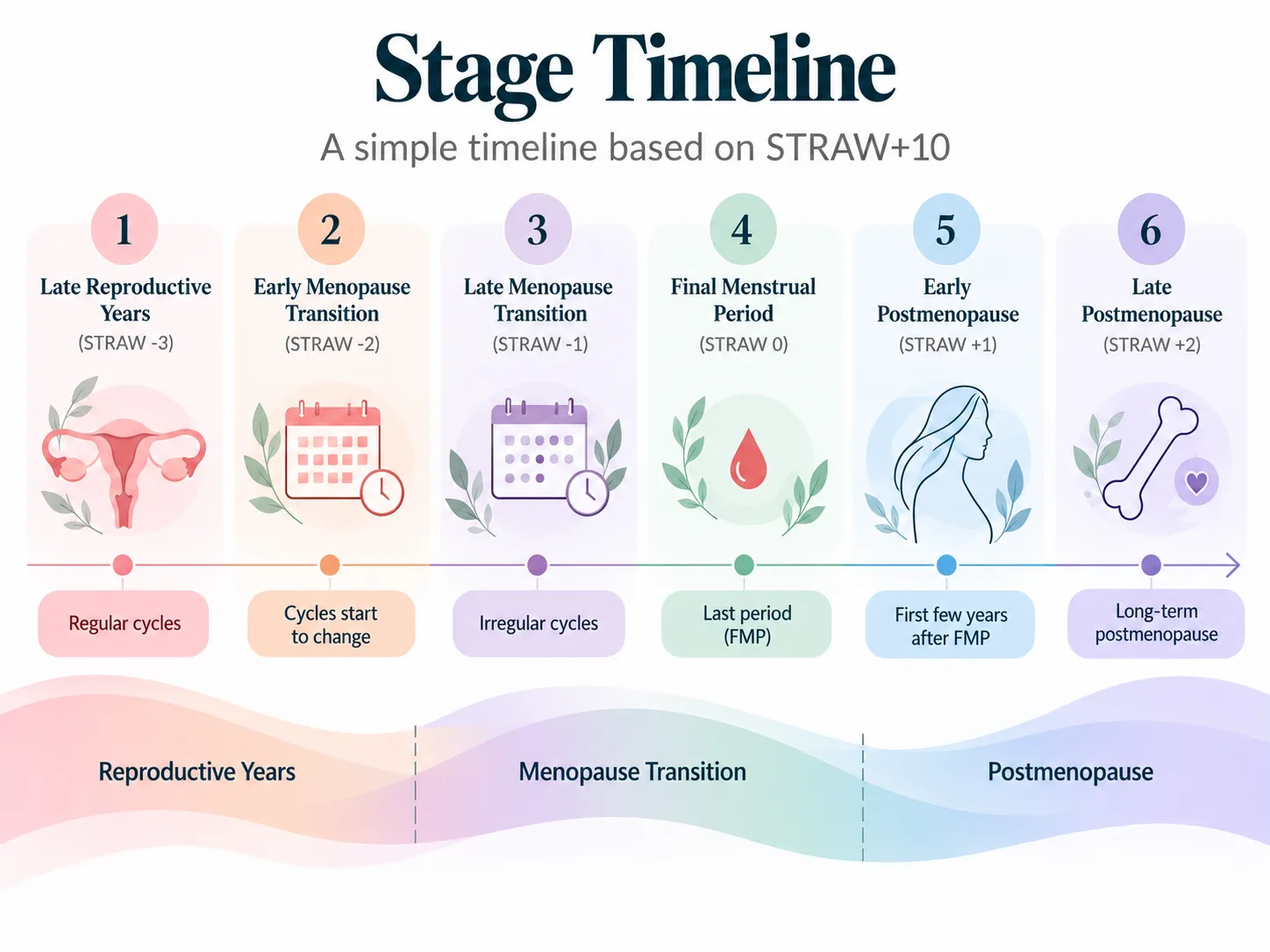
Your menstrual timeline and symptom timeline are different
Hot flashes and night sweats may start before the final period and continue afterward. Other symptoms may follow different trajectories. SWAN research found that frequent vasomotor symptoms lasted a median of 7.4 years among affected women—longer than the duration many people imagine when they hear the word “perimenopause.” The important distinction is that symptom duration and menstrual-transition duration are not interchangeable.
How do you know the transition is almost over?
Increasingly long gaps between periods suggest a later stage, but there is no final symptom that reliably predicts the date of menopause. A 90-day gap is not menopause. If a period returns, the 12-month clock for confirming natural menopause begins again from that bleeding episode.
Why Hormones Fluctuate in Perimenopause
If your periods have become less predictable, it can help to know what is happening beneath the surface. Perimenopause is not an overnight loss of estrogen. The brain–ovary feedback system and the timing of ovulation become more variable. Estrogen may rise and fall, while progesterone exposure changes when ovulation is delayed or absent. Those shifts can affect bleeding, sleep, temperature regulation and how you feel from month to month.
Why ovarian follicles matter
The ovaries contain a finite population of follicles. As reproductive aging progresses, the number and responsiveness of remaining follicles decline. Those follicles are involved not only in releasing eggs but also in producing hormones and providing feedback to the pituitary gland. When the feedback changes, the pituitary may release more follicle-stimulating hormone (FSH) to encourage follicle development.
One consequence can be a shorter follicular phase early in reproductive aging. That helps explain why some women first notice periods arriving closer together, before the longer gaps associated with late perimenopause begin.
Why estrogen can be high one month and lower the next
Estrogen production is not a steady downward slope during perimenopause. A cycle may involve substantial estrogen production, while the next may be quite different. This helps explain why breast tenderness, changing menstrual flow, temperature-related symptoms, and sleep complaints can vary from month to month. Importantly, none of these symptoms identifies a specific hormone level on its own.
Why progesterone becomes less predictable
Progesterone is largely produced after ovulation. When ovulation is delayed or does not occur, the normal post-ovulation progesterone rise may be delayed or absent. This can affect the uterine lining and menstrual bleeding. But the online claim that every perimenopausal woman has one universal “estrogen dominance” pattern is not medically precise. Hormone patterns differ, and a label is not a substitute for evaluating symptoms and bleeding.
Why FSH is a poor one-time answer
FSH often rises during reproductive aging, but it also fluctuates. A single normal FSH result does not prove that perimenopause is absent. A single elevated result cannot tell you exactly how close you are to your final period. Think of one hormone result as a photograph of a moving process: it can provide context, but it does not show the entire timeline.
|
Biologic change
|
Why it happens
|
What it may mean clinically
|
|
Declining follicle pool
|
Fewer and less responsive ovarian follicles alter the feedback loop.
|
Cycle changes may precede major symptoms.
|
|
Lower inhibin B
|
Less negative feedback allows pituitary FSH to rise variably.
|
FSH can be elevated in one cycle and less elevated in another.
|
|
Variable FSH
|
Follicular recruitment and timing become less predictable.
|
One measurement does not reliably stage the transition.
|
|
Fluctuating estradiol
|
Follicles may produce high, normal or low estradiol across cycles.
|
Symptoms cannot be read as a specific estrogen value.
|
|
Less reliable ovulation
|
Some cycles do not release an egg or ovulate later.
|
Fertility declines but does not disappear immediately.
|
|
Variable progesterone
|
No ovulation means no usual corpus-luteum progesterone surge.
|
Uterine lining exposure and bleeding may become irregular.
|
|
Changing endometrial response
|
Estrogen and progesterone exposure vary; structural conditions may coexist.
|
Heavy or prolonged bleeding still needs evaluation.
|
Do You Need a Hormone Test to Diagnose Perimenopause?
WHY I MAY NOT ORDER A BIG HORMONE PANEL
If you are 47, your periods have recently become unpredictable, and you are having recurrent hot flashes, a single FSH or estradiol level may not change care. If you are 37 with absent periods, by contrast, I would take a different approach and consider an evaluation for causes including primary ovarian insufficiency. A test is valuable when it answers a specific question.
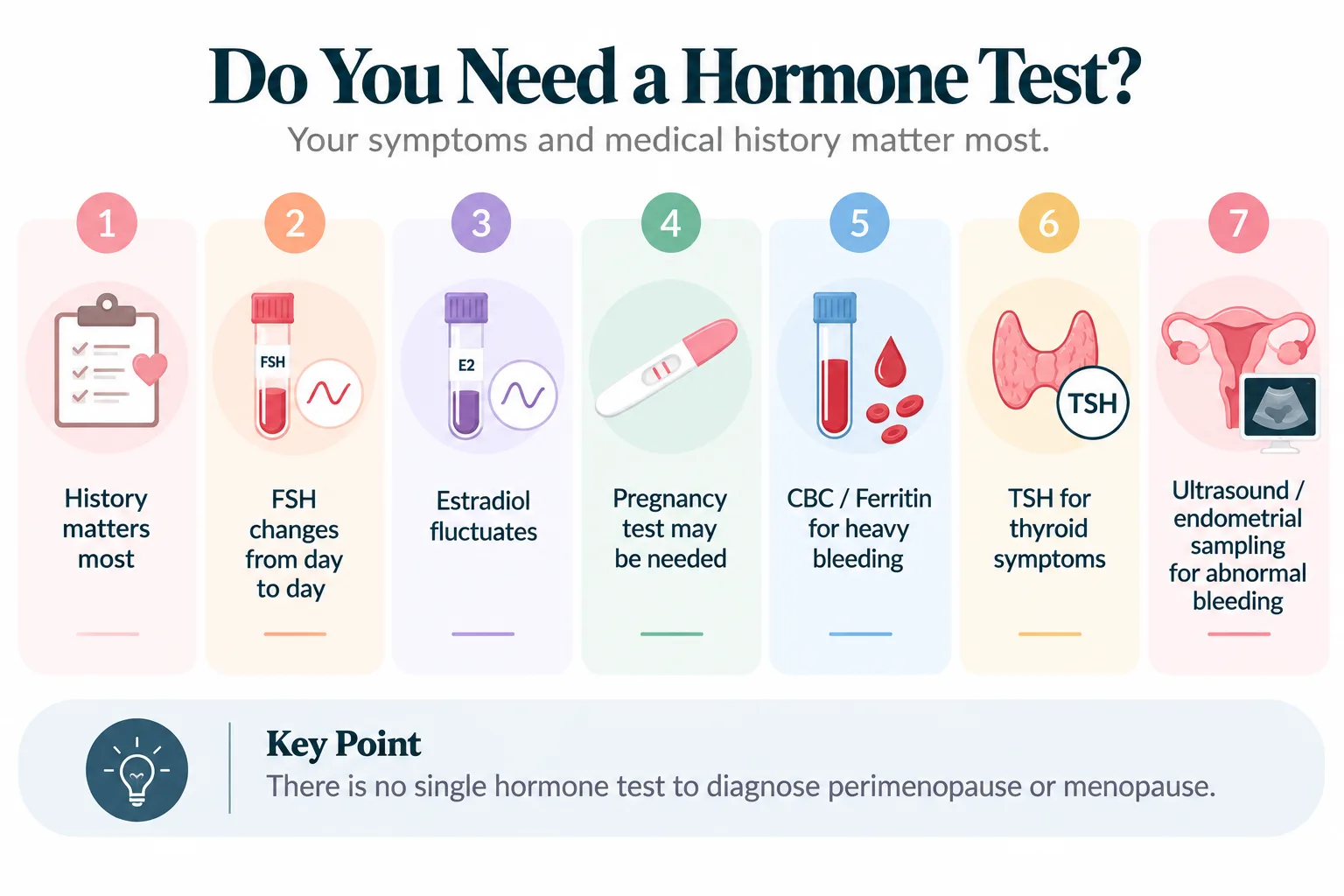
WHAT TO ASK AT YOUR VISIT
Would a pregnancy test, blood count and iron assessment, thyroid testing or targeted gynecologic evaluation be more useful for my situation? If an FSH test is suggested, ask what its result will change in management.
It can be frustrating when you feel different but a hormone test comes back normal. That result does not necessarily settle the question. Estradiol and FSH can vary substantially across a cycle and from one month to another. In otherwise healthy women aged 45 or older with typical changes, history is often more informative than a routine one-time hormone panel. Tests are most useful when they answer a specific clinical question.
FSH and estradiol
FSH may be elevated during reproductive aging, but it fluctuates. Estradiol also varies considerably. A normal value on one day does not rule out perimenopause, and a high FSH does not establish the precise stage. Testing can be more relevant when the pattern is unusual or when early menopause or POI is suspected.
NICE NG23 advises considering FSH testing in selected people aged 40–45 with menopause-associated symptoms and menstrual changes, or under 40 when menopause or primary ovarian insufficiency is suspected. A single result is not sufficient to diagnose primary ovarian insufficiency.
AMH: ovarian reserve is not a menopause countdown
Anti-Müllerian hormone (AMH) provides information related to ovarian reserve and may have a role in fertility evaluation. It cannot reliably tell an individual woman the month or year of menopause, nor does it diagnose the cause of fatigue, anxiety, or night sweats.
When other blood tests are more useful
Testing becomes valuable when it answers a specific clinical question. A pregnancy test can investigate a missed period. Thyroid testing may help explain menstrual and systemic changes. A complete blood count and iron studies can evaluate anemia with heavy bleeding. Prolactin or other investigations may be appropriate in selected cases. The question should be: “What are we trying to rule in or rule out?”
What about home FSH menopause tests?
At-home tests generally measure urinary FSH at one moment. Because levels fluctuate, they cannot reliably determine the stage of the transition or replace an assessment of bleeding, symptoms, age, and medical history. A home result should be treated as context,not a verdict.
PRACTICAL TIP : Bring three to six months of cycle dates and a concise symptom timeline to your appointment. A documented shift from 29-day cycles to 24, 35, 26, and 48 days may tell us more about your transition than an isolated hormone number.
Test or procedure
|
When it can help
|
What it cannot prove
|
|
FSH
|
Selected evaluation at 40–45 or suspected ovarian insufficiency under 40, in context.
|
A single result cannot stage or rule out typical perimenopause.
|
|
Estradiol
|
Selected endocrine evaluation when a specific clinical question exists.
|
Normal or high estradiol on one day does not exclude transition.
|
|
AMH
|
Ovarian reserve or fertility counseling in selected settings.
|
Not a reliable personal menopause countdown or routine perimenopause test.
|
|
Pregnancy test
|
Absent or unusual periods when conception is possible.
|
Does not explain other cycle changes if negative.
|
|
TSH
|
Symptoms or menstrual changes suggesting thyroid disease.
|
Does not identify menopausal stage.
|
|
CBC ± ferritin
|
Heavy bleeding, fatigue, dizziness or possible iron deficiency.
|
Anemia can coexist with perimenopause; cause still matters.
|
|
Prolactin / targeted endocrine tests
|
Galactorrhea, amenorrhea or other specific findings.
|
Broad panels without clinical indications often add noise.
|
|
Pelvic ultrasound
|
Structural causes of bleeding, pelvic mass or pain.
|
Does not diagnose perimenopause from ovarian appearance.
|
|
Endometrial sampling
|
Abnormal uterine bleeding, particularly at age 45+ or earlier with risk factors.
|
Evaluates the uterine lining; it is not a menopause-stage test.
|
Conditions That Can Mimic Perimenopause
Because sleep disruption, fatigue, mood changes and irregular bleeding are not unique to perimenopause, a thoughtful assessment keeps other explanations in view. This does not mean your symptoms are being dismissed. It means I can look for treatable conditions—such as thyroid problems, anemia or pregnancy—while also considering the menopause transition.
Pregnancy
Pregnancy remains possible while ovulation continues, even irregularly. Missed periods, breast changes, and fatigue should not automatically be attributed to the menopausal transition when pregnancy is possible.
Thyroid dysfunction and anemia
Thyroid disorders can affect menstruation, energy, mood, and temperature tolerance. Heavy menstrual bleeding may contribute to iron deficiency or anemia, producing fatigue and difficulty concentrating. Both may warrant targeted evaluation.
PCOS, prolactin changes, and hypothalamic causes
PCOS can cause irregular ovulation long before perimenopause. Elevated prolactin, certain medications, significant energy deficiency, major weight changes, or intense exercise may also disrupt periods. A pattern that has existed since adolescence is interpreted differently from a new change beginning at 47.
Fibroids, polyps, and endometrial conditions
Structural uterine conditions can cause heavy, prolonged, or intermenstrual bleeding. In the appropriate clinical setting, pelvic ultrasound, endometrial sampling, or other evaluation may be recommended. These decisions are guided by the bleeding pattern, age, risk factors, and examination.
Primary ovarian insufficiency before 40
POI deserves special attention because it is not simply “perimenopause happening early.” Ovarian function may be intermittent, fertility questions can be complex, and longer-term health management differs. Missing periods and menopause-like symptoms before 40 should prompt a thoughtful assessment.
Possible mimic
|
Distinguishing clue
|
Targeted clinical question
|
|
Pregnancy
|
Missed period, nausea or bleeding in someone who could conceive.
|
Is a pregnancy test indicated now?
|
|
Thyroid dysfunction
|
Fatigue, palpitations, heat/cold intolerance or cycle changes.
|
Would TSH testing clarify the picture?
|
|
Iron-deficiency anemia
|
Heavy bleeding, fatigue, exertional breathlessness or dizziness.
|
Are CBC and ferritin needed?
|
|
Fibroids / endometrial polyps
|
Heavy, prolonged or intermenstrual bleeding, pressure or pain.
|
Is imaging or endometrial assessment appropriate?
|
|
PCOS or prolactin disorder
|
Longstanding irregular cycles, androgenic symptoms or galactorrhea.
|
Did irregularity precede midlife; is targeted endocrine work-up needed?
|
|
Primary ovarian insufficiency
|
Irregular/absent periods and low-estrogen symptoms before 40.
|
Is age-appropriate repeat FSH assessment and specialist care indicated?
|
|
Sleep apnea / mood disorder
|
Snoring, unrefreshing sleep, low mood or cognitive complaints.
|
Are sleep and mental-health assessments warranted?
|
|
Medication or other illness
|
Symptoms began after a medication change or with systemic signs.
|
Could drugs or another condition explain the change?
|
Can You Get Pregnant During Perimenopause?
There is one practical question worth answering even if your periods have become infrequent: could you still become pregnant? Yes. Ovulation may be less predictable, but it can still occur. Whether you hope to conceive or prefer to avoid pregnancy, your plan should reflect that possibility.
Why irregular periods do not mean infertility
A delayed ovulation can produce a very long cycle. Pregnancy can occur if ovulation happens during that cycle, even if you assumed your periods had stopped because of perimenopause. Menopausal hormone therapy is not a contraceptive method.
What if you want to become pregnant?
If pregnancy is a goal, do not assume that continued menstruation means fertility is unchanged. Egg quantity and quality decline with reproductive age. A timely discussion with me or a fertility specialist can clarify evaluation and options, especially in the 40s.
When can contraception be stopped?
The answer depends on age, method, menstrual history, and whether hormones are masking natural bleeding. Do not stop contraception solely because you have skipped several periods or received a high FSH result. Ask me for method-specific guidance.
How Birth Control, IUDs and Surgery Can Hide the Signs
If you use hormonal contraception or have had surgery involving the uterus or ovaries, your periods may no longer provide reliable clues. In these situations, I look more closely at your symptoms, medications, surgical history and reproductive goals.
Combined hormonal birth control
Combined pills, patches, and vaginal rings can suppress ovulation and produce withdrawal bleeding. Those bleeds do not necessarily reflect your natural menstrual cycle. Hormonal contraception may also affect symptoms and the interpretation of laboratory testing.
Hormonal IUD
A levonorgestrel-releasing IUD may make periods very light or stop them entirely while ovarian function continues. No bleeding in this situation does not automatically mean menopause has occurred. Contraception decisions need individualized guidance.
Hysterectomy with ovaries preserved
Removing the uterus eliminates menstrual bleeding but does not necessarily stop ovarian hormone production. If one or both ovaries remain, reproductive aging can continue. The challenge is that the menstrual calendar is no longer available to help stage the transition.
Removal of both ovaries
Removal of both ovaries causes surgical menopause, which is biologically different from the gradual natural transition. Symptoms can begin abruptly, and the implications for treatment depend on age, medical history, and the reason for surgery.
Endometrial ablation
Ablation changes the uterine lining and can reduce or stop bleeding without ending ovarian function. Menstrual absence is therefore not a reliable standalone menopause marker. Pregnancy can still occur after ablation and may be high risk.
Situation
|
What it does to the bleeding signal
|
How to interpret the transition
|
|
Combined pill, patch or ring
|
Withdrawal bleeding and suppressed ovulation can conceal natural cycle changes.
|
FSH/estradiol measured during use may mislead; plan assessment around contraceptive needs.
|
|
Levonorgestrel hormonal IUD
|
Bleeding may become light or stop although ovaries continue functioning.
|
Amenorrhea from the IUD alone cannot confirm menopause.
|
|
Copper IUD
|
Usually does not suppress ovulation; can increase menstrual bleeding.
|
Cycle changes remain observable but heavy bleeding may have more than one cause.
|
|
Hysterectomy, ovaries preserved
|
There is no uterine bleeding to mark the final period.
|
Ovarian aging continues; age and symptoms become more important.
|
|
Endometrial ablation
|
Bleeding may diminish or cease despite ongoing ovarian cycles.
|
Menstrual criteria may be unreliable; new pain or bleeding still warrants evaluation.
|
|
Both ovaries removed
|
Ovarian hormone production changes abruptly after surgery.
|
This is surgical menopause, not the gradual natural transition.
|
What Helps Perimenopause Symptoms? Treatment and Everyday Strategies
MATCH TREATMENT TO YOUR MAIN PROBLEM: For disruptive hot flashes, discuss evidence-based hormonal and nonhormonal medicines, individual risks and contraindications. For painful sex or vaginal dryness, local therapies may be more relevant. For irregular heavy bleeding, first determine whether the uterine lining and other causes need evaluation. If you still need birth control, we can review options that address both contraception and symptoms.
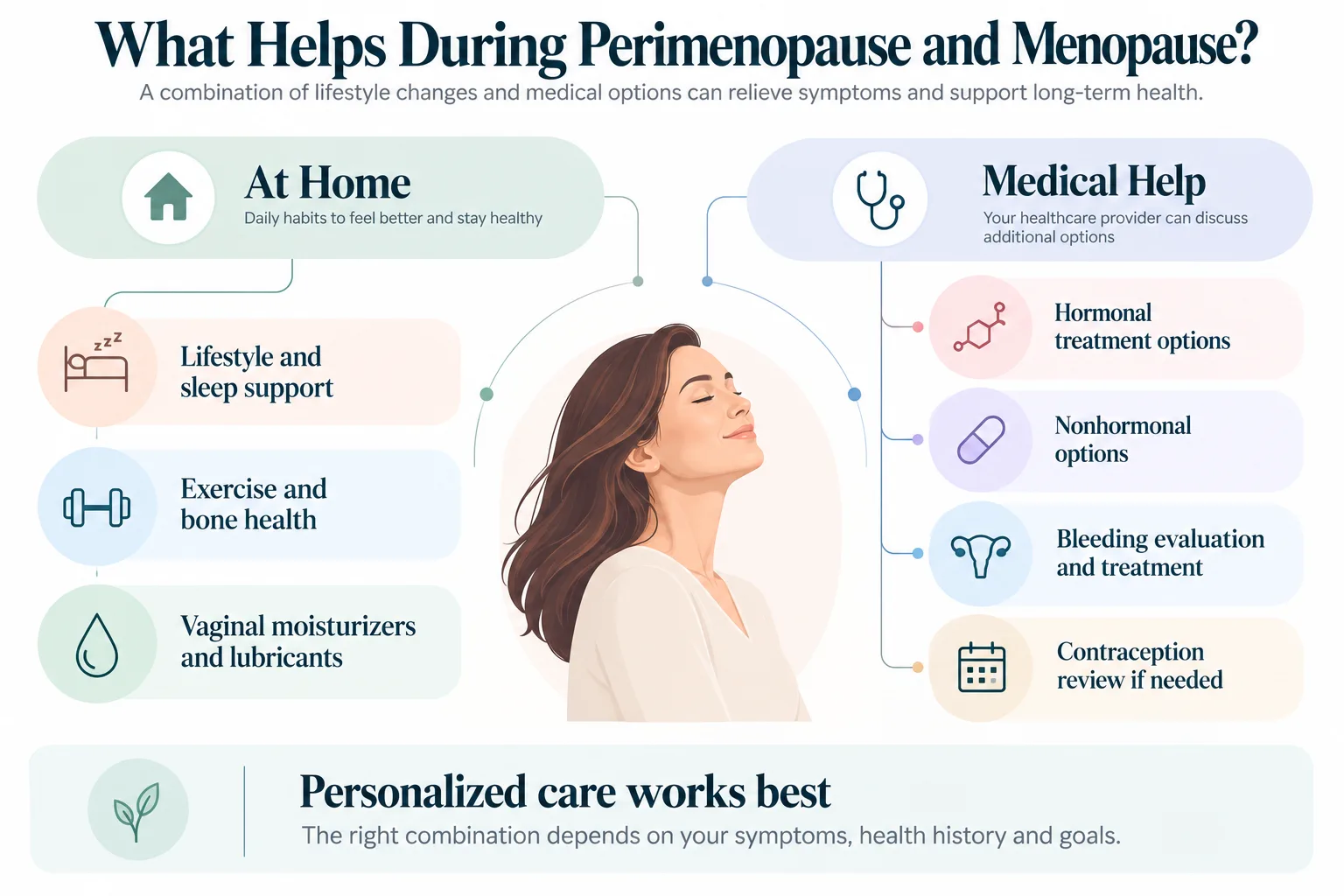
BEYOND MEDICATION : Strength and weight-bearing movement support muscle and bone health; sleep support can improve daytime functioning; and reducing smoking and excessive alcohol can improve general health. These strategies complement—but do not replace—treatment for severe symptoms or unsafe bleeding.
If your symptoms are mild and manageable, you may not need treatment. If they interrupt sleep, relationships, work or daily routines, it is reasonable to ask about support before your periods stop. The right option depends on the concern—heavy bleeding, night sweats, vaginal dryness, contraception or something else—not on reaching a particular hormone number.
Depending on the clinical situation, options may include hormonal contraception, menopausal hormone therapy for appropriate candidates, nonhormonal prescription treatment, vaginal therapies, and targeted lifestyle measures. The choice depends on the problem being treated, medical history, contraindications, and reproductive goals.
A helpful place to start is the concern you most want to improve: night sweats, bleeding, vaginal discomfort, sleep or contraception. Different problems may call for different approaches, and your medical history helps guide what is appropriate.
|
Care priority
|
What can help
|
Clinical caution
|
|
Education and monitoring
|
Cycle tracking, symptom impact, shared decisions and follow-up.
|
No medication is required simply because the transition has begun.
|
|
Systemic hormone therapy
|
Effective for many bothersome hot flashes and night sweats in appropriate candidates.
|
Evaluate risks; patients with a uterus generally require endometrial protection with progestogen.
|
|
Nonhormonal prescriptions
|
Options for vasomotor symptoms when hormone therapy is not desired or suitable.
|
Choose by symptoms, contraindications, interactions and access.
|
|
Vaginal or local therapy
|
May help vaginal dryness, painful sex and some urinary symptoms.
|
Evaluate infection, bleeding or other causes when indicated.
|
|
Bleeding control / contraception
|
Hormonal contraceptives or other treatments may address bleeding and pregnancy prevention.
|
Investigate abnormal bleeding; menopausal hormone therapy is not contraception.
|
|
Lifestyle and prevention
|
Sleep care, exercise, resistance training, nutrition and smoking cessation.
|
Helpful for general health but not a substitute for treating severe symptoms or pathology.
|
Everyday measures that support your health
- Choose regular movement, including resistance training, to protect muscle and bone health.
- Use a consistent sleep schedule and identify the factors that worsen night sweats or awakenings.
- Limit alcohol or other personal triggers when they clearly worsen your symptoms; triggers differ among women.
- I recommend vaginal moisturizers or lubricants for dryness; persistent symptoms may benefit from targeted medical treatment.
- Review contraception before stopping it, because irregular periods do not necessarily mean infertility.
- Seek treatment when symptoms disrupt life; you do not need to wait until the final period.
- Bone, Heart and Metabolic Health During the Transition
Even when symptoms are manageable, this stage can be a helpful moment to review your broader health. Bone strength, muscle, sleep, cardiovascular risk factors and preventive screening deserve attention in midlife. These are not all caused by perimenopause, and there is no need to assume every change is hormonal.
Bone health
Bone loss accelerates around the final menstrual period. Adequate calcium and vitamin D intake, resistance and weight-bearing activity, avoidance of smoking, and individualized fracture-risk assessment may be relevant. Bone-density testing is based on age and risk factors; it is not automatically required for everyone who suspects perimenopause.
Muscle and body composition
Longitudinal SWAN research suggests the menopause transition is associated with accelerated fat gain and loss of lean mass even when changes in total body weight are less striking. This helps explain why the scale does not tell the whole story. Resistance exercise and muscle preservation deserve attention, not just weight loss.
Cardiovascular and metabolic health
Blood pressure, lipid levels, glucose regulation, sleep, physical activity, and family history should be reviewed as appropriate. Menopause-related changes may interact with age and other risk factors. The clinical goal is a complete risk assessment, not a claim that every midlife change is caused by estrogen.
What to Track Before Your Gynecology Appointment
MAKE YOUR APPOINTMENT SPECIFIC: Start your visit with a one-sentence priority: “My periods used to be predictable, but for four months they have been irregular, and night sweats are affecting my job.” Bring your cycle dates, flow history, major symptoms, medications, contraceptive method and goals. This makes it easier to decide whether the immediate priority is treatment, investigation or family-planning advice.
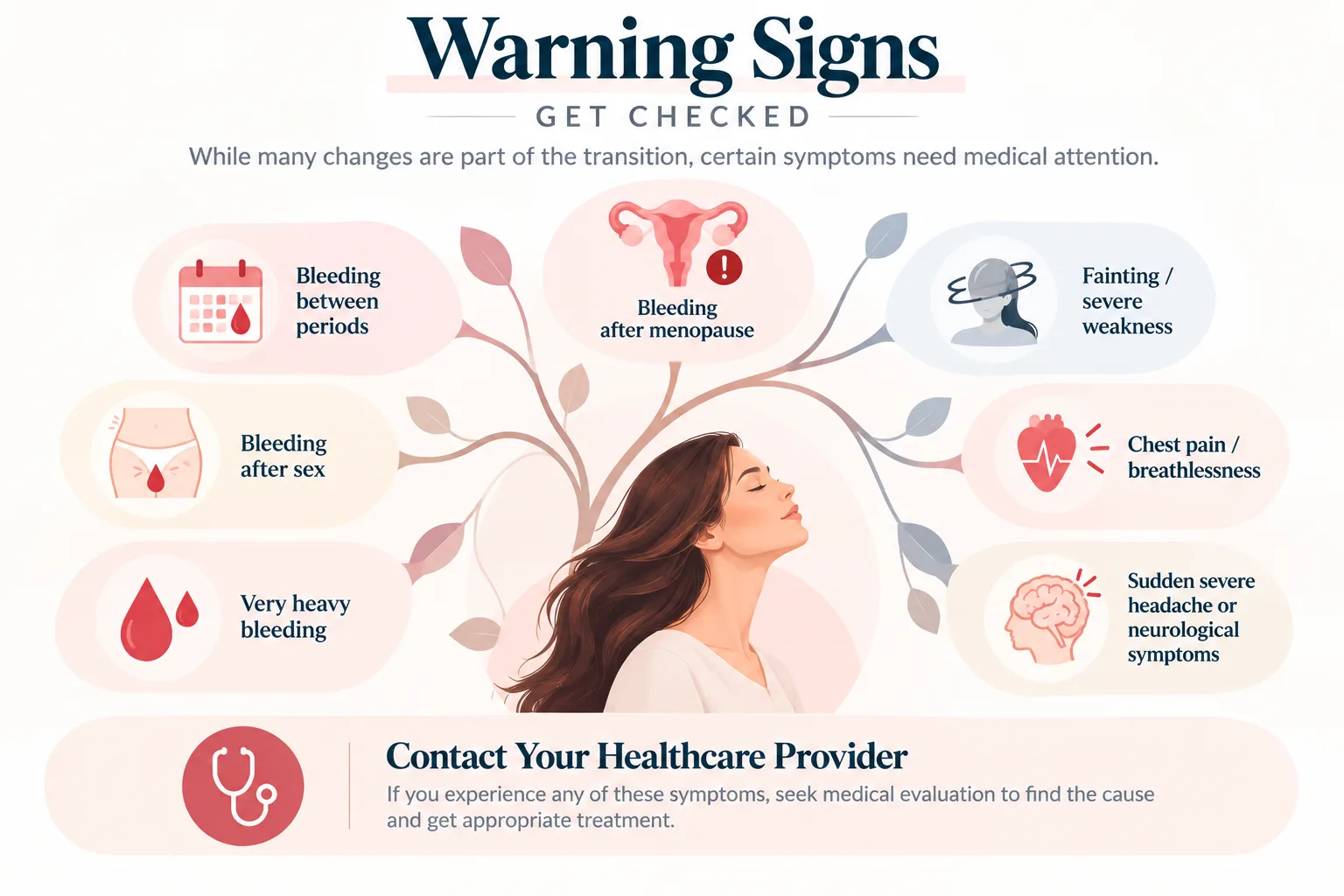
You do not need a perfect diary before seeking care. Even a few notes about your previous cycle pattern, recent changes and most disruptive symptoms help me focus the visit on what matters to you.
- First day of each period and number of days until the next one.
- How many days you bleed, and whether flow is light, usual, or unusually heavy.
- Spotting between periods, bleeding after sex, or large clots.
- Night sweats, hot flashes, sleep interruptions, and how often they occur.
- Changes in headaches, mood, concentration, vaginal comfort, or urinary symptoms.
- Current contraception, prescription medications, hormones, and supplements.
- Pregnancy possibility, fertility goals, and relevant medical or surgical history.
Before your visit, choose the two or three concerns you most want to address—for example, heavy bleeding, sleep, fertility, contraception or treatment. I use those priorities to guide an individualized assessment.
What to track
|
How to record it
|
Why it helps / when not to wait
|
|
Cycle timing
|
First bleeding day, cycle length and missed periods.
|
Distinguishes persistent variation from an isolated late cycle; consider pregnancy if possible.
|
|
Bleeding amount
|
Heavy days, flooding, clots and overnight changes.
|
Guides anemia and uterine evaluation; urgent care for heavy bleeding with fainting or breathlessness.
|
|
Unexpected bleeding
|
Spotting between periods, after sex or after menopause.
|
Requires appropriate assessment; any bleeding after confirmed menopause should be evaluated.
|
|
Hot flashes and sleep
|
Episodes per week, night waking and daytime impairment.
|
Measures symptom burden and treatment response; persistent severe sleep issues merit care.
|
|
Vaginal and urinary symptoms
|
Dryness, painful sex, burning or recurrent urinary issues.
|
Distinguishes tissue changes from infection or other conditions.
|
|
Medications and reproductive context
|
Hormones, IUD, contraception, surgery and supplements.
|
Can hide natural cycle clues or affect laboratory interpretation.
|
|
Your top priorities
|
Choose two goals: bleeding, sleep, fertility, contraception or treatment.
|
Makes the visit useful; never delay red-flag assessment just to complete tracking.
|
When to See a Gynecologist and When Bleeding Is Urgent
You can seek care whenever symptoms affect your life; you do not have to wait until menopause is confirmed. I recommend assessment of unexpected bleeding even when perimenopause seems likely. Some patterns require prompt or urgent attention.
You do not have to wait for menopause to be confirmed before discussing symptoms or treatment. And if you experience bleeding after 12 consecutive months without a natural period, seek evaluation rather than assuming the transition has restarted.
|
Situation
|
Recommended action
|
Reason
|
|
New irregularity without warning signs
|
Track dates and symptoms; book an appointment with me if changes persist or interfere with daily life.
|
History may clarify the transition without broad hormone testing.
|
|
Bleeding between periods or after sex
|
Arrange a gynecologic appointment.
|
This pattern deserves assessment independently of menopausal stage.
|
|
Heavy or prolonged bleeding
|
Arrange a timely evaluation for possible anemia or uterine causes.
|
Hormonal variability and other gynecologic conditions can overlap.
|
|
Bleeding after a full year without natural periods
|
Contact a clinician, including for a single spotting episode.
|
Bleeding after menopause needs evaluation.
|
|
Very heavy bleeding with marked weakness
|
Seek urgent medical attention.
|
Significant blood loss needs prompt assessment.
|
|
Missed period when pregnancy is possible
|
Consider a pregnancy test and clinical advice.
|
Ovulation can still occur during the transition.
|
Perimenopause Myths: What Is Actually True?
As you sort through advice online, you may hear that regular periods rule out perimenopause or that a single hormone test can predict your final period. Neither is reliable. These distinctions can help you avoid unnecessary worry and know which questions are worth asking.
- MYTH: “Estrogen only falls during perimenopause.” REALITY: Levels can fluctuate considerably before settling lower after menopause.
- MYTH: “A normal FSH rules it out.” REALITY: One result may not represent months of hormonal variability.
- MYTH: “A high FSH tells me when my final period will occur.” REALITY: No routine test predicts that date precisely.
- MYTH: “Irregular periods mean I cannot become pregnant.” REALITY: Ovulation may still occur unpredictably.
- MYTH: “Heavy bleeding is always just hormones.” REALITY: Other gynecologic causes may need evaluation.
- MYTH: “Every symptom in my 40s must be perimenopause.” REALITY: Other conditions may mimic or coexist with the transition.
- MYTH: “If it is natural, I have to tolerate it.” REALITY: A natural life stage can still warrant medical treatment for troublesome symptoms.
Final Thoughts
Perimenopause is a gradual transition, not a single test result. You might first notice a shorter cycle, a skipped month, disrupted sleep or another change that feels unfamiliar. What matters is the pattern over time, how you are feeling and whether another explanation needs attention.
The right questions are not only “Am I in perimenopause?” but also “Does this pattern fit my age and history? Could something else be contributing? Is my bleeding safe? Is pregnancy still possible? What can we do about symptoms that are affecting my life?” These are the questions that turn a generic definition into useful clinical care.
At Galleria Women’s Health in Henderson, Nevada, I consider menstrual history, symptoms, pregnancy intentions, medical risk factors and quality of life together. If your periods or symptoms are changing, we can investigate the cause and choose care that fits your needs.
Key Terms Explained: Understanding Perimenopause
-
Perimenopause: The transition surrounding the final menstrual period, when ovulation becomes less predictable and hormone levels fluctuate. In everyday use, it generally refers to the years before menopause; the STRAW+10 framework also includes the first 12 months afterward.
-
Premenopause: A broad term for the reproductive years before menopause. Unlike perimenopause, it does not identify a specific stage of reproductive aging.
-
Menopause: The final natural menstrual period, identified retrospectively after 12 consecutive months without bleeding when no other cause explains its absence.
-
Postmenopause: The stage beginning at the final menstrual period and continuing throughout the remaining years of life. The 12-month interval confirms the final period retrospectively.
-
Early Perimenopause: The early menopausal transition (STRAW −2), characterized by persistent cycle-length variability of 7 days or more between consecutive cycles, recurring within 10 cycles.
-
Late Perimenopause: The late menopausal transition (STRAW −1), typically marked by an interval of 60 days or more without menstruation.
-
Estradiol (E2): The primary estrogen produced by the ovaries during reproductive life. Its levels may fluctuate substantially during perimenopause.
-
Progesterone: A hormone primarily produced after ovulation. When ovulation becomes inconsistent, progesterone exposure can also become less predictable.
-
FSH (Follicle-Stimulating Hormone): A pituitary hormone involved in ovarian follicle development. Its levels can fluctuate during perimenopause, so one result cannot reliably determine your menopausal stage.
-
Anovulation: A menstrual cycle in which no egg is released. It can contribute to irregular or prolonged bleeding during the transition.
-
Vasomotor Symptoms (VMS): The medical term for hot flashes and night sweats associated with changes in temperature regulation.
-
Genitourinary Syndrome of Menopause (GSM): A collection of vaginal, vulvar, sexual and urinary symptoms associated with declining estrogen and other changes in the genitourinary tissues.
-
Primary Ovarian Insufficiency (POI): Reduced ovarian function before age 40. It requires separate medical evaluation and should not automatically be classified as routine perimenopause.
-
Hormone Therapy (HT): Treatment using estrogen, sometimes combined with a progestogen, to manage certain menopausal symptoms in appropriate patients. Systemic menopausal hormone therapy is not contraception.
-
STRAW+10: The Stages of Reproductive Aging Workshop +10 framework, which describes reproductive aging using menstrual-cycle patterns and other clinical markers.
Medical References and Clinical Resources
- The Menopause Society — Perimenopause
- ACOG — The Menopause Years
- ACOG — Perimenopausal Bleeding and Bleeding After Menopause
- NICE NG23 — Menopause: Identification and Management
- STRAW+10 — Executive Summary of the Stages of Reproductive Aging WorkshopHarlow et al. (2012) — STRAW+10: Executive Summary of the Stages of Reproductive Aging Workshop
- Office on Women’s Health — Menopause Basics
- National Institute on Aging — What Is Menopause?
- Avis et al. (2015) — Duration of Menopausal Vasomotor Symptoms (JAMA Internal Medicine)
- Medical disclaimer: Educational content only; not a substitute for individualized medical evaluation. Final publication and author attribution require Dr. Kashyap’s clinical review and approval.
Additional references reviewed for this revision
- The Menopause Society — Perimenopause: https://menopause.org/patient-education/menopause-topics/perimenopause
- The Menopause Society — Symptoms: https://menopause.org/patient-education/menopause-topics/symptoms
- ACOG — The Menopause Years: https://www.acog.org/womens-health/faqs/the-menopause-years
- ACOG — Perimenopausal Bleeding and Bleeding After Menopause: https://www.acog.org/womens-health/faqs/perimenopausal-bleeding-and-bleeding-after-menopause
- NHS — Symptoms of Menopause and Perimenopause: https://www.nhs.uk/conditions/menopause-and-perimenopause/symptoms/
- Cleveland Clinic — Perimenopause: https://my.clevelandclinic.org/health/diseases/21608-perimenopause
- Harlow SD et al. (2012). Executive summary of STRAW+10. https://pmc.ncbi.nlm.nih.gov/articles/PMC3580996/
- Avis NE et al. (2015). Duration of menopausal vasomotor symptoms over the menopause transition. JAMA Internal Medicine. https://pubmed.ncbi.nlm.nih.gov/25686030/
- NICE NG23 — Menopause: identification and management (recommendations on FSH testing). https://www.nice.org.uk/guidance/ng23/chapter/Recommendations



 Meet Your Doctor


Leave a Comment